

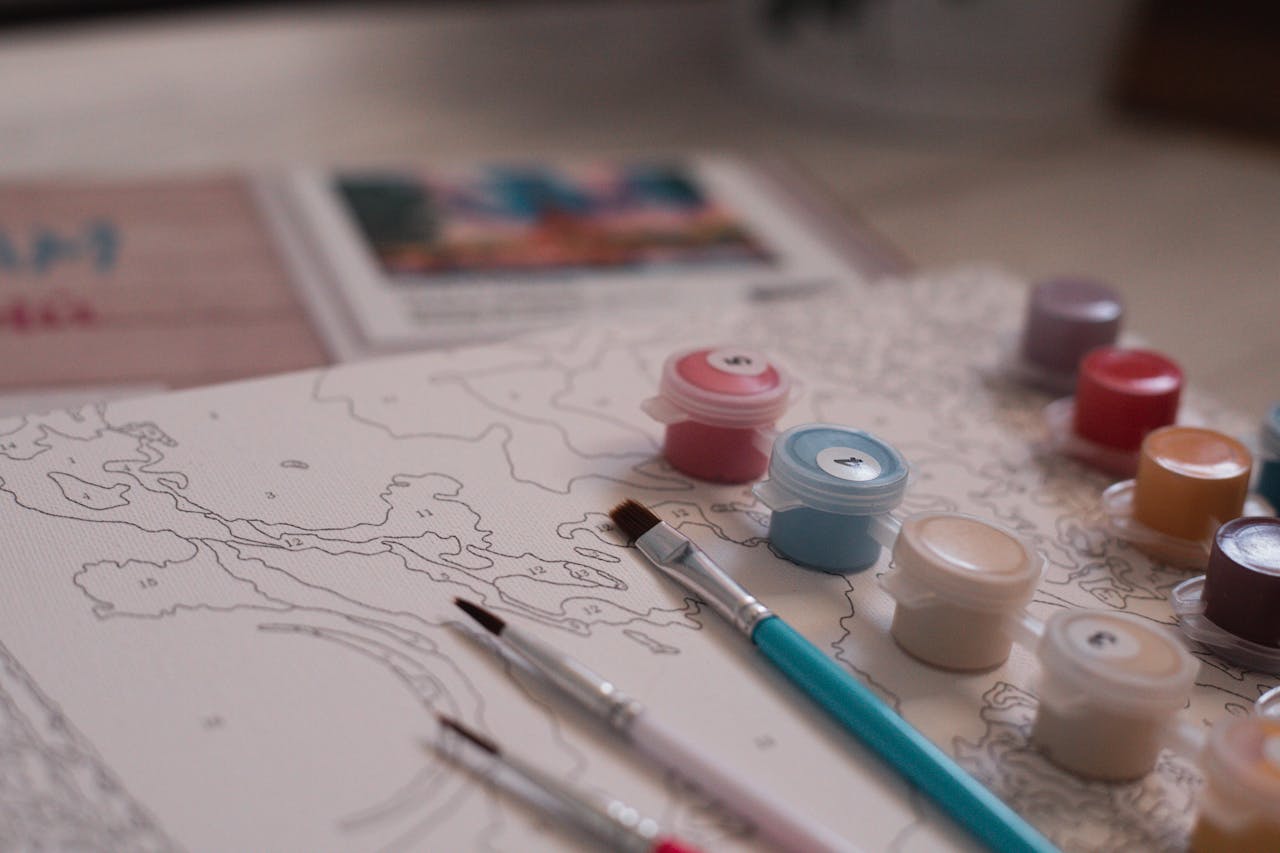
Most of the time lost on a numbered canvas is not spent painting. It goes on rinsing brushes, hunting for the right pot, squinting at a number, and waiting for something to dry. Fix those four and the same painting finishes in noticeably fewer evenings, without the result suffering.
A caveat first, because it matters. If there is no deadline, speed is not really the point of this. The hours are the point. What follows is for when there is a birthday coming, or when slow progress is the thing that makes a canvas get abandoned.
The one change that does most of the work
Paint one color everywhere before you rinse the brush. Take the color that covers the most canvas, find every section carrying that number, and do all of them. Then rinse once and move to the next.
Painting section by section in the order they appear means a rinse between almost every section. On a canvas with thirty sections of one color, that is thirty rinses replaced by one. It is the single biggest saving available, and it also produces a more consistent result, because all the areas of a color go on with the same paint at the same consistency.
The side benefit is that you stop missing sections. Working through one number at a time, you scan the whole canvas for it and nothing gets left behind to be discovered at the end.
Order of work
- Largest sections first. Big areas cover fast and build visible progress, which is what keeps a project going. The fiddly parts are easier once most of the canvas is no longer white.
- Top of the canvas downward. Your hand rests below where you are working, so this keeps it off wet paint.
- Left to right if you are right-handed, right to left if you are not, for the same reason.
- Dark colors before very pale ones where you have the choice. Pale paint over a stray dark smudge needs two coats; the reverse does not.
Set up so you are not hunting
Lay the pots out in numerical order at the start rather than searching the tray each time. Keep the 11x17 printout of the design propped beside the canvas and read the numbers off that instead of leaning in over the wet paint, which is both slower and how smudges happen.
Put a lamp beside you rather than behind you. Light from behind casts your own shadow across exactly the area you are working on, and a surprising amount of squinting is caused by that rather than by the printing.
Two cups of water, not one. A dirty rinse and a clean one. It sounds fussy and it saves a re-rinse every time a pale color comes up.
Two common tips that slow you down
Do not decant the paint onto a palette. This gets recommended constantly and it is wrong for a numbered kit. The pots are already the right colors in the right quantities, and there is no mixing to do. Spread thinly on an open palette, acrylic starts skinning over within minutes, so you end up either working against the clock or throwing paint away. Dip straight from the pot and close the lid when you move on.
Do not add fast-drying mediums. Acrylic is already dry to the touch in minutes at these thicknesses. Adding a medium changes the consistency and the coverage, and thin coverage means a second coat, which costs more time than it saves. If a pot is too thick, a single drop of water is the whole intervention.
The same goes for pre-mixing colors in advance. There is nothing to mix. Every color you need is in a pot with a number on it.
Sessions
Shorter and more frequent beats occasional marathons. Concentration on fine sections falls off after about ninety minutes, and tired work needs correcting, which is slower than not doing it. Forty minutes most evenings will finish a canvas faster than four hours on a Sunday.
Set an end point that is a task rather than a clock: finish this color, then stop. It is easier to start again tomorrow when you know exactly what you are starting.
Choose an easier canvas if speed matters
The design decides the hours far more than technique does. A 12x16 with broad sky and water is ten to fifteen hours. A detailed 16x20 with grass, feathers or foliage can run past twenty-five, and nothing in this article closes that gap.
If there is a date to hit, the forgiving designs are Summer's Song, Be Still, Hummingbird, House Near the Lake, Guiding Light, Rural Route Bluebirds, Away From it All and Northwoods Retreat. The ones to avoid under time pressure are Seaside Paradise, Mountain Village, Golden Hour, Orchard Puzzle, Bamboo Tiger, Enchanted Woods, Moonrise Song, Morning Ride and Sweet Petunias.
And take the larger size on anything detailed. Bigger sections are quicker to fill and easier to see, so the 16x20 often finishes sooner than the 12x16 of the same design.
Two things not to rush
Let a coat dry before painting the section next to it, or the two colors bleed at the border and you will be fixing an edge instead of moving on. And let the whole canvas cure for a few days before framing or varnishing it. Dry to the touch is not the same as hard.
Browse the range in the catalog, get a canvas made from your own photograph, or start with the beginner's guide if this would be your first.


