


A stretching frame is the wooden skeleton underneath a canvas. The canvas fabric is pulled over it and fastened at the back, which is what turns a floppy sheet of cloth into a taut surface you can paint on and hang.
The parts are called stretcher bars, and they are sold individually by length so you can build any rectangle you need.
Before anything else, the honest caveat, because it is the reason most people end up on a page like this: a paint by numbers canvas usually cannot be stretched. More on that below. We do not sell stretcher bars.
What Stretcher Bars Are
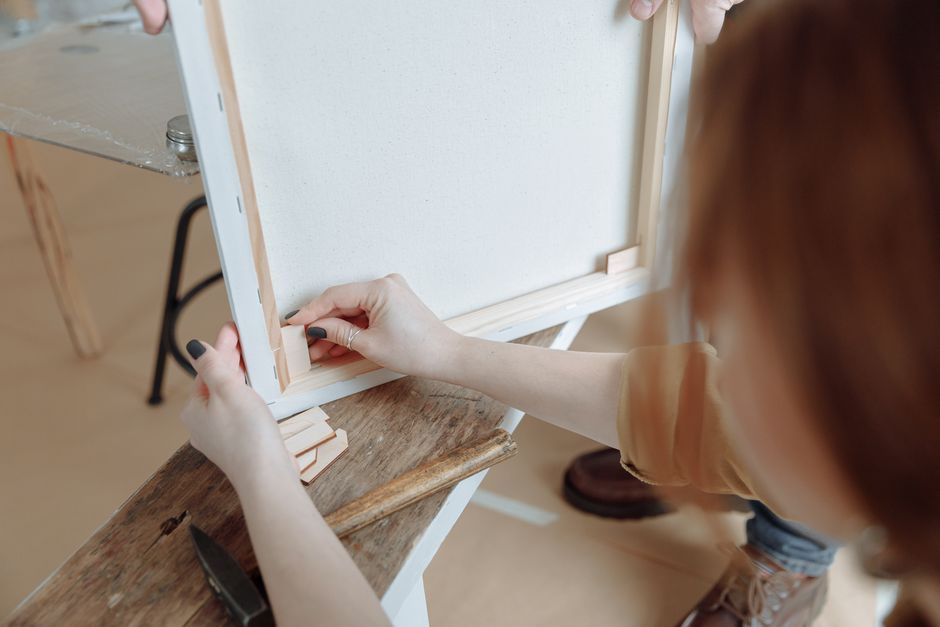
Lengths of kiln-dried softwood, usually pine, milled with a slot at each end so that four of them push together into a rectangle without glue or screws. You buy two of one length and two of another.
Two features matter and both are about keeping the wood away from the cloth:
A raised lip along the front edge. Look at a bar end-on and you will see the front face is not flat. It rises slightly at the outer edge so that the canvas, once stretched, only touches the frame at that raised line. Without it the cloth rests on the whole width of the bar and every edge eventually prints through as a visible ridge in the paint.
Depth. Standard bars are around three quarters of an inch deep. Gallery-depth bars are an inch and a half or more, which is what gives that chunky look where the painting continues around the sides and needs no frame.
You will also see corner wedges, small triangular keys that tap into slots inside each corner. They are for later, not for assembly. If a canvas slackens after a year or two, tapping them in a fraction pushes the corners apart and takes the sag out.
Cross braces are extra bars fitted across the middle of larger frames to stop the long sides bowing inward. Anything much over about thirty inches wants one.
Choosing Them
- Match the length to the image, not to the cloth. Bars are sold by the finished outside dimension.
- Heavier bars for larger work. The failure mode on a big canvas is the long sides bowing in under tension, which pulls the whole thing out of square. Heavy-duty bars and a cross brace fix it.
- Kiln-dried, knot-free. A knot is a hard spot that resists tension unevenly, and undried wood moves with the seasons and takes your canvas with it.
- Check they are actually square once assembled. Measure both diagonals. If they match, it is square. If they do not, the finished painting will not sit flat against a wall.
Stretching a Canvas: the Order That Matters
This is where most guides go wrong. The corners are not first. Doing the corners first locks the tension in unevenly and guarantees a slack middle.
- Assemble the frame and check it is square by measuring the diagonals.
- Lay the canvas face down on a clean flat surface and center the frame on the back of it. You want at least an inch and a half of spare cloth on every side.
- One staple in the center of one long side. Just one.
- Then the center of the opposite side, pulling firm across the frame with canvas pliers before you fire. This first opposing pair sets the tension for everything else.
- Then the centers of the two short sides, same way.
- Now work outward from each center toward the corners, alternating between opposite sides as you go, a staple every two inches or so. Always opposite, never all the way round one side.
- Corners last. Pull the corner point in toward the frame, fold the two flaps flat and neat against the side bar, and staple them down.
If one patch comes out slack, you can pull and restaple that section on its own. There is no need to strip the whole thing and start over.
Why Your Paint by Numbers Canvas Probably Cannot Be Stretched
Look at step two again: an inch and a half of spare cloth on every side.
An unframed paint by numbers canvas is printed with a much narrower blank margin than that, ours included. It is designed to be mounted flat to a board or set into a frame, not wrapped around bars. There is simply not enough cloth to reach the back and hold a staple.
Several of our own customers have found this out after finishing a painting, which is a fair complaint and the reason we say it plainly here. Measure the blank margin before you buy anything. If it is under an inch, mounting is your route, and our guide to framing or mounting a finished canvas covers how.
The simplest way to avoid the question entirely is a framed kit, which arrives already stretched on a wooden frame. Ours are in 12 x 16 and 16 x 20, and they hang the day the paint is dry.
Priming, and When Not To
Raw canvas needs sealing before paint goes on it, or the fibers drink the paint and the surface goes blotchy. That is what gesso does, brushed or rolled on in thin coats, sanded lightly between them.
Two exceptions worth knowing:
Most canvas sold today is already primed. Check the label before you buy gesso you do not need.
Never prime a numbered canvas. Gesso is opaque white. One coat over a paint by numbers canvas covers the outlines and the numbers permanently, and there is no getting them back. The canvas in a kit arrives primed and printed and ready. Open it and paint on it.
Looking After a Stretched Canvas
- Store and carry it by the frame, never by pressing on the face. A push from behind leaves a permanent dent in the weave.
- Stand them on edge rather than stacking them face to face, which can make them stick together in warm weather.
- Keep them out of damp rooms. Mold comes through the back of a canvas before it shows on the front.
- If it slackens over time, tap the corner wedges in a fraction. Small taps, all eight, rather than driving one home.
- Dust with a dry soft brush. Do not wipe an acrylic painting with a damp cloth.
Where This Leaves You
If you paint freehand and want to build your own supports, stretcher bars are cheap, satisfying and worth learning. Any art supply shop sells them by length.
If you are here because you have a finished paint by numbers canvas and want it on a wall, the honest answer is usually mounting rather than stretching. Our framing guide covers that, and the catalog is here when you are ready for the next one.


