


How you hang a finished canvas depends first on which kind you painted. A framed kit arrives pre-stretched on a wooden frame and needs nothing but a nail. An unframed canvas is trimmed close to the printed edge, which rules out some of the advice you will find elsewhere. Start there, then choose the display.
how to frame and display it goes through the options once you have decided which kind of canvas you have.
If you painted a framed canvas
The 12x16 and 16x20 framed kits come already stretched over a wooden frame, so the moment the last section is dry the piece is finished. Hang it on a single nail or picture hook. There is no mounting to do and no frame to buy.
Two things worth doing first. Let it cure for a few days before it touches a wall, because acrylic is dry to the touch long before it is fully hard. And if the painting will hang somewhere it gets handled or catches direct sun, a coat of matte or satin acrylic varnish is worth the twenty minutes.
If you painted an unframed canvas
This is where most display advice goes wrong. The unframed 16x20 is trimmed close to the printed image, which means there is not enough spare canvas to wrap around stretcher bars and staple. Do not buy stretcher bars expecting to stretch it. Several customers have tried, and it is the one complaint about the unframed kits that we have not solved.
What does work:
- Mount it to a board. Foam board or a thin plywood panel cut to size, canvas attached with acid-free double-sided tape or spray adhesive worked from the center outward. This gives you a rigid piece you can then put in a standard frame.
- Frame it under glass with a mat. A mat covers the trimmed edge entirely and is the tidiest solution. Take it to a frame shop with the canvas flat, not rolled.
- Use a poster hanger. Two wooden rails, one at the top and one at the bottom, magnetic or screwed. This suits the canvas well because it does not need any margin, and it reads as deliberate rather than as a compromise.
- Clip it to a wire. A picture wire across a wall with small clips lets you swap pieces around. It suits a hallway or a stairwell where several canvases can hang together.
There is a longer walkthrough in how to frame a paint by number canvas.
Choosing a frame that does not fight the painting
The frame's job is to stop the eye at the edge of the picture, not to be the picture.
- Pick up a color that is already in the painting, usually one of the darker ones. A frame in a color that appears nowhere on the canvas always looks bolted on.
- Keep the moulding narrower than you think. On a 12x16, anything much over an inch and a half starts to dominate.
- A mat adds breathing room and reads as more considered. Off-white or cream is safer than bright white against a painting with warm tones in it.
- Match the frame to the room rather than to the trend. Painted wood suits a cottage-style design; a thin dark wood or metal suits a plainer room.
Hanging several together
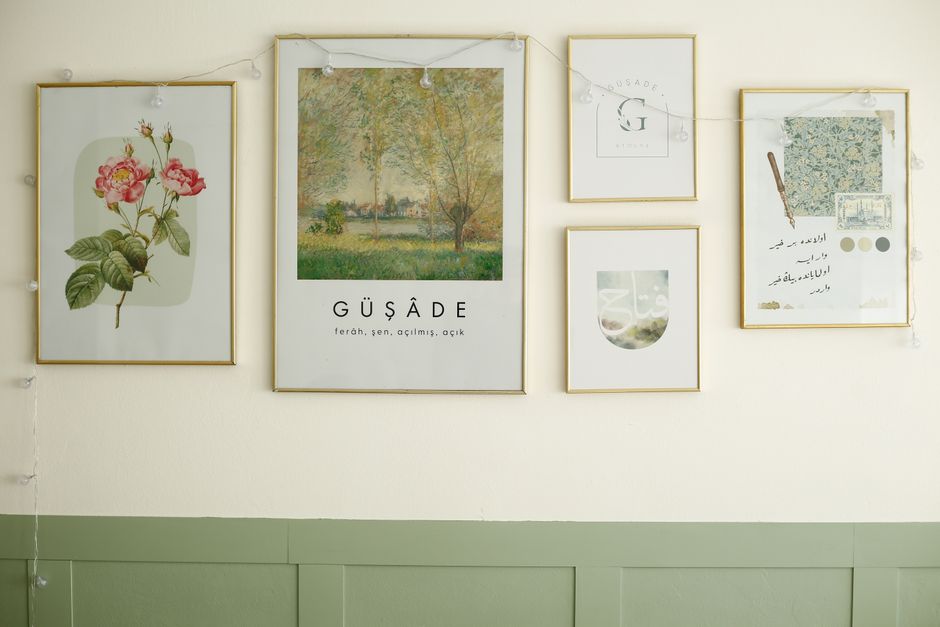
Once you have painted three or four, a group on one wall is more effective than the same pieces scattered around the house.
Two arrangements work reliably. A grid, with equal gaps of two or three inches, if all the canvases are the same size. Or a common horizontal line, either along the tops or through the centers, if they are different sizes. The mistake is centering each piece independently and letting the tops and bottoms wander.
Lay the whole arrangement out on the floor first and photograph it. Then cut paper rectangles to size, tape them to the wall, and live with the layout for a day before making any holes. Center height for the group should be around eye level, roughly 57 to 60 inches from the floor, which is lower than most people instinctively hang.
Mixing designs from a series works well: the cabin designs share a palette, and so do the florals, so several of them together look intentional.
Off the wall
A few options that do not involve hanging anything:
- A picture ledge. A narrow shelf lets framed canvases lean against the wall. You can change the arrangement whenever you like and you only drill twice.
- An easel. The framed kits include a wooden tabletop easel, which is a perfectly good permanent home for a finished piece on a sideboard or a hall table.
- A mantel or a bookshelf. Leaning a canvas against the wall behind other objects gives it depth and takes nothing to set up.
One thing to avoid: cutting a finished canvas up to make coasters or panels. It is a lot of hours to put through a craft knife, and acrylic on canvas does not take kindly to being cut, sealed and handled.
Where it goes
Keep paintings out of direct sunlight, which fades acrylic over years, and off walls that get damp. Beyond that, hang it where you will actually see it. The most common thing people say about a finished canvas is that they notice it every time they pass, and that only happens if it is somewhere you walk.
Other customers' finished canvases, framed and hung in their own homes, are in the customer gallery. The full range of designs is in the catalog.


