


A hallway is the one place in a house where people look at art from three feet away. Everywhere else it is viewed across a room. That single fact changes what works there, and it is why a canvas that looked unremarkable over the sofa can be the best thing in the house in a corridor.
It also means hallways punish the things a living room forgives.
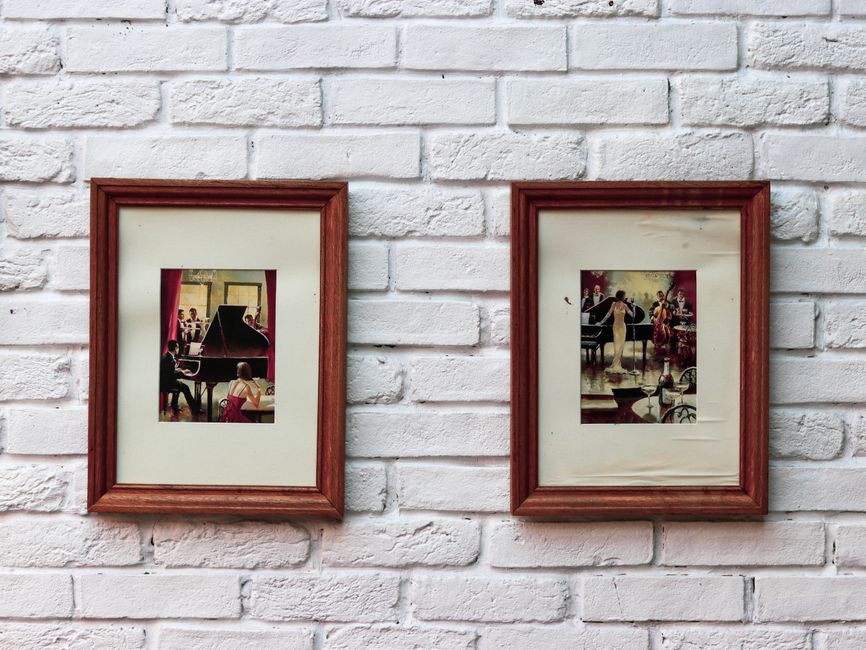
Close viewing rewards detail and exposes edges
At three feet you see brushwork. Sections that were slightly overfilled read as texture, which is fine. What does show is the opposite mistake: a hairline of bare white canvas between two sections, where the paint stopped short of the printed line.
If a canvas is destined for a hallway, take each color slightly over the line rather than up to it. Bare canvas showing through is the one flaw that is genuinely visible at close range, and it is entirely avoidable while painting.
The upside is that detailed designs finally get looked at. A design with fine foliage or water is largely wasted across a room and comes into its own in a corridor.
Size to the corridor, not to the wall
The instinct is to fill the wall. In a narrow hallway that produces something you walk past sideways.
A 12 by 16 or 16 by 20 is usually right. Anything much larger cannot be stepped back from far enough to be seen whole, and a painting you can only see in parts stops working as a painting. Several smaller canvases along the length beat one large one.
Light is the actual problem
Most hallways have no window and one overhead fixture, which is close to the worst lighting possible for a painting — straight down, flattening everything, often a warm bulb pushing the whole canvas amber.
What helps, in order of effort:
- Choose a design with real contrast. High-contrast work survives bad light; subtle tonal work disappears in it. This is the cheapest fix and the most effective.
- Change the bulb to a neutral 3000–3500K. A 2700K bulb warms every color on the canvas, which flatters an autumn scene and ruins a snow scene.
- Add a picture light or a directional spot angled from above and in front, not straight down.
Avoid glass over a hallway canvas. Beyond the conventional reason — glass pressed against acrylic can lift paint — a glazed picture in a corridor mostly reflects the ceiling light back at you.
Height, and the thing corridors get wrong
Center at 57 to 60 inches from the floor, same as anywhere else. Hallways are hung too high more often than any other room, probably because there is no furniture to reference against.
If you are hanging several along a run, align them on a shared center line rather than a shared top edge. Different-sized canvases lined up along their tops look like an accident; lined up through their centers they look intentional.
Why a framed kit suits this spot
A framed canvas arrives stretched on wooden bars, sits about an inch and a half off the wall, and hangs on one nail. In a corridor where people brush past, that shallow profile matters — nothing to catch a shoulder or a coat.
An unframed canvas needs a flat frame with glazing to hang at all, and glazing is the thing you do not want here.
Common questions
What size canvas suits a narrow hallway?
12 by 16 or 16 by 20. Larger pieces cannot be viewed whole in a corridor, and several small canvases along the length work better than one big one.
How do I hang several pieces down a hallway?
Share one horizontal center line at 57 to 60 inches and keep the gaps even — 3 to 5 inches between frames reads as one group.
Which designs work best in low light?
Ones with strong contrast between light and dark. Subtle tonal designs need daylight to read and will look flat under a single overhead bulb.
Should hallway art be behind glass?
Not canvas. Glass against acrylic can lift paint, and in a corridor it mostly reflects the ceiling light.


