


Short version: framed kits come with a wooden tabletop easel, that is the correct tool for this kind of painting, and you almost certainly do not need to buy anything else. The longer version explains why, because the reasoning is not obvious and it saves people money.
What comes in the box
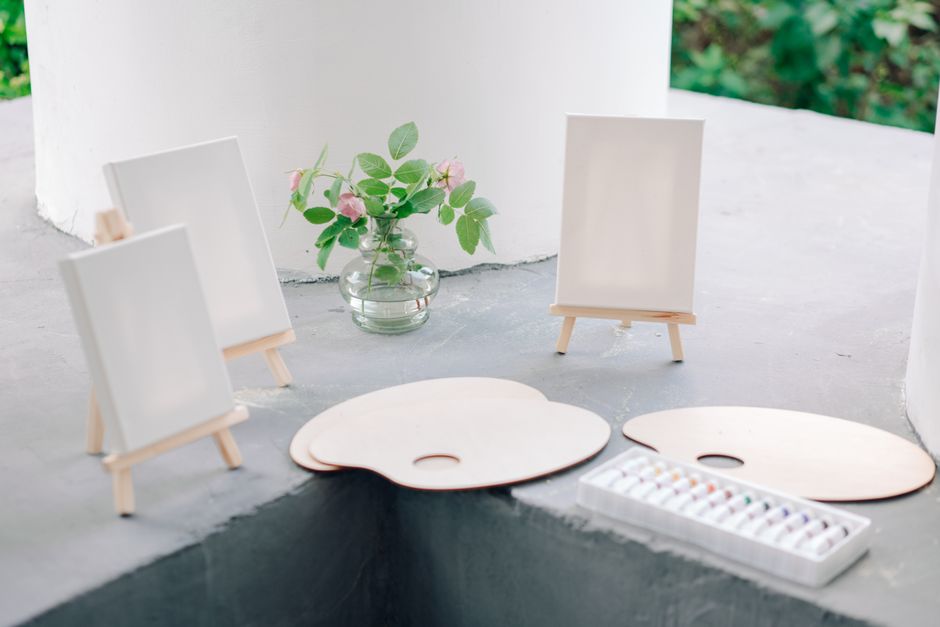
Our framed sizes, 12x16 and 16x20, include a small wooden tabletop easel. It holds the pre-stretched canvas upright on a table at a shallow angle while you work.
The unframed 16x20 does not include one, and that is deliberate rather than an omission. A loose rolled canvas has nothing rigid to stand on an easel in the first place.
Why a tabletop easel and not a standing one
Paint by numbers is close work. You are reading small printed numbers, filling small shapes, and your hand is resting on or near the surface for hours. That is a completely different physical activity from painting freehand at arm's length, and it wants a completely different setup.
A standing studio easel holds the canvas near vertical. Two problems follow. Acrylic thinned even slightly with water will run down a vertical surface, which is the last thing you want when you are trying to keep one color out of the section next to it. And you cannot rest your hand against a vertical canvas, so every fine section is painted with an unsupported arm. That is tiring within twenty minutes and it shows in the edges.
A shallow angle solves both. Paint stays where you put it, you can steady your painting hand against the frame or the table, and you are looking down at the canvas rather than across it, which makes faint numbers considerably easier to read.
That is what the tabletop easel gives you, and it is why we include one rather than something larger.
Working flat, which is also fine
Plenty of people ignore the easel entirely and work with the canvas flat on a table. That is a perfectly good way to do it, particularly for the fine sections, and many painters switch between the two: flat for detail, propped up to step back and look at it.
For an unframed canvas, flat is really the only option, and the setup that works is simple. Tape the corners down to the table, or better, mount the canvas to a piece of foam board or stiff cardboard with a few pieces of tape. That gives you something rigid you can pick up and move without touching wet paint, and you can prop it against a stack of books when you want to see the whole thing from a distance. No easel required.
If you do want to buy one
We do not sell easels separately, so there is nothing to steer you toward. Four things are worth checking.
- Stability over height. A wide, heavy base matters far more than how tall it goes. A light easel that shifts when you press a brush against it is worse than no easel.
- An adjustable angle. The whole point is working at a shallow tilt. An easel fixed near vertical does not suit this.
- A deep enough ledge. It needs to hold the wooden frame of a stretched canvas, not just a thin board.
- The right height for a seated position. You should be able to sit with your forearms supported. If you are leaning up or reaching over, it is the wrong height and your shoulders will tell you within an hour.
Children's easels are a different product
A lot of what turns up in a search for art easels is aimed at young children: standing, double-sided, a chalkboard on one face and a dry-wipe surface on the other, a paper roll across the top, and storage bins at the base.
They are sensible objects for what they do. They are not useful for a numbered canvas, for all the reasons above, and they are sized for a standing child rather than a seated adult. If someone recommends one for paint by numbers, they have not thought about it.
The one thing genuinely worth borrowing from that category is the safety point. Any standing easel used around children needs a wide, stable footprint and crossbars, and anything height-adjustable needs its fittings checked periodically, because they work loose.
We do not make a children's range, so this is general advice rather than a recommendation.
The setup that actually matters
If you are going to improve one thing about where you paint, make it the lamp rather than the easel.
An adjustable desk lamp placed to one side, throwing light across the canvas at a low angle, does more for reading faint numbers than any support ever will. Overhead lighting flattens the contrast and puts your own shadow on the work. That single change is the most common thing people say made a difference, and it costs less than an easel.
The full range of designs is here, the framed sizes include the easel, and our beginners guide covers how a first kit goes.


