


Ledgebay does not sell a horse design, and the previous version of this page said otherwise, complete with a kit specification that did not describe anything we make. That has been corrected. If you want a horse on a numbered canvas, the route is a custom kit made from your own photograph, and for most people looking for this, a particular horse was the point anyway. Cats raise the same question, and the answer is usually a custom canvas rather than a stock one.
Your horse, from a photograph
A custom paint by numbers kit takes a photograph you send in and returns it as a printed canvas with every section outlined and numbered, plus a set of paints matched to it. Sizes are 12x16, 16x20 and 18x24, framed or unframed, and it is printed in the USA rather than drop-shipped from overseas.
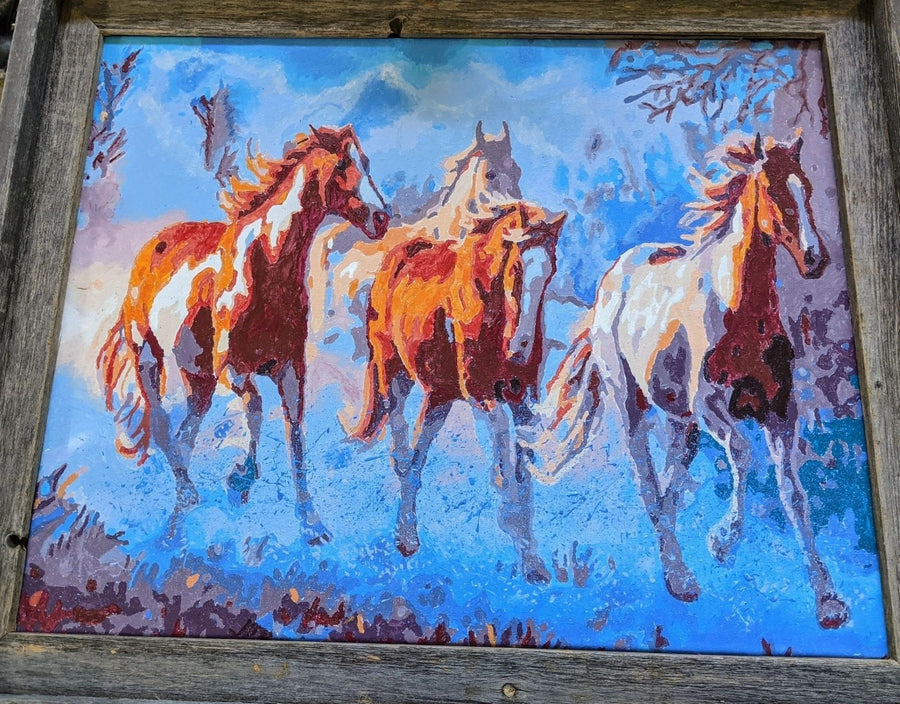
People order these for a horse they own, a horse they had, or a horse somebody in the family rides. The memorial versions are common and they land well, as long as you expect a painting rather than a photograph.
Photographing a horse so it converts
Horses are easier than most animals to photograph for this, because they are large and usually outdoors in daylight. A few things make the difference.
- Head and neck beats the whole horse. A full-body shot in a field gives you a small horse and a great deal of grass. Head and shoulders fills the frame with the thing you care about.
- Side light, not midday. Late afternoon light rakes across the shoulder and the neck and shows the muscle underneath. Overhead sun flattens everything and puts hard shadows under the jaw.
- Stand back and zoom in. Photographing a horse's head from a foot away distorts the nose. Step back several paces and use the zoom, and the proportions stay right.
- Watch dark horses. A black or dark bay in shade is one flat tone with nothing for the conversion to separate. Photograph a dark horse where the light catches the coat and the sheen shows the shape.
- Simple background. Sky, a plain fence, an open field. A cluttered yard behind the horse competes with it.
- Ears forward. It is the whole expression, and it is worth the extra two minutes to get.
What makes a horse hard to paint
Three things, and a numbered canvas handles all of them for you.
The proportions are unforgiving. Everybody knows what a horse looks like, so a head slightly too long or legs slightly too short reads as wrong immediately, even to people who could not say why. Freehand this is most of the work. On a printed canvas it is already correct.
The coat is muscle underneath. What makes a painted horse look solid rather than flat is the light running over shoulder, barrel and hindquarters. Those are broad tonal shapes, not detail, and they are exactly what the numbered sections give you. Resist the urge to blend them all together; the section boundaries are where the form turns.
Manes and tails have direction. Paint each strand in one stroke, following the way the hair falls, rather than filling the section in like a shape. Pull from the crest outward and from the dock downward. This is the one place where how you move the brush matters more than which color is in it.
Sizes
- 12x16 — a head-and-shoulders portrait of one horse, close, simple background.
- 16x20 — the sensible default. More room for the mane and the eye.
- 18x24 — the largest available. Take it for two horses, or for a horse and rider.
Framed sizes arrive pre-stretched on a wooden frame and hang on a nail the moment you finish, and include a wooden tabletop easel. Unframed costs less and is trimmed close to the printed edge, so it suits mounting to a board rather than stretching over your own bars.
What is actually in the box
- Pre-printed cotton canvas, rolled in a tube rather than folded, so it arrives without creases
- Acrylic paints, vacuum-sealed so they arrive moist
- Brushes in a range of sizes
- Printed instructions and an 11x17 printout of the design
- Framed sizes also include a wooden tabletop easel
No varnish, no hanging hardware and no spirit level, whatever the old version of this page claimed. Varnish is worth buying separately if the finished piece will hang somewhere it gets handled or catches sun, and a matte or satin acrylic varnish from any art shop will do.
If you want something in the catalog instead
Worth being clear that nothing here is a horse. Morning Ride, despite the name, is a bicycle on a dune path at sunrise. The animals collection is wildlife: a tiger, wolves, a moose, songbirds, geese, swans, a hummingbird.
Working through it
Largest sections first, top of the canvas downward, one color at a time across the whole canvas before rinsing. Leave the eye and the mane highlights until last. Expect ten to fifteen hours on a 12x16 and more on the larger sizes, over as many evenings as you like.
The custom kit offers one or two extra paint sets at checkout, which is worth taking on a large canvas where one coat color does most of the work. The beginner's guide covers the mechanics, and finished canvases from other customers are in the customer gallery.


