


Flowers behave differently from every other paint by numbers subject, in one good way and one demanding way.
The demanding part: a floral design has far more sections than a landscape of the same size, because every petal is its own shape. The good part, which nobody mentions: flowers forgive a stray edge better than anything else you can paint. If your brush wanders slightly past a petal outline, the result reads as another petal sitting behind it. Do the same thing in an open sky and it is simply a mistake. Hummingbird designs pair the same blooms with a subject that needs a much finer brush.
That trade — more sections, but each one more forgiving — is what makes florals a genuinely reasonable choice for a nervous beginner, as long as you know what you are taking on.
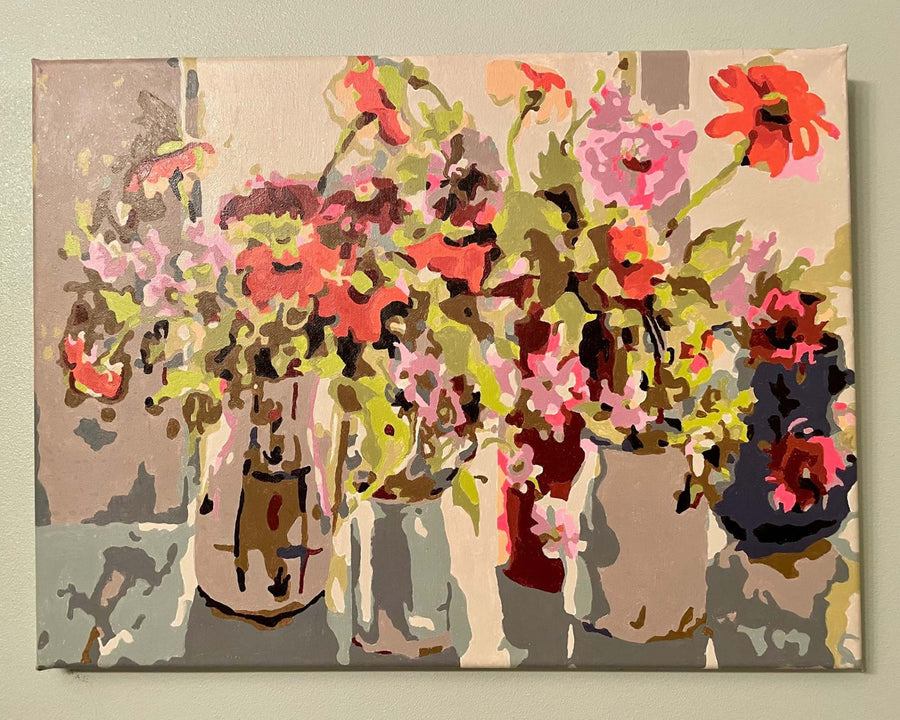
The one habit that matters most on a floral
Work one number at a time across the entire canvas, not one flower at a time.
This is good advice generally and it is close to essential here, for a reason specific to flowers: a floral design carries many closely related tones. Six pinks, five purples, four greens. Painted side by side in the same sitting they separate clearly. Painted an hour apart, flower by flower, they do not, and you end up with a canvas where the same numbered pink appears as three different colors depending on when you got to it.
So open number 12, find every section on the canvas marked 12, fill them all, and only then move on. It also means adjacent sections have dried by the time you come back to their neighbors, so nothing bleeds.
Where to be careful, and where not to be
Inside a mass of flowers, relax. Overlapping petals hide a great deal.
The edge that matters is the outside one — where the flowers meet the background. A wall, a sky or a table behind the arrangement is a large, plain, uninterrupted area, and the eye goes straight to any wobble along that boundary. Slow down there, use less paint on a smaller brush, and let the background dry hard before you bring the flowers up against it.
Three floral designs, honestly described
All three of ours are from Judy Buswell, who works in watercolor. That matters to how they paint: the backgrounds in her originals are loose washes, so they go in fast and forgivingly, while the flowers keep their edges and hold the detail. It is a good combination for a numbered canvas.
Rita's Pansies
Five pots of pansies in a wrought-iron stand against a stone wall, with two white-framed windows behind. The one to start with. Reviewers are genuinely split — several finished it as their first ever kit and found it straightforward, while others call it very detailed and say it needs patience for small lines. Both are right: the wall and the pots are easy and large, and the pansy heads are among the smaller sections we sell. Take the flowers slowly and the rest goes quickly.
Cosmos From the Garden
Pink cosmos in a green glass jar on a windowsill, with light coming through from behind, a small yellow ceramic bird at the base and fruit on a plate beside it. The softest of the three. Every petal is its own numbered shape, so there are more small sections here than in a landscape, but this is the design where a slightly wobbly edge disappears most completely. Watch the pinks — work one at a time across the whole canvas or they will run together.
Sweet Petunias
Three terracotta pots overflowing with petunias in magenta, pink and lilac against a stone wall, with the chips and water stains painted into the pots. The most demanding of the three, and worth being straight about: the petals are small, there are hundreds of them, and the pots are the only large restful shapes on the canvas. Budget nearer 25 hours than 15. One reviewer who loved it recommends buying a lit magnifier to go with it, which is sound advice for a canvas made almost entirely of overlapping petals. Take the 16x20, not the 12x16.
And one that is not a floral, despite the name
Worth flagging because people find it by searching for flowers: Morning Glory is two egrets on a marsh at sunrise, not a flower painting. It is a lovely design and a good second canvas, but if you came here for flowers it is not one.
If you would rather paint fruit
Apple Harvest is the same painter and the same loose-background character — a bushel of apples on a garden table with an apple branch fading out behind. Reviewers call it time-consuming, because each apple is individually shaped and shaded, but the shading is entirely worked out for you: each apple is split into three or four numbered tones and the roundness appears once they are filled, with no blending on your part.
Choosing a size for a floral
Take the larger canvas. This is true generally and it is emphatic on flower designs, because the section count is the same at both sizes and only the section size changes. A 12x16 floral gives you the same several hundred petals in two-thirds the area.
The framed sizes arrive pre-stretched and ready to hang. The unframed canvas is the same design and paints for less, trimmed close to the printed edge, so plan to mount it to a board rather than stretch it.
Common questions
Are flower kits good for beginners?
Yes, with the caveat above. They take longer than a landscape and the sections are smaller, but the forgiveness on edges means a first-timer's result looks better than the same person's first landscape. Rita's Pansies is the one to start with.
How do I stop all the pinks looking the same?
Paint one numbered pink everywhere it appears before opening the next pot. Side by side they separate obviously. Matched from memory, they do not.
Do I have to stay perfectly inside the lines?
Inside the flowers, no — a stray edge reads as another petal. Along the outside edge where the flowers meet the background, yes.
What if I run out of one color?
Common on florals, because one or two colors do most of the work. Every design has a matching replacement paint set, which is far cheaper than a second kit.
Can I have my own flowers turned into a kit?
Yes — a custom canvas from your photograph works well for flowers, and a garden you planted is a better subject than most. Photograph in soft, even light rather than bright sun, which blows out pale petals into shapeless white.
If you would like something with more open space in it first, our guide to choosing an easy kit covers what makes a design forgiving, and the full range is in the shop.


