


Pets convert into paint by numbers better than almost any other subject, and there is a specific reason for it. A face is defined by subtle tone, which this format flattens. An animal is defined by shape and pattern, which it keeps. That is why a dog painted from a photograph looks like that dog, while a person often looks nearly like that person. Which photographs convert well follows the same rules for any subject, not just animals.
How it works
You send a photograph of your animal. It is converted into outlined shapes, each carrying a number, printed onto cotton canvas, and paints are mixed to match that specific image. The kit arrives with the canvas, the numbered pots, brushes in a range of sizes and an 11x17 reference print.
A custom canvas comes in 12x16, 16x20 or 18x24, framed or unframed, and is printed in the USA rather than drop-shipped from overseas.
Choosing the photograph
Get down to their level
The single biggest improvement, and it costs nothing. A photograph taken from standing looks down on the animal and foreshortens the head. Crouch until the camera is at eye height and the face reads properly.
Fill the frame with the head
A full-body shot of a dog across a lawn gives the conversion a small head made of very few sections, and a face rendered in too few sections stops being your dog and becomes a dog. Head and shoulders is the format that works.
Two animals is fine at 16x20. Three or more, go to 18x24 or crop.
Light from the side, indoors near a window
Bright indirect light shows the structure of the head and the sheen of the coat. Direct midday sun throws a hard shadow that becomes a hard-edged dark shape in the painting. Flat overcast light or a straight-on flash gives you no tonal separation to work with at all.
Sharp eyes
Zoom right in on the eyes before you send the picture. Everything else can be a little soft and still work. The eyes cannot.
Coat color, honestly
This is the part worth knowing before you order, because it is where expectations go wrong.
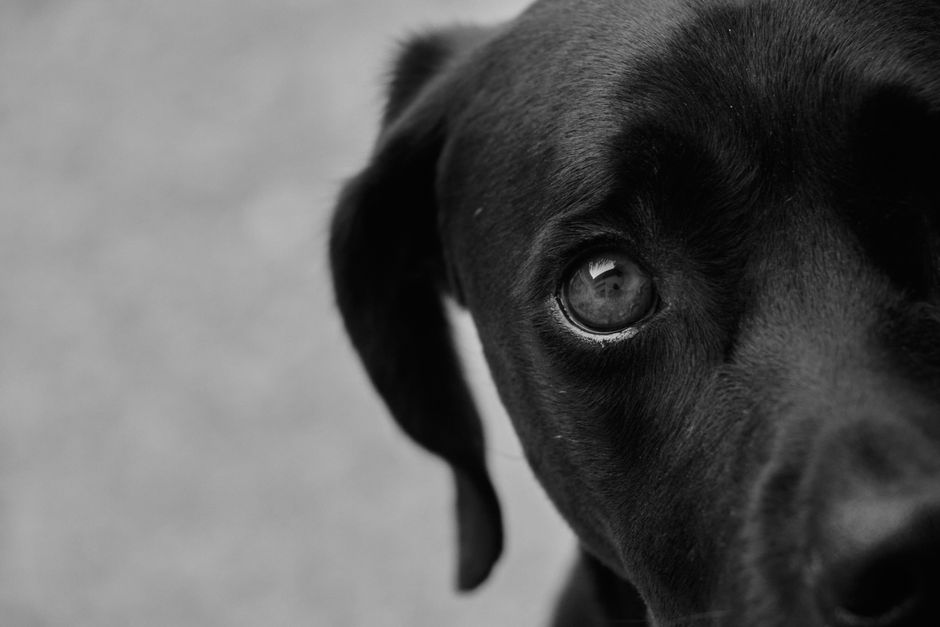
Black and very dark coats are the hard case. A black dog photographed in dim light records as an almost featureless dark shape, and the conversion cannot invent structure the camera did not capture. Photographed in bright indirect light, the same dog shows highlights along the muzzle, brow and shoulders, and those highlights are what the painting is built from. If your animal is black, the photograph matters more than for any other coat, and it is worth taking a fresh one specifically.
Tabby, merle, brindle and other patterned coats convert beautifully. Pattern is exactly what this format is good at.
White and cream coats need a background with some tone in it, otherwise the animal and the backdrop merge into one pale area.
Long, fine, wispy fur, the kind that catches the light around the edges, will be simplified. It becomes a defined edge rather than a soft halo. Not worse, but different from the photograph.
Painting fur so it reads as fur
One technique matters more than everything else here, and it is easy.
Follow the direction of each numbered section with the brush rather than dabbing at it. The shapes have already been drawn running the way the coat lies. A stroke that goes with them does the work for you and the fur reads as fur. A stroke that goes across them, or a dabbing motion, turns the same shapes into patches.
Beyond that:
- Do the eyes last, when the areas around them are dry and your hand is warmed up. Getting a clean edge on an eye is what makes the whole painting land.
- Let each area dry before the one beside it. Two wet grays sharing an edge will creep into each other, and on fur that shows immediately.
- Use the smallest brush that will cover the section in two or three strokes, not the one that will do it in one.
- Expect the background to go quickly and the head to go slowly. That ratio is normal. Do not use the background pace to estimate the whole canvas.
If this is a memorial
A great many custom canvases are of an animal that has died, and it is worth saying two practical things about that.
The photograph you have may not be the technically best one, and that is fine. A slightly imperfect picture of the right moment makes a better painting than a sharp one that does not look like them. Send the one you actually love.
And give yourself the larger size. These take ten to twenty hours and sometimes more, and the time is a good part of what people find worthwhile about them. There is no reason to rush through it.
What to expect from the finished thing
It will look like a painting of your animal, not a photocopy. Features are simplified into paintable shapes. Everyone who expects a painting is pleased; the only people ever disappointed are the ones expecting a photograph reproduced in paint.
The customer gallery is full of finished pet canvases photographed by the people who painted them, and it is a far more honest preview than any product image.
Common questions
Can I use a photo from my phone?
Yes, and most people do. Send the original file rather than a screenshot or something forwarded through a messaging app, because both have been compressed and lost detail.
Can two pets be on one canvas?
Yes, if they are in the same photograph. Choose 16x20 or larger. Combining two separate photographs into one canvas is a different job and not what this product does.
How hard is a pet canvas compared with a stock design?
A little harder, because a photograph contains more closely related tones than a painted design does. If it would be your first kit, the beginner guide is worth reading first, or start on one of the 39 designs in the catalog and keep the pet canvas for your second.
What if I run out of a color?
Add the spare paint sets at checkout. Custom paints are mixed for your specific image, so unlike the stock design sets they cannot be reordered afterward.
What do I do with it when it is finished?
If you ordered it framed, it arrives on a wooden frame and is ready to hang. If it is unframed, note that these canvases are trimmed close to the print, so mounting flat to a board is the usual route rather than stretching. The framing guide covers it.


