


The thing that surprises people about a winter canvas is how little white is in it. Open the pots on a snow scene and you find blues, violets, warm grays and a cream or two, with true white reserved for a handful of small sections. That is not a shortcut. It is how snow actually looks, and it is the main reason winter designs turn out better than painters expect.
Why snow is not white
Snow is a mirror with no color of its own. What you see when you look at a field of it is the sky, bounced back. Under a clear afternoon sky the shadowed hollows go distinctly blue. At dusk they go violet. Under a low sun the lit planes turn cream, gold or pink, and only the brightest edge facing the light is anything close to white.
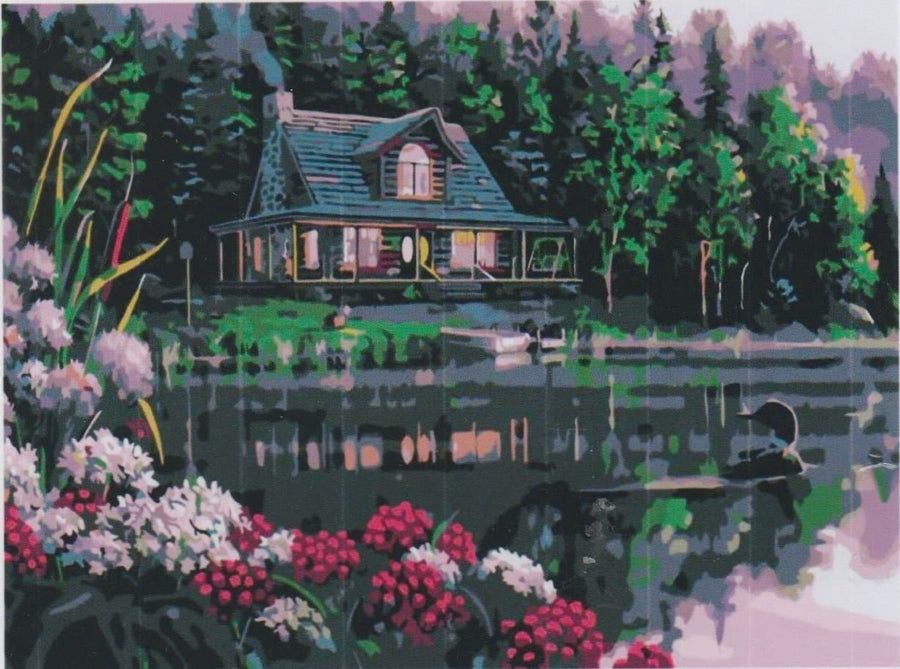
A well-drawn winter paint by number encodes all of that in its numbers. You do not have to work it out. But knowing why the pot marked for a large snowfield is pale blue rather than white stops people from second-guessing the kit halfway through, which is a real thing that happens.
What makes winter designs easier
Two things, and they are worth knowing if you are choosing a first canvas.
Large simple areas. Snow covers detail. A summer field is grass, weeds, flowers and fenceline; the same field in January is three or four big shapes. That means fewer sections and bigger ones.
A narrow palette. Winter scenes run on a limited range of related tones, so there are fewer pots to keep track of and fewer brush washes between them.
And what makes them harder
The same narrow palette. When every pot is a close cousin of the next, telling two of them apart in the pot is genuinely difficult, and a section painted in the wrong pale blue is not obvious until the whole area is done and reads flat.
Two habits fix it. Dab a spot of each pale color on a scrap of white paper and label it, so you are comparing painted samples rather than wet pots. And work one number completely across the whole canvas before opening the next, so a mix-up is impossible rather than merely unlikely.
Night scenes carry the same problem in the other direction: a dozen close darks in the sky. Same fix.
The winter designs in the catalog
Three of the 39 designs are genuine winter subjects, and they are quite different from one another.
Christmas Magic
Abraham Hunter's painting of Santa's sleigh drawn up outside a snowbound cottage: eight harnessed reindeer, wreaths in every window, a lit tree inside, aurora and a low moon overhead, and rabbits, a fox and a cardinal scattered through the drifts. The snow and sky are broad and forgiving. The eight sets of antlers and harness, and the garland along the eaves, are not. Reviewers describe it as generously supplied but not a beginner's kit.
If it is intended as a Christmas gift or a Christmas decoration, allow around six weeks of an evening or two a week. It is one of the more detailed designs in the range and it is not one to rush in December.
Aurora Bliss
Kim Norlien's log cabin under the northern lights, deep in snow-loaded pines, with lit windows, smoke from the chimney and a campfire burning on the bank of an open stream. The aurora goes in as wide bands running the same direction, one after another, and the blend appears without you doing anything clever. The lit windows and the fire reflections in the water are the fiddly part.
The easiest of the three, and the best choice if you want a night scene rather than another daylight landscape.
Moonrise Song
Abraham Hunter again: three wolves on the snow at the edge of a frozen stream, one mid-howl, with aurora across the sky and the moon rising through spruce. The snow here is painted almost entirely in blues and violets, which is exactly why the animals read so clearly against it.
The hardest of the three by some distance. The wolves are built from a great many narrow gray and cream sections that have to sit correctly against each other to read as fur, and reviewers call it both difficult and worth it. The trick is to follow the direction of each section with the brush rather than dabbing at it; the shapes already run the way the coat lies.
Painting a winter scene of your own
If the winter picture you want is one you took, a custom canvas made from your photo is the route. Snow photographs convert well, because the format's habit of flattening tones into shapes suits a landscape that is already made of large flat areas.
Two things to watch when choosing the photo. Cameras routinely underexpose snow, so a picture that looks gray on screen will be gray on canvas; use one taken in strong side light rather than flat overcast. And avoid a shot that is mostly featureless white field, because a huge area of one number is dull to paint however good it looks in a photograph.
Practical notes for a winter canvas
- Light matters more than usual. Distinguishing pale blue from pale gray under a warm household bulb is close to impossible. A daylight bulb positioned to the side is the single best thing you can do for a snow scene.
- Let the snow dry properly before the darks. Dark tree trunks and antlers painted onto still-soft pale paint drag and muddy immediately. Snow first, everything standing in it afterward.
- Expect a second coat on the whites. Pale colors over a dark printed number often ghost. One thin coat, let it dry, one more.
- Do not chase perfection in a snowfield. Slight variation across a big pale area is what stops it looking like a wall.
Common questions
Which winter design should a beginner pick?
Aurora Bliss. Broad sweeping bands of aurora and snow, with the detail confined to a small bright area you can save until last.
Is a winter scene a good Christmas gift?
Yes, with one caveat: give it early enough to be painted, not on the day it is meant to be finished. A canvas that arrives on Christmas morning gets started in January, which is fine, and a winter subject in January is no bad thing.
What if I run out of the main snow color?
The large background color is the one that runs out, and on a winter canvas that is usually the snow. Each design has a matching set in the extra paint collection.
Where can I see the whole range?
The catalog lists all 39 designs, and the customer gallery shows finished ones, which is the most honest preview available. If it would be your first, the beginner guide covers what makes a design easy or hard.


