


We do not make a wolf design. Our catalog runs to landscapes, cabins, waterfowl and florals, and there is no wolf in it. Worth saying at the top rather than three paragraphs down.
There is still a useful answer to the question, because a wolf is a genuinely demanding subject for a numbered canvas and most articles about it will not tell you why.
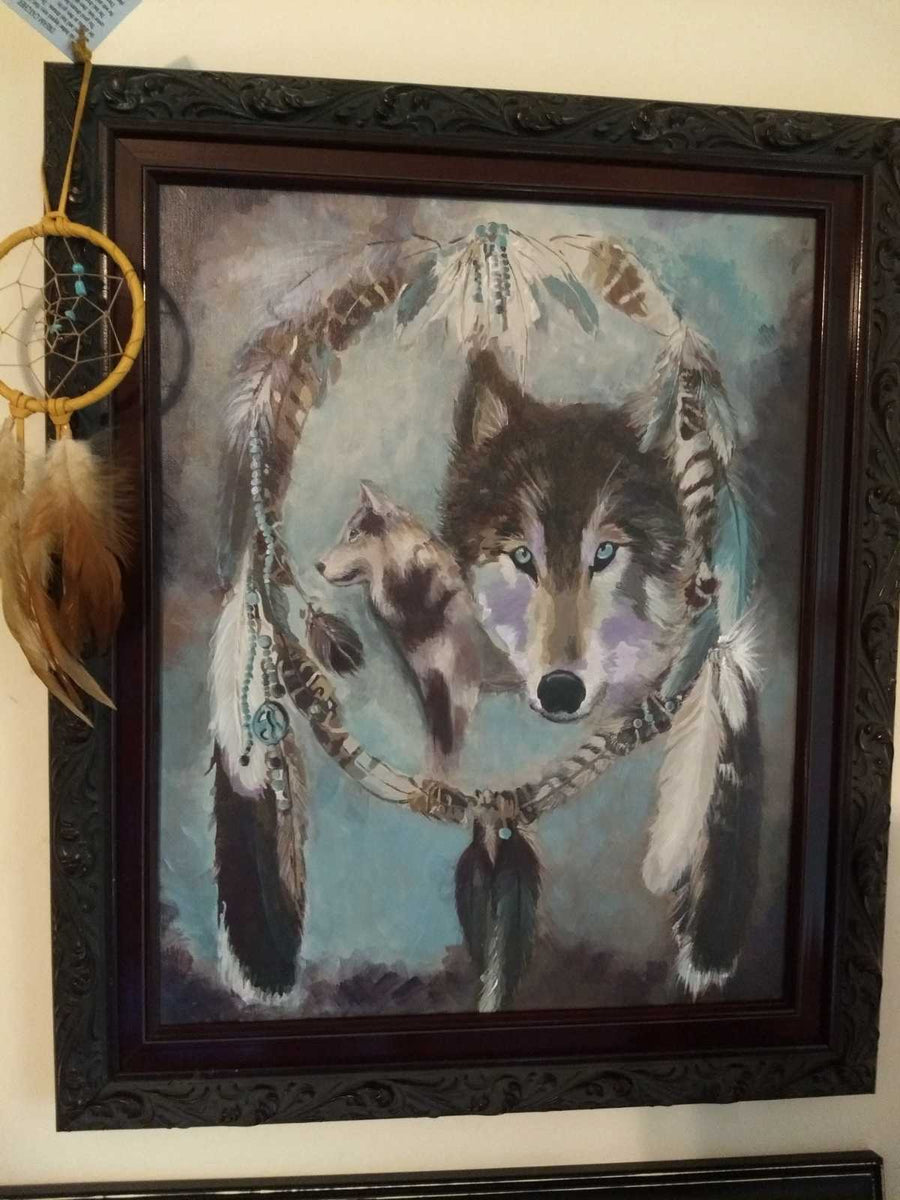
First, a correction about the time
You will see wolf kits advertised as an hour's work. They are not.
A 16 by 20 paint by number canvas takes most people 10 to 20 hours, spread over several weeks, and a detailed animal design will be at the upper end of that or beyond. Anyone promising a finished wolf portrait in under an hour is describing something that does not exist, and it sets you up to feel slow when you are painting at a perfectly normal pace.
The long timescale is the point of the hobby rather than a drawback. But go in knowing it.
Why wolves are hard to paint by number
Fur has no edges. This is the central problem. A numbered kit works by dividing an image into regions with boundaries, and fur is precisely the thing that has no boundaries in it. Converting a wolf's coat into numbered shapes produces either a small number of flat patches that read as a gray blanket, or hundreds of tiny slivers that are tedious to fill and still do not look like fur.
The eyes carry the whole picture. A wolf portrait lives or dies on the eyes, and they are usually the smallest and most finely divided part of the canvas. A few square millimetres decide whether the finished piece looks alert or vacant, and there is no way to compensate elsewhere.
Gray is unforgiving. A wolf's coat is a narrow band of grays, browns and off-whites sitting directly against each other. Like a sunflower painting, there is nowhere to hide a misjudged tone, and confusing two adjacent numbers is immediately visible.
None of this makes it impossible. It does mean a wolf design is a second or third kit rather than a first one, and that the difference between a good and a poor wolf kit is much wider than for a landscape.
What to look for if you buy one elsewhere
Zoom into the listing image and look at the coat. If the fur is rendered as a confetti of tiny irregular fragments, the design was made by running a photograph through software. That is the most common failure in animal kits.
Check the eyes have their own tones. Good designs give an eye several numbered values including a separate highlight. If the eye is one or two flat shapes, the finished wolf will look dead.
Look for a dark background. Wolf designs with strong contrast behind the animal are more forgiving than a wolf against pale snow or mist, where the whole canvas sits in one narrow tonal range.
Rolled, not folded, and sealed paint. True of any kit and covered in more detail in how to judge a paint by numbers kit.
The custom route, and the copyright trap
Our custom paint by numbers service makes a kit from a photograph you upload, and a wolf photograph works as well as any other subject.
There is a real catch, and it is the one people fall into with this subject specifically. Most striking wolf images online are somebody's copyrighted photograph or digital artwork. Wildlife photographers make their living from exactly these pictures, and a dramatic wolf-howling-at-the-moon composite is almost certainly an artist's work rather than a free image.
What is safe to send us: a photograph you took yourself, at a sanctuary, a zoo, or in the wild if you have been lucky. An image you have bought a license for. A genuinely free-license stock photograph where commercial use is permitted, which you should check rather than assume.
What is not safe: anything pulled from an image search, a photographer's site, or a social media post.
On composition, choose a photograph where the animal fills a good part of the frame and the light comes from one side. Side lighting creates the tonal separation a numbered conversion needs. A flatly lit wolf on a gray day gives the software almost nothing to work with, and the kit that comes back will be disappointing however good the photograph looked.
A note on wolves themselves
Since it appears in almost every article on this subject: the idea that wolf packs are led by an alpha who fought their way to the top is out of date.
That model came from studies of unrelated captive wolves forced together, which produced conflict that does not reflect wild behavior. In the wild, a pack is essentially a family: a breeding pair and their offspring from several years. The parents lead because they are the parents, not because they won anything. The researcher who popularized the alpha framing, David Mech, spent years afterward trying to correct it.
The rest holds up reasonably well. Wolves are fast over short distances, they have an exceptional sense of smell, breeding pairs are typically long-term, and they live across an unusually wide range of climates.
What we do make
Plenty of wildlife, just not wolves. Our designs include egrets on a marsh at sunrise, a bald eagle over a lake, waterfowl, swans and songbirds, all from licensed original paintings by working artists rather than converted photographs. You can see them in the animals collection.
They also avoid the fur problem entirely, which is not an accident. Feathers and water divide into numbered shapes far more naturally than a wolf's coat does, and it shows in the finished canvas.
If a wolf is what you want, the custom route with a photograph you own is the honest recommendation. If you would rather start with something built for the format, the best-selling designs are the place to look, and every one has a matching replacement paint set.


