


Art therapy is a clinical profession, not a craft activity. That distinction matters, and it gets blurred constantly by companies with something to sell — including, until recently, this page.
We sell paint by numbers kits. They are a hobby. They are not therapy, they do not treat anything, and nothing on this page should be read as a health claim about them. What follows is a straight description of what art therapy actually is, what the evidence supports, and how to find a real practitioner.
If you are struggling right now, please speak to your doctor or a mental health service rather than reading further. In the US, the 988 Suicide and Crisis Lifeline is available by call or text.
What Art Therapy Is
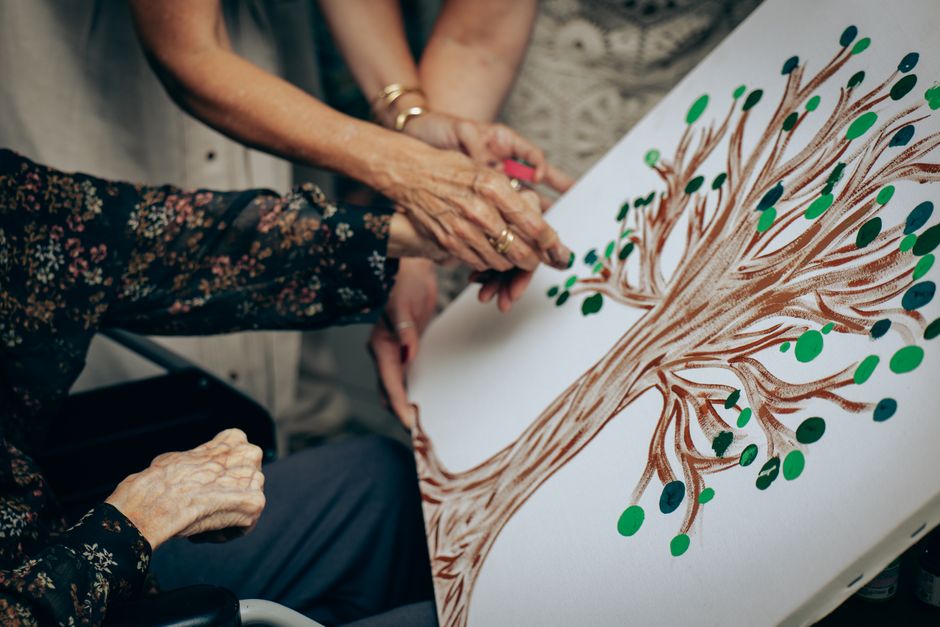
Art therapy is psychotherapy in which making images is part of the therapeutic work. A trained therapist uses the art-making, and the conversation around it, in the same way a talking therapist uses conversation alone.
In the United States it is a credentialed profession. Practitioners hold a master's degree in art therapy and are registered and board-certified through the Art Therapy Credentials Board — the letters to look for are ATR and ATR-BC. In the UK, art therapists are regulated by the Health and Care Professions Council.
That training is the point. The therapy is not in the paint.
What happens in a session
Typically: a check-in, an art activity chosen by you or suggested by the therapist, time to make something, and a conversation about it afterwards. The therapist does not decode your picture and hand you a diagnosis — they help you explore what it means to you.
You do not need to be good at art. That is not politeness; the process is the material, and technical skill is irrelevant to it.
Where it is used
Hospitals and cancer services, mental health services, schools, veterans' programmes, hospices, and settings supporting people with dementia. It is generally offered alongside other treatment — talking therapy, medication, mindfulness — rather than instead of it.
What the Evidence Supports
Here is where care is needed, because this subject attracts overstatement.
Reasonably supported: reductions in anxiety, distress and self-reported stress across a range of settings, and improvements in quality of life for people undergoing treatment for serious illness. A useful overview is Role of Art Therapy in the Promotion of Mental Health, and Art Therapy: A Complementary Treatment for Mental Disorders covers the clinical picture.
Weaker or mixed: claims about specific diagnoses. Much of the literature rests on small studies with varied methods, which is why reviews tend to conclude that art therapy is promising rather than established for any particular condition.
Not supported: that art therapy improves memory or cognition in general; that it treats cancer, as opposed to helping with distress and quality of life during treatment; and that any commercially sold craft product is clinically proven to do anything. If you see a company claim the last one, including about our kits, it is marketing.
You will also see specific percentages quoted — that some proportion of participants showed reduced stress, and so on. Those figures come from individual studies with particular populations and methods. They are worth reading in context rather than repeating as headlines, which is what the earlier version of this article did.
Techniques a Therapist Might Use
- Drawing and painting, using color and mark-making to work with feeling rather than to produce a picture.
- Clay and modelling, which is physical and often suits people who find flat work exposing.
- Collage, which removes the pressure of making marks at all.
- Digital work, increasingly common and useful where fine motor control is a barrier.
Which is used depends on the person, not on a protocol.
How to Find a Qualified Art Therapist
- Ask your doctor for a referral. The most reliable route, and the one that also checks whether art therapy is the right thing for you at all.
- Check credentials directly. In the US, look for ATR or ATR-BC and verify through the Art Therapy Credentials Board. The American Art Therapy Association maintains directories.
- Contact local mental health services. Many hospital and community services run art therapy groups.
- In the UK, check the HCPC register. Mind's guide to arts and creative therapies is a clear, non-commercial starting point.
"Art therapy" is not a protected term everywhere, so anyone can advertise it. Checking the register is worth the five minutes.
Common Questions
Do I need to be good at art?
No, and it makes no difference to the outcome.
Is it only for children?
No. It is used across all ages, including with older adults and in dementia care.
Does the therapist interpret my artwork?
Not in the sense of reading hidden meanings back to you. It is collaborative — they help you find what it means to you.
Can it be done in a group?
Both individual and group formats are common. Groups add shared experience; individual sessions allow more focus.
Will it bring up difficult feelings?
It can, particularly where trauma is involved. Handling that safely is precisely what the training is for, and it is the main reason to work with a qualified therapist rather than alone.
Painting at Home Is a Different Thing
Making art on your own is worthwhile. It is just not the same activity as the one described above, and it is honest to say so plainly.
What people who paint at home report is narrower and more credible: an absorbing hour, repetitive work that settles them, and an object at the end. Several of our own reviewers describe a paint by numbers canvas as what they do instead of scrolling on a phone all evening. That is a modest claim and probably a true one.
If that is what you are after, our catalog is here and five ways to start painting is the practical companion to this article. If what you need is therapy, use the routes above instead.


