


A canvas is a good thing for a family to share, but not in the way most articles describe it. The honest version is that a numbered canvas is an adult project that a child can meaningfully take part in, provided the parts are divided sensibly. Handed round as an everyone-does-a-bit activity it usually ends with one person finishing it alone.
Here is what actually works.
Be realistic about ages
Our kits are made for adults. The printed sections are fine enough that grown painters keep a magnifier on the table for the detailed areas, and a 16x20 takes ten to twenty hours. There is no children's range.
- Roughly ten and up can paint a numbered canvas independently, given a design with generous areas.
- Twelve and up manages it comfortably, and generally prefers being handed the real thing rather than something made down to their level.
- Under about ten should share a canvas rather than own one. Give them the sky, the water, the field, the barn wall — any large block where staying inside the line is achievable.
- Under about six, give them their own sheet of paper and a few colors alongside you. Unstructured painting suits them better anyway, and nobody is waiting on anybody.
An adult with unsteady hands or failing eyesight is in much the same position as a younger child here, and the same solution works: take the large calm areas and let someone else do the windows.
Dividing a canvas so it actually gets finished
- Split by area, not by turn. "You do the lake, I will do the cabin" works. Passing the brush every ten minutes does not — sections get half-finished and nobody knows what was done.
- Give the fine work to one person. The windows, railings, branches and eyes should belong to whoever has the steadiest hand. Trying to share the detail is how a canvas ends up looking patchy.
- Save an obvious part for the youngest. Something they can point at afterward and say is theirs. That is most of the value of the exercise.
- Let neighbors dry. Two people painting adjacent sections at the same time will smear each other's edges. Work in different parts of the canvas.
- Agree who gets it at the end. Genuinely worth settling before you start.
Or paint separately, together
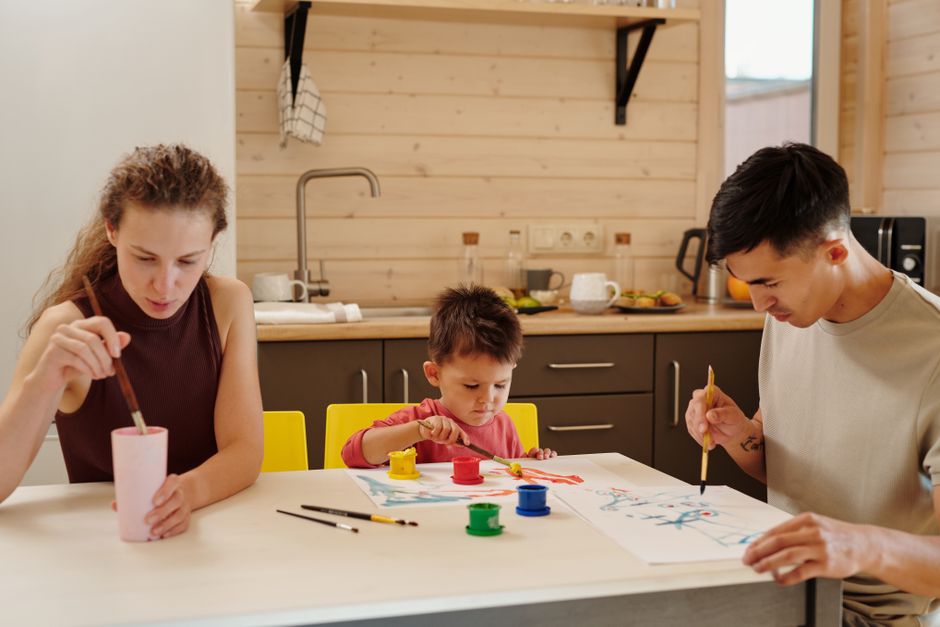
The alternative that often works better: two canvases at the same table. Everyone paints at their own pace and to their own standard, nobody is blocked waiting for anybody, and there is no negotiation over whose section is whose. The company is the point, not the shared surface.
This also solves the age problem entirely. An adult can take a demanding design while a twelve-year-old takes an open landscape, and both are working on something suited to them.
Setting up a session that works
- One good lamp per painter. More important than anything else, and the thing most often skipped. Angled across the canvas rather than straight down.
- Cover the table. An old cloth or a plastic sheet. Acrylic wipes off easily while wet and not at all once dry.
- A tray or board each. It keeps pots from wandering, and it means a canvas can be lifted away whole rather than packed up.
- Keep sessions short. Ninety minutes is plenty and thirty is fine. Stopping while everyone is still enjoying it is what makes people come back the next evening.
- Leave it set up if you can. The single biggest predictor of whether a canvas gets finished is whether packing it away is required.
- Damp cloth within reach. For hands, mostly.
Choosing something everyone will stay with
Two things decide this. First, large open areas — a big sky, water, a field — so there is plenty that a less confident painter can do well. Avoid anything dense and evenly detailed; a design with small sections scattered across the whole canvas leaves nothing for anyone but the most patient person at the table.
Second, a subject the family actually cares about. Our designs are licensed artwork — Americana scenes, wildlife, cabins, florals and a couple of seasonal ones. There is no abstract line, no portrait range and no multi-panel or wall-sized kits, so if that is what you had in mind you will need to look elsewhere.
Where family painting really works is a custom canvas made from your own photograph — the family dog, the house everyone grew up in, a holiday picture everyone recognizes. Everyone at the table has a stake in the picture, which is worth more than any amount of encouragement. It is printed in the USA in 12x16, 16x20 and 18x24, framed or unframed.
For a shared stock design, an open landscape is the safer choice. Our guide to the best kits for beginners names which ones suit a first attempt and which to leave until later.
What comes in the box
A pre-printed cotton canvas rolled in a tube rather than folded, acrylic paints vacuum-sealed so they arrive moist, brushes in a range of sizes, and an 11x17 printout of the design — genuinely useful when two people are working on one canvas and only one of them can lean over it. Framed sizes arrive pre-stretched with a wooden tabletop easel.
If a color runs low, and on a shared canvas it will run low faster, there is a matching replacement paint set for every design.
You can browse the range in the full catalog, and the customer gallery is worth a look — a good many of the canvases in it were finished by more than one person.


