


Watercolor kits with numbered regions exist, and people ask about them constantly. They are the one format in this category we would steer you away from, and it is worth setting out exactly why rather than just asserting it.
Five reasons, and then the two situations where one is genuinely the right buy.
1. The outlines and numbers show through
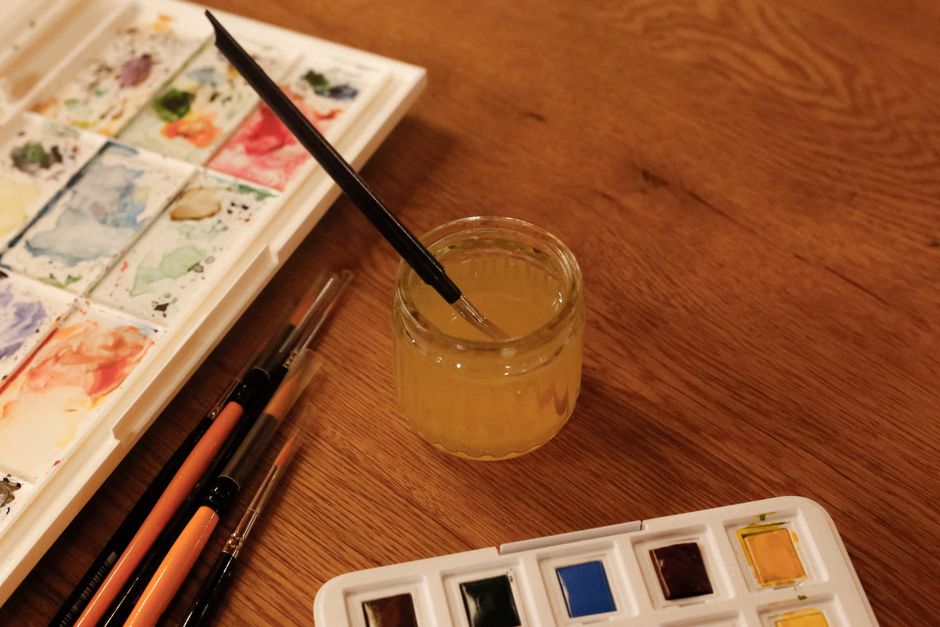
The whole character of watercolor comes from transparency. Light passes through the pigment, hits the white of the paper and comes back up, which is what gives a wash its glow.
A numbered kit depends on the opposite. Every region carries a printed outline and a printed number, and the picture is only clean once those have disappeared underneath the paint. Acrylic buries them because acrylic is opaque. Watercolor does not, because not covering things is precisely what it is for.
The result is a finished picture with a visible grid of lines running through it, worst in the pale areas of sky and water where the wash is thinnest. There is no technique that fixes this. It is the medium doing what it does.
2. The surface is wrong
Watercolor needs paper that has been sized to hold water on the surface long enough for the pigment to settle out evenly. That is what watercolor paper is, and it is why it costs what it does.
A pre-printed cotton canvas is not that. Lay a wash on it and the water either beads and runs, or sinks in unevenly and dries blotchy. Canvas can be prepared for watercolor with an absorbent ground, but that is a job you do yourself beforehand and it is not what arrives in a box. Our overview of types of canvas for painting covers what different surfaces actually do.
3. A mistake is permanent
Put the wrong color in a region of an acrylic kit and you wait ten minutes and paint over it. Nobody will ever know.
Put the wrong color in a region of a watercolor kit and it is there. Watercolor can be lifted slightly while wet and lightened a little afterwards, but it cannot be covered, and it cannot be made lighter than the paper underneath it. On a format explicitly aimed at people who have never painted before, that is the wrong risk profile.
4. Adjacent regions bleed into each other
A numbered design is a mosaic of shapes that meet along a line. Watercolor spreads: lay a wet wash next to one that is still damp and the two run together across the boundary you were trying to respect.
Worse, dried watercolor re-wets. A wash laid beside a finished neighbor can soften and lift it, so a region you painted an hour ago can be damaged by the one next to it. Acrylic, once dry, is inert and cannot be disturbed.
5. The paint runs out, invisibly
Watercolor kits supply small pans or cakes, and there is no reliable way to judge how much of a pan you have used or how far it has to stretch. With numbered pots of acrylic you can see the level dropping.
Because a watercolor region often needs two or three passes to reach any strength, and because the thin washes tempt you to use more, running short before the canvas is finished is common. And unlike an acrylic kit, where a matching replacement set can be bought, watercolor pans are rarely available to match.
The pencil kits are the exception
A number of kits sold as watercolor are actually watercolor pencils: you color the region dry, then wet it with a brush to soften it.
These work considerably better than watercolor paint in this format. You control exactly where the color goes while it is dry, there is no bleeding across boundaries, and the pencil covers the printed guide more effectively than a wash does. If you are set on a watercolor kit, this is the version to look for, and it is worth checking which one you are buying because the listings frequently do not say.
The two cases where a watercolor kit is right
You already paint in watercolor and what you want from a kit is the drawing and the color scheme handed to you. You know how the medium behaves, you will not be surprised by any of the above, and you will probably ignore half the numbers anyway.
The kit is printed on real watercolor paper. A few are. That removes the second problem entirely and softens the fourth. Check the specification rather than the photograph.
What we would suggest instead
If it is the look of watercolor you want, several of our designs are taken from original watercolor paintings and reproduced as acrylic kits, which gives you the loose, airy quality of the artwork with a paint that behaves itself. Judy Buswell's florals are the clearest examples of this.
If it is the medium itself you want, buy paper, a small pan set and one good round brush, and paint freehand. It is a genuinely rewarding thing to learn and it deserves better than being squeezed into a format built for something else. Our beginner's guide to watercolor covers the two rules that govern all of it.
There is more on why the two ideas conflict in paint by number watercolor, the general checklist for judging any kit is in how to choose a paint by numbers kit, and our own acrylic designs are in the full collection.
If you are deciding between the two media rather than between kits, watercolor versus acrylic comes down to one property: acrylic becomes waterproof and watercolor does not.


