


An abstract cat painting keeps whatever makes the cat recognizable and lets go of the rest. Usually that means the silhouette, the set of the ears and the eyes. Everything else — fur direction, exact color, background detail — becomes shape and color rather than description.
That is why cats suit the approach so well. A cat's outline is one of the most readable shapes in the world. You can push the color a long way from anything real and the animal still reads as a cat.
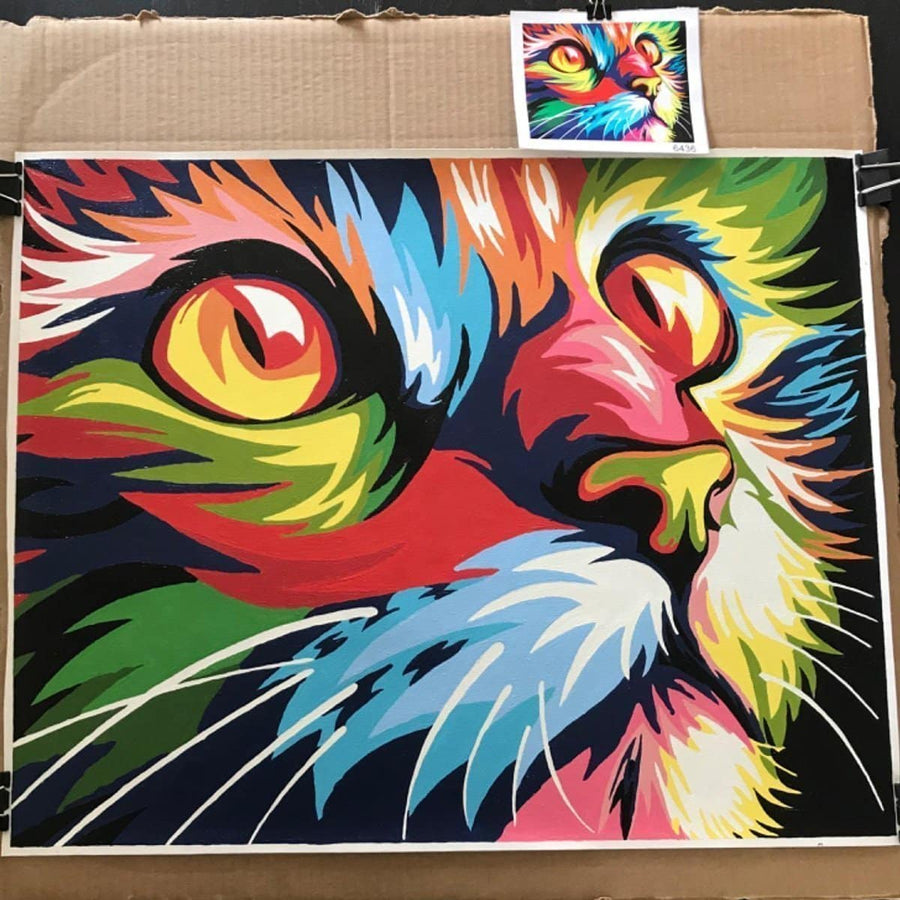
What people usually mean by abstract cat painting
The phrase covers four fairly different things, and it helps to know which one you are after before you start.
Simplified or graphic. The cat reduced to a few flat shapes and a limited palette. No shading, no fur texture, clean edges. This is the most forgiving version and the one that looks most deliberate when it goes slightly wrong.
Expressive color. The drawing stays fairly true to the animal but the color does not. A blue cat, a yellow cat, a cat built out of pinks and greens. Franz Marc painted Two Cats, Blue and Yellow in 1912 on exactly this principle, one cat in deep blue and one in bright yellow, and it hangs in the Kunstmuseum Basel today.
Loose and watery. Watercolor washes allowed to bleed past the edges, with only the face brought into focus. The looseness is doing the abstracting.
Semi-abstract portrait. A recognizable cat, painted with real attention to the eyes and expression, set against a background that is pure color and mark-making. This is the version most people actually want when they say abstract, particularly when the cat is their own.
A short note on cats in art
Cats have carried a lot of weight in painting without ever quite being the subject. Théophile Steinlen, who lived in Montmartre and kept a houseful of them, drew the black cat on the 1896 Tournée du Chat Noir poster that is still on kitchen walls everywhere. Marc used animals as a way of getting at feeling rather than likeness.
What both understood is the thing worth borrowing: a cat gives you permission to be unrealistic. Nobody looks at a blue cat and thinks the painter got it wrong.
How to actually start one
If you are painting rather than following a numbered canvas, a few things make the difference between a finished piece and an abandoned one.
Start from a photo, not from memory. Cats do not hold still, and the proportions of a cat's head are much harder to recall than you think. Work from a photograph where the eyes are sharp and the light is coming from one clear direction.
Block in the silhouette first. Get the outline right and the painting is most of the way there. Squint at your reference until the detail drops away and only the shape remains, then paint that shape.
Decide the palette before you touch the canvas. Three or four colors plus a dark and a light is plenty. Abstract work goes muddy when it is improvised color by color. Picking the palette in advance is what keeps it looking intentional. If you want a starting point, our guide to the color wheel covers which combinations hold together.
With acrylics, work dark to light. Acrylic is opaque, and a light color will cover a dark one far more easily than the other way around. Lay the shadows and the background in first, then bring the lighter tones over the top.
Leave the eyes until last. They are the smallest part of the canvas and they carry the whole painting. Paint them when your hand is warmed up and the surrounding paint is dry.
Painting your own cat
Most people asking about cat painting have a particular cat in mind, and often one that is no longer around. That changes what matters. Likeness stops being a technical exercise and becomes the whole point.
Two things help more than any technique. The first is choosing the right photograph: eyes open and in focus, head turned slightly rather than straight on, and light from one side so the face has some form to it. Phone photos taken from above rarely work, because the cat ends up all forehead.
The second is deciding in advance how literal you want to be. A loose, colorful treatment forgives a lot and often feels more alive. A tight, accurate one is harder and less forgiving, and when it misses by a little it can feel wrong in a way a stylized version never does.
If you would rather not draw
The drawing is the part that stops most people, and it is the part paint by numbers removes. You get the outlines already on the canvas and a numbered color for each section, so the whole evening is spent on the painting rather than on whether the head is the right size.
We do not sell a stock abstract cat design. What we do sell is a custom canvas made from your own photo, which is the honest answer for anyone who wants their own cat on the wall. Send a clear photograph and it comes back as a numbered canvas with a matched set of paints, at 12 x 16, 16 x 20 or 18 x 24. Canvases are printed in the United States rather than drop-shipped from overseas.
If it is a big cat you are after rather than a house cat, Bamboo Tiger in our animals collection is the closest thing we make. It is a demanding canvas — a lot of small sections in the fur — so it suits someone who has painted before.
Common questions
What paint should I use?
Acrylic, for a first attempt. It dries fast enough to layer in one sitting, it cleans up with water, and mistakes can be painted over once dry. Oils stay workable longer, which is an advantage once you know what you are doing and a liability before then.
How do I get the fur to look like fur?
Mostly by not trying to paint it. Fur reads as fur from a step back when you get the direction and the light right, using a few loose strokes that follow the way the coat lies. Painting individual hairs looks less convincing, not more.
What size canvas?
For a single cat, 12 x 16 or 16 x 20 is plenty. Go larger only if there is more than one animal in the picture, or if the face needs to carry real detail.
How long does it take?
A simplified, graphic cat can be done in an evening. A detailed portrait, painted a bit at a time, is more like 10 to 20 hours. There is no rush in either case.
If you would like to see how other people's finished canvases turned out, the customer gallery is worth a look.


