


Lake scenes are among the most forgiving subjects in paint by numbers, because most of the canvas is water and sky. Both are broad, calm areas of closely related color, which means fewer tiny sections and more of the satisfying kind of painting where a whole region fills in one sitting.
They are also the scenes people keep on the wall longest, which is probably not a coincidence. Here are the lake designs we make, and what is genuinely worth knowing about painting water.
Our lake and water designs
Moonlight Bay — Kim Norlien's painting of a canoe and a campfire on a moonlit lake, with a full moon laying a silver track across water that has not moved all evening. The moon track is the whole picture, and it is a satisfying section to paint.
Still Waters — a log cabin at dusk on a glass-calm northern lake, lamplight in the windows, smoke from the chimney, and a loon crossing water still enough to mirror the treeline. The wider country-living range trades the water for barns, fields and porch light.
Away From it All — Hayden Lambson's log cabin on a rocky point above a northern lake, half hidden by birch and aspen. One of the more approachable canvases we make.
House Near the Lake — Image World's lit lakeside house under a full moon, with a wooden dock and a rowboat below it. The lit windows against the dark are the reason this one works.
Colorful House Near the Lake — a stone-and-timber porch above a spring lake, hung with baskets of flowers. More detail in the flowers than the others, so a step up.
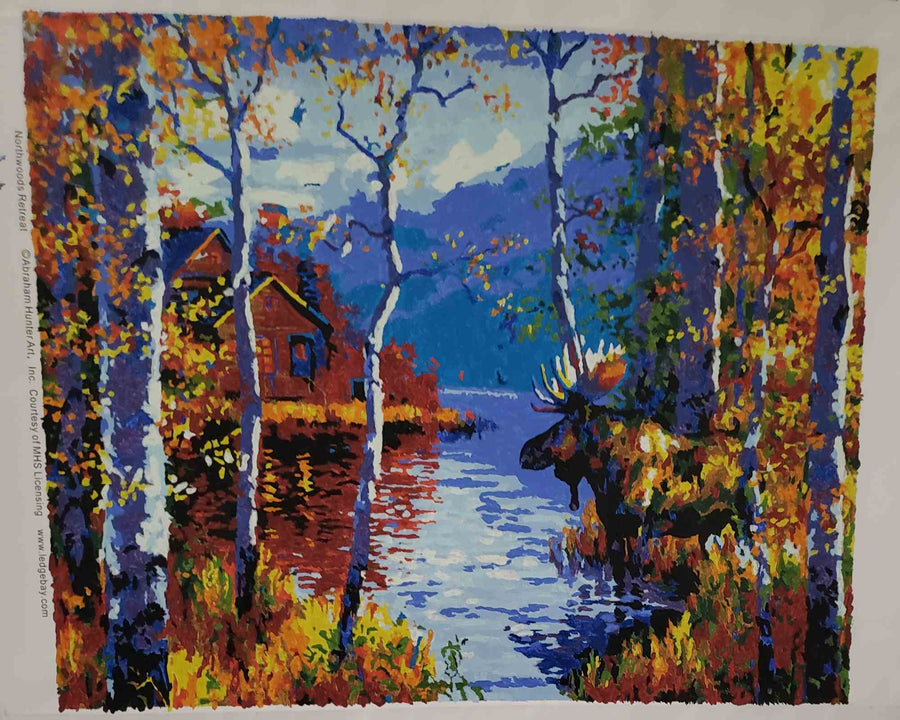
Northwoods Retreat — Abraham Hunter's bull moose standing chest-deep at the lake edge below a cabin. A wildlife painting and a water painting at once.
Mountain Paradise — Kim Norlien's lakeside lodge below a waterfall, windows lit, a fire pit by the water.
All of them come at 12 x 16 framed, 16 x 20 framed and 16 x 20 unframed. You can see the full set in the kit collection, and the artists' own pages are on our artists page.
If the lake you actually want is one you know — a family cabin, a place you spent summers — a custom canvas from your own photo will do that instead. Water photographs convert well, because reflections already read as flat shapes.
Why water is easier to paint than it looks
The thing that makes water intimidating in freehand painting is exactly what makes it easy on a numbered canvas. Reflections are not really detail — they are broad bands of color, softened and slightly darker than the thing they reflect, broken by horizontal marks where the surface moves.
A numbered canvas has already done that analysis for you. What looks like a complicated reflection resolves into four or five long shapes, and once you fill them in the reflection appears. It is the single most satisfying moment in painting a lake scene, and it happens without any skill on your part.
Two things worth understanding while you do it, because they will make you paint more confidently:
Reflections are darker and duller than what they reflect. A bright sky reflects as a slightly grayer, deeper version of itself. If a section looks like it should be lighter than the number suggests, trust the number — the artist got it right.
Still water reflects; moving water scatters. On a calm lake the reflection is a near-mirror with sharp vertical continuity. Where there is a breeze or a wake, the same reflection breaks into short horizontal dashes. That is why the marks in a rippled section run sideways rather than up and down.
Painting a lake canvas well
A few things specific to this kind of scene.
Do the sky and the water first. They are the biggest areas and they sit behind everything else. Getting them down early means the canvas stops looking blank, which matters more for motivation than people admit.
Keep the waterline level. The far edge of a lake is horizontal, and the eye notices immediately when it is not. Take care with the boundary sections along that line.
Save the lit windows and the moon for last. The brightest, warmest sections are small and they carry the whole picture. Paint them when your hand is warm and everything around them is dry.
Expect to use a lot of two or three colors. Water and sky eat the mid-blues and grays. If a pot is looking low halfway through, that is the moment to order a replacement paint set, rather than after you have run out.
General tips for any numbered canvas
- Work from the darkest colors toward the lightest. Dark paint covers the printed number in one coat, whereas pale colors often need two. Light paint straying into a dark area is easy to fix later; the reverse is not. Advice to start with the lights and work toward the darks is common online and it is backwards.
- Paint the largest sections first, then work down to the small ones.
- Work top to bottom so your hand is not resting on paint you have just laid down.
- Finish every section of one color before opening the next pot. It is faster, it uses less paint, and it removes the risk of losing track.
- Close the pot when you are not using it. Acrylic skins over quickly in an open pot.
- Use a second, older brush for scooping and stirring and keep your good brush for the canvas.
- Never stand brushes in the water jar. The weight bends the bristles permanently and the soaking loosens the ferrule. Lay them flat.
- Rinse in warm water before the paint dries, working the water right up to the base of the bristles.
- Do not rush the drying. A second coat over paint that is not dry lifts the first one.
Choosing between them
If it is your first canvas, Away From it All or Still Waters are the gentler options — broad water, clear shapes, generous areas. Colorful House Near the Lake and Northwoods Retreat ask for more patience, because flowers and fur both break into smaller sections.
Beyond that, pick the picture you want to look at. Ten to twenty hours is a long time to spend with a scene you chose for the wrong reason, and every one of these is easy enough that difficulty should not be the deciding factor.
Our beginner's guide covers what the first evening is actually like, and the customer gallery shows finished canvases photographed by the people who painted them.


