


Sunflowers are the easiest flower to paint convincingly. The shape is simple, the color range is narrow, and the one thing that makes or breaks the painting — the dark center against the yellow — is a contrast you cannot really get wrong.
Contrast is also the practical answer to which colors are easiest to see, which matters more than palette choice if eyesight is a factor.
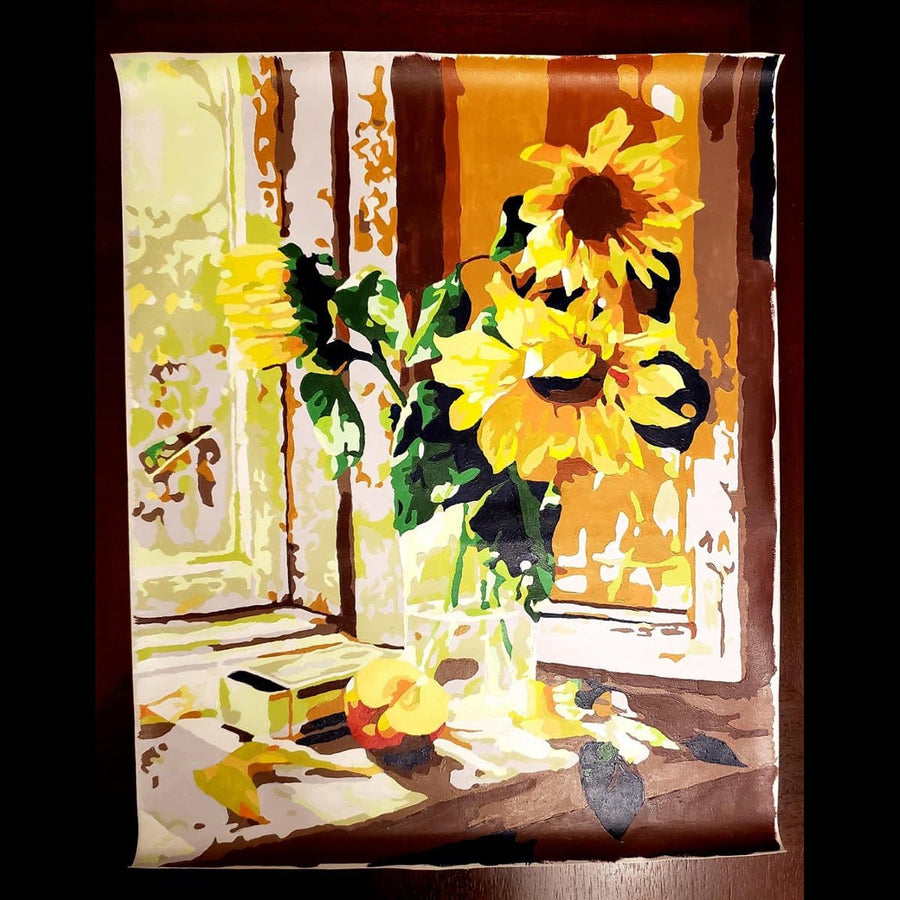
Here is how to paint one, what the colors actually are, and a few things about the flower worth knowing while you work.
The Colors You Need
Six will do the whole flower:
- Cadmium yellow medium — the body of the petals.
- Yellow ochre — the shadowed side of each petal.
- Burnt umber — the center disc.
- Titanium white — highlights on the petal edges facing the light.
- Sap green — leaves and stem.
- Ultramarine blue — for the background, and for knocking the green back so it stops looking like plastic.
One correction to something often written: you do not mix anything to get sunflower yellow. Yellow is a primary — it comes out of the tube. What you mix are the variations: ochre for shadow, a touch of red for the warm turn of a petal, white for the lit edge. Trying to build yellow from other colors will only give you something duller than the tube you already own.
How to Paint One
- Background first. Cover the canvas behind the flower before you paint the flower, and take the color right through where the petals will be. Cutting a background in around finished petals never looks right.
- Block the center. A flat disc of burnt umber. Not a perfect circle — sunflower centers are slightly oval and rarely centerd in the head.
- Petals in one stroke each. Load the brush and pull from the outside of the petal in toward the center, lifting as you go. One stroke per petal. Going back over it is what makes petals look like cardboard.
- Vary them deliberately. Real sunflowers have petals of different lengths, some curled, some overlapping, one or two missing. A ring of identical petals reads as a cartoon.
- Shadow and light. Ochre on the petals turned away from the light, white on the ones facing it. This is the step that makes the head look round rather than flat.
- Texture the center last. Stipple with the tip of a dry brush — darker at the middle, a rim of lighter ochre and gold where the seeds meet the petals. Never paint the center as flat brown.
- Leaves and stem. Green straight from the tube looks wrong on anything. Knock it back with a little umber or ultramarine.
The most common mistake is painting the center too small. Look at a real one: the disc is usually about a third of the whole head.
Getting the Yellow to Sing
Yellow is the lightest color on the palette, which means it only looks bright when there is something dark next to it. Two consequences:
Choose the background deliberately. A blue or a deep teal behind a sunflower makes it glow, because blue sits opposite yellow-orange on the color wheel. A pale background does the opposite — the flower goes flat, however bright the paint.
Do not lighten the yellow with white. It turns chalky and loses the intensity. If you need a paler yellow, use lemon yellow rather than white-tinted cadmium.
There is more on this in our piece on passive and active colors.
A Few Things About the Flower
The name. Helianthus, from the Greek helios (sun) and anthos (flower).
They really do follow the sun — while young. Immature heads track it from east to west through the day and swing back overnight. Once the flower matures, that stops and the head settles facing east. Worth knowing if you are painting a field: mature sunflowers all face the same way.
They are American. Sunflowers are native to North America and were cultivated by indigenous peoples for seeds, oil and pigment long before they reached Europe in the sixteenth century.
That last fact makes one popular story impossible. The Greek myth of Clytie, the nymph who pined for Apollo and was turned into a flower that follows the sun, is often told about sunflowers — but the Greeks had never seen one. The flower in that myth was the heliotrope.
Color varieties. Not all sunflowers are yellow. There are deep red and mahogany varieties, burnt-orange ones, and pale creams that are nearly white. If you want a sunflower painting that does not look like every other sunflower painting, that is where to start.
What they symbolise. Adoration and loyalty in the European tradition, from the sun-following. In North America the association is with harvest and provision, which fits a plant grown for food rather than decoration.
If You Would Rather Not Draw It
Everything above assumes you are drawing the flower yourself. If that is the obstacle, a numbered canvas settles the drawing and the colors and leaves you the brushwork.
To be straightforward: we do not currently have a sunflower design. Our florals are Rita's Pansies, Sweet Petunias, Morning Glory and Cosmos From the Garden, several by Judy Buswell, and the full catalog is here. Sweet Petunias is one our own reviewers rate as demanding, so it is not the one to start on.
If it has to be sunflowers, photograph some and Custom Paint by Numbers will convert the photograph into a numbered canvas. A single head fills a canvas better than a whole field — fields convert into a great many tiny sections.
More technique in ten ways to paint flowers and painting still life in acrylics.


