


Painting large is not the same activity scaled up. It is a different one. The brushes change, the amount of paint changes dramatically, how you stand changes, and the composition has to work from across a room rather than from arm's length.
None of that is a reason to avoid it. But almost everyone who moves up a size for the first time is surprised by the same things, and knowing them in advance is the difference between an ambitious canvas that gets finished and one that sits in a corner.
What counts as large
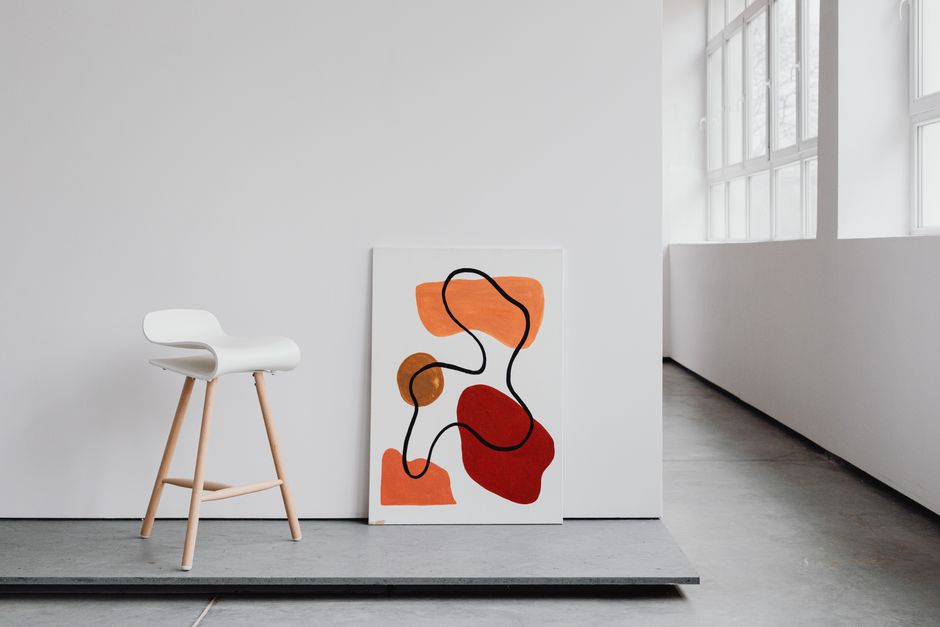
There is no official threshold, but in practice the standard sizes run 11 x 14, 16 x 20, 18 x 24, 24 x 36, and most people would call anything past 24 x 36 a large canvas. Above that you are into 30 x 40, 36 x 48 and beyond, and those sizes start to bring in real practical questions about where you work and how you move the thing.
The useful way to think about it is not inches but area. A 16 x 20 is 320 square inches. A 30 x 40 is 1,200. That is nearly four times the surface, which is worth holding onto as you read the rest of this.
Paint is the cost nobody plans for
Area grows as the square of the dimensions, and paint consumption grows with area. Doubling both sides of a canvas quadruples what it takes to cover.
Two consequences. The first is financial: a large canvas in artist-grade paint can cost more in materials than the canvas itself, and running out of a mixed color halfway through is far worse than running out on a small piece, because matching a mix you made three weeks ago is close to impossible.
The second is practical: mix more than you think you need, and mix it all at once. Keep it in a sealed container. For acrylics, a stay-wet palette or an airtight tub is worth the trouble on a canvas this size.
The brushes have to grow too
The commonest mistake on a first large canvas is bringing the same brushes. A brush that felt generous on a 16 x 20 will take a week to cover a 36 x 48, and the result looks fussy and worked-over rather than confident.
Scale the brushes to the canvas. Large flats and house-painting brushes for the broad passages, and keep the small brushes for the last ten percent. The rule of thumb is to use the biggest brush that will do the job, then go one size bigger.
Your arm changes as well. Small paintings are made at the wrist; large ones are made from the elbow and the shoulder, standing rather than sitting. That is where the sweep and energy in big paintings comes from, and it does not happen if you are hunched over the surface.
Step back, constantly
On a small canvas your eye takes in the whole thing at once. On a large one it does not, and you can spend two hours making a beautiful passage that turns out to be in the wrong place entirely.
The habit worth building is to walk back six or eight feet every fifteen minutes. Professional studios are large partly for this reason. If you do not have the room, photograph the canvas on your phone and look at that — shrinking it down shows you the composition the same way distance does, and it will show up an imbalance immediately.
Canvas material at scale
Cotton duck is what most ready-made canvas is, and it is fine at small and medium sizes. Its weakness shows up as the area grows: cotton has more give, so a big cotton canvas is more likely to slacken over time and need re-tensioning.
Linen costs considerably more and is the traditional choice at scale for exactly that reason. It is stronger and more dimensionally stable, with a finer, more even weave. If you are making something you want to survive decades, this is where the extra money goes.
Polyester and other synthetics are the modern option: usually sold pre-primed, dimensionally stable, and resistant to moisture and mildew. Some painters find the surface less sympathetic than natural fiber, which is a matter of taste rather than quality.
Weight matters more the larger you go. Light canvas flexes under the brush, which is irritating on a small piece and genuinely disruptive on a large one.
The support underneath
This is the part that gets skipped, and it is the one that ruins large canvases.
A big canvas on thin stretcher bars will bow inward under the tension of its own fabric, and once the frame twists, the painting sits unevenly against a wall forever. Anything past about 30 inches on a side wants deeper, heavier bars and a cross-brace through the middle. Ready-made large canvases vary enormously on this point, and it is worth pressing gently on the center of the back before you buy: a good one is rigid, a poor one flexes.
Composition changes
Large paintings are seen from further away, which changes what works. Fine detail simply disappears at viewing distance, so a large canvas covered in small incident tends to read as busy rather than rich.
What holds up at scale is strong shape, clear value contrast, and generous empty areas. Space that would look unfinished on a small canvas reads as deliberate on a large one, and it gives the eye somewhere to rest. If you are enlarging a composition that worked small, expect to simplify it rather than add to it.
The practical questions
Worth answering before you buy rather than after:
- Can you get it out of the room? Doorways and stairwells have ended more large canvases than bad technique has.
- Where will it dry? A wet 36 x 48 needs somewhere to stand undisturbed for days.
- What will framing cost? Custom framing scales with size and can easily exceed everything else combined. Many large works are painted around the edges and hung unframed for this reason.
- How will it hang? Large canvases are heavier than they look and need a fixing into a stud rather than a picture hook.
- How would you ship it? If the answer is that you would not, that is worth knowing at the start.
Where paint by numbers fits
Honestly: it does not go very large, and there is a reason.
A numbered canvas has to hold a printed number in every section. Enlarge the design and you face a choice — keep the same number of sections, in which case they become large flat blocks and the picture loses all its detail, or keep the detail, in which case the section count climbs into territory where the painting takes months. Most kits settle at 16 x 20 because that is where the two pressures balance.
Our licensed designs come at 12 x 16 framed, 16 x 20 framed and 16 x 20 unframed. A custom canvas from your own photo goes up to 18 x 24, which is our largest. That is not a large canvas by fine-art standards and we would not pretend otherwise — but it is the right size for the format, and 18 x 24 is genuinely worth choosing when a photo has more than one face in it, because each face gets enough sections to look like the person.
If you want the scale, paint freehand. If you want the structure, take the 16 x 20 and spend the saved effort on the painting. Our guide to canvas sizes and difficulty goes into how size and section size interact, and the kit collection shows what each design looks like at each size.


