


Cows are easier to paint than people think and harder to draw than people expect. The painting is forgiving — hide, grass and sky all tolerate a loose edge. The drawing is not, because everyone knows what a cow looks like and a head that is slightly the wrong shape reads immediately as wrong.
One honest note before the method: we do not make a cow design. There are 39 designs in our catalog and none of them is a cow, so if you came here looking to buy one, the answer is no. What follows is how to paint one yourself.
What you need
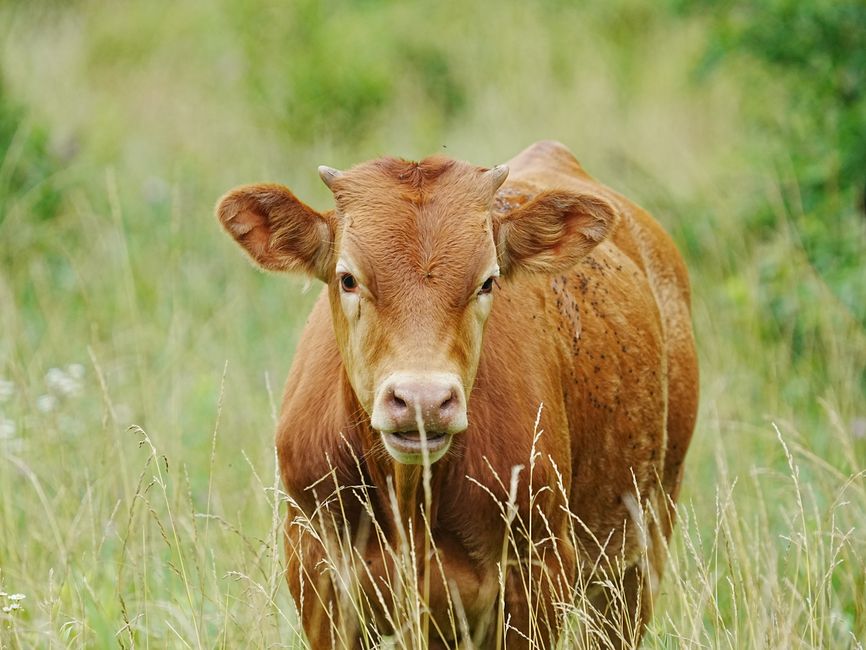
Acrylics in six colors — a warm and a cool red, yellow and blue — plus a large tube of white. You will mix everything from those, including the blacks, which look far better mixed from a deep blue and a burnt umber than they do from a tube.
Three brushes: a medium flat for the field and sky, a small round for the animal, a detail round for the eye and the markings. A primed surface, which for board or paper means a coat of gesso first.
And a reference photograph. Painting a cow from memory produces a cow-shaped animal that is not a cow. Take your own if you can.
1. Background first
Sky, then the far field, then the near grass — top to bottom, before the animal exists on the canvas. Painting the background around a finished cow is fiddly and it shows. Painting the cow over a dry background gives you a clean edge and a second chance at the silhouette.
Keep the distant field lighter, cooler and less contrasted than the grass in front. That single decision does more to create depth than anything you do to the cow.
2. Block in the shape
Do not draw the outline. Place three simple masses: a barrel for the body, a wedge for the neck and shoulder, a blocky rectangle for the head. Check the proportions against your reference before you commit to anything else.
The two things that most often go wrong: the head ends up too small, and the legs end up too short. Both are the result of drawing what you think is there rather than measuring. Hold your brush at arm's length and compare the head to the body length.
3. Paint the values, not the color
Lay in the whole animal as a mid-tone first, then add the shadow side and the lit side. A cow is a large rounded form and it will look like a cardboard cutout unless the underside of the belly, the far side of the neck and the inside of the legs go darker.
Ignore the markings entirely at this stage. That is the discipline the whole thing depends on.
4. The head
The head is where a cow becomes recognizable. Three things carry it: the width across the muzzle, the set of the ears out to the sides, and the eye placement well to the side of the skull rather than facing forward.
The eye is a dark almond, not a circle, with a single small highlight. One highlight, not two. The nose is broad, wet and slightly darker than the surrounding hide, with one soft light catch across the top of it. Overdo the shine and it stops looking like an animal.
5. Markings last, and follow the form
This is the step that separates a convincing cow from a white shape with black blobs on it. The patches wrap around the body. A patch on the flank curves with the barrel and narrows as it turns away from you. A patch painted as a flat shape flattens the whole animal.
The patches also need the same shading as the hide underneath. A black patch on the shadow side is not the same black as one in full sun. Keep the edges slightly soft and irregular; hard-edged patches look printed on.
6. Finish at the edges
Soften the outline where the animal turns away from you — the far side of the back, the underside of the belly — and keep it crisp where it faces you. A silhouette that is uniformly sharp all the way round looks cut out.
A few strokes of grass overlapping the bottom of the hooves settles the animal into the field rather than leaving it standing on top of it. Let each layer dry before the next, which is covered properly in our guide to layering acrylic paint.
The nearest thing we make
If it is the barnyard rather than the cow specifically, The Road Home is a red barn and farmhouse at the end of a dirt road, and it is one of our best sellers. Nature's Blessings puts geese and swans at a rustic garden fence.
And if you have a photograph of a particular animal — a cow on a farm somebody in the family worked, or any other — a custom canvas made from your own photo is the route to painting that one specifically rather than a stand-in. The rest of the catalog is in one collection.


