


Forest scenes are the most section-dense subject in paint by numbers, and that is the single most useful thing to know before choosing one. A sky is four shapes. A stand of birch in autumn is four hundred. They are among the most satisfying canvases to finish and among the worst first canvases anyone can pick, and it is worth being told which of those applies to you.
Why woodland is harder than it looks
Three things stack up.
Foliage has no large shapes. Leaves, needles and branches break the picture into small pieces by their nature. There is no way to draw a birch canopy as four generous areas the way you can draw a sky.
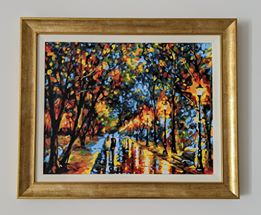
The palette is narrow. A forest is greens, or in autumn golds and russets, in many closely related tones. Telling two of them apart in the pot is genuinely difficult, and a section painted in the wrong green is not obvious until the whole area is done and reads flat. Painting trees and foliage goes further into keeping those greens apart.
Bare branches are line work. Winter woodland means fine dark lines crossing a pale background, which is the most demanding kind of edge to cut cleanly.
None of this is a reason to avoid them. It is a reason to know what you are sitting down to, and to give yourself the larger canvas size, where every section is bigger.
How to paint trees so they read as trees
Background first, always
Sky, distant hills and open water go in before anything that stands in front of them, and they must be properly dry before you start on the branches. A pale trunk or a bare twig painted onto still-soft sky drags and muddies immediately, and you cannot recover the clean edge afterward.
This is the single technique that most changes how a forest canvas turns out.
Follow the direction of the section
The shapes have already been drawn running the way the branch grows or the way the needles hang. Pull the brush along them rather than dabbing at the section, and the mass reads as foliage. Dab at it and the same shapes read as patches.
Smallest brush that will do it in two or three strokes
Not the one that will do it in one. Overreaching with a large brush on a small section is how the edges get lost, and on foliage the edges are the picture.
Sample your greens on paper
Put a dab of every close green on a scrap of white paper and label it with its number. Comparing painted samples is reliable; comparing wet pots is not. It takes two minutes and it prevents the one mistake that costs a whole afternoon.
Do the tiny sections when your eyes are fresh
Everyone saves the branch work for the end of a long evening and everyone regrets it. Start a session on the fine work and finish it on the broad areas.
The woodland designs in the catalog
Four of the 39 designs are genuinely forest scenes, and they differ considerably in how hard they are.
Away From It All
Hayden Lambson's log cabin on a rocky point above a northern lake, half hidden by birch and aspen that have turned gold, with a stream spilling over mossy granite in the foreground.
The most forgiving of the four and a reasonable first canvas. Sky, water and the mass of the rock face are large comfortable areas; the autumn foliage is where the small sections live, and the chimney stonework needs a steady hand. Around 10 to 20 hours at 16x20.
Northwoods Retreat
Abraham Hunter's bull moose standing chest-deep at the edge of a lake below a lit cabin, with white birch trunks crossing the foreground and the leaves gone gold.
Its reviewers genuinely disagree about the difficulty, and the difference is how you count the birch leaves. The moose, the water and the hills go quickly. The gold foliage is hundreds of small sections and you can take as long over it as you like.
Mystic Hour
Derk Hansen's log cabin on a river in morning mist, worked in olive, gold and gray rather than strong color, with a plank footbridge and a canoe pulled up on the grass.
Nothing on it is technically hard. There is simply a lot of it, because the water and the mist are made of many closely related tones. Budget nearer 25 hours than 15 at 16x20 and treat it as a canvas to spend time in rather than finish.
Enchanted Woods
Derk Hansen again: four black-capped chickadees working through bare brush outside a snowbound cabin, with snow-loaded spruce behind and a pale pink early-winter sky.
The hardest of the four, and its reviewers agree on both halves of that: it comes out beautifully, and there are a great many small areas. The bare foreground branches are the reason. If close work is what you enjoy, this is one of the most satisfying canvases in the range. If you would rather paint in broad sweeps, pick one of the other three.
A forest of your own
If the woodland you actually want is somewhere specific, a custom canvas made from your own photograph will do it. Two cautions particular to this subject.
Dense woodland photographs convert into an enormous number of tiny sections, so choose an image with some structure in it: a path, a clearing, water, a single strong trunk. And avoid deep shade, where a camera records very little tonal separation and the conversion has nothing to work from. Bright overcast light in a wood, or low sun coming through trunks, gives much better results than midday under a full canopy.
Common questions
Which forest design should a beginner choose?
Away From It All. It has the largest proportion of broad, forgiving areas, and the difficult parts are confined to the foliage rather than spread across the whole canvas.
How do I stop the greens looking flat?
Trust the numbers. A canopy that seems to use too many near-identical greens is doing that deliberately, and the variation only becomes visible once the whole area is complete. Judge it from six feet away, not up close.
The branches are too fine for my brush.
Wet the fine brush and draw it across your palm first to bring the bristles to a point. If a branch is still thinner than any brush you have, paint the background right up to both sides of it and let the printed line do the work, which is what it is there for.
I have run out of the main green.
Predictable on a forest canvas, since the foliage is the largest area. Each design has a matching set in the extra paint collection.
Where can I see the full range?
The catalog lists all 39 designs, and the customer gallery shows finished ones. If this would be your first kit, read the beginner guide before committing to a forest.


