


A lit cabin in the snow is the most requested subject we have, and there is a technical reason these designs are so satisfying to paint: they are all built on one small bright thing against a large dark one.
Get that relationship right and the canvas glows. Get it wrong and it goes gray. Here are the designs, and the one sequencing decision that decides which you end up with.
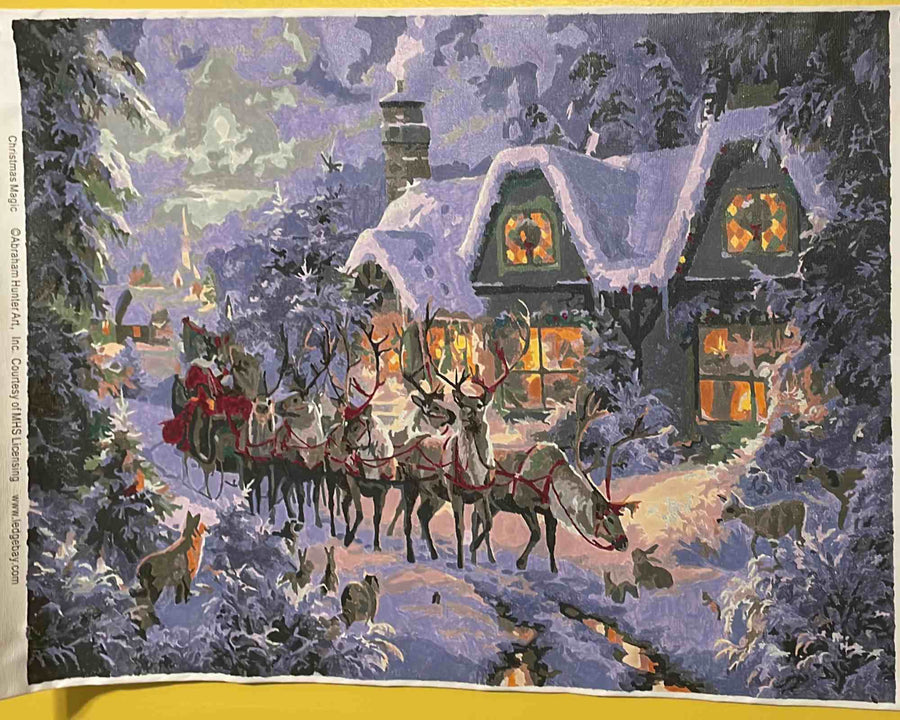
The Christmas design
Christmas Magic
Abraham Hunter's snowbound cottage with Santa's sleigh drawn up outside. Eight harnessed reindeer stand in the snow, there are wreaths in every window and a lit tree inside, garland runs along the eaves, and a village steeple shows through the trees. Rabbits, a fox, a cardinal and a pair of deer are scattered through the drifts, with warm light from the windows falling across them in long patches.
Reviewers describe it as fresh and generously supplied, and not a beginner's kit — eight reindeer means eight sets of antlers and harness, and the garland and window details are fine work. The snow and sky are broad and easy.
Allow six weeks if it is a gift. This is 10 to 20 hours of work and the last stretch is the fiddly part, which is the worst thing to be rushing in the third week of December.
Winter cabins
Aurora Bliss
Kim Norlien's log cabin under the northern lights — green and violet ribbons across a star-filled sky, snow-loaded pines, windows lit gold, and a campfire burning down on the bank of an open stream, with the fire and the lights coming back off the water in long broken reflections.
More forgiving than it looks. The aurora and the snow go in as broad sweeping bands, and the aurora in particular is easier than it appears — it is divided into wide numbered bands running the same direction, so you lay them in one after another and the blend appears on its own. The lit windows and fire reflections are the fine work.
Still Waters
Also Norlien: a log cabin at dusk on a glass-calm northern lake, lamplight warm in the windows, smoke lifting from the chimney, and a loon crossing water so still it mirrors the treeline. Banks of pink and white wildflowers crowd the foreground.
The large flower masses and broad water make it forgiving for a first canvas, while the reflections give a more practiced painter something to work at.
Cabin Fever
Norlien again — a lakeside log home at dusk with a red canoe tied at the dock, mist in the trees on the far shore, and the whole scene repeating upside down in the lake. There is more architectural detail here than in a pure landscape, so it rewards a steady hand, but the large sky and water mean you are never facing a wall of tiny sections.
Northwoods Retreat
Abraham Hunter's bull moose feeding in the shallows below a lit cabin, with birches gone gold and the cabin lights breaking up in the water as long red-gold streaks. Its reviewers split between calling it beginner-friendly and calling it a challenge, and the difference is entirely how carefully you count the birch leaves.
The one thing that makes these work
Paint the dark first, let it dry completely, then put the lights in on top.
Every design here has a handful of small bright elements — lit windows, a fire, lamplight on water, an aurora. A gold window laid onto dry navy stays gold and crisp. The same gold laid into navy that is still even slightly tacky turns muddy gray-green on contact, and second coats never fully recover it.
Two supporting points follow from that:
Do not lighten the dark. A night sky or a dusk lake in the pot looks alarmingly dark against bare canvas, and the instinct is to thin it. Resist. The windows only glow because the surround is genuinely dark, and a timid sky cannot be fixed afterward without repainting it.
Snow is not white. Look at any of these and the snow is painted in blues, violets and grays, with true white used only where light hits directly. That is why the animals read so clearly against it. Trust the numbered tones even when a pot looks too blue to be snow.
Reflections
Four of the five designs above put lights on water, so it is worth knowing the two rules.
Reflections run vertically, straight down from whatever is being reflected, and they break up rather than mirroring cleanly. And they are always less bright than the source — a reflection painted as bright as the fire looks like a second fire underwater. Paint the water surface first, let it dry, then pull the reflection down over it in vertical strokes.
Painting as a family activity
Worth being straight about, since these get bought for exactly that. Our kits are made for adults — the sections are small and the numbers are fine, and Christmas Magic is one of the more detailed designs we sell. A young child will not manage one, and handing it over will not go well.
What does work is two canvases at one table, an adult on a detailed design and a child on something simpler. Same evening, same table, different kits.
Common questions
When should I start a Christmas canvas?
Six weeks ahead if it is a gift, working an evening or two a week. Earlier if it is Christmas Magic.
Which of these suits a beginner?
Still Waters or Aurora Bliss. Both have large calm areas and the detail is contained in a few small places.
Should I thin the paint?
Only if a pot has genuinely thickened, and then a single drop of water stirred into the pot. Thinning paint that is already flowing is what causes the printed numbers to show through, and on a dark design that shows badly.
What if I want to hang it this Christmas?
Take a framed size. It arrives pre-stretched on a wooden frame and is ready to hang the moment the paint is dry, with no framing step in between.
What if a color runs out?
Common on winter designs, since one or two blues do most of the work. Every design has a matching replacement paint set.
The full range is in the shop, and there is more on painting snow and night skies if that is the part you are unsure about.


