


A subject is easy to paint when small errors do not show. That is the whole principle, and it is why a field of lavender is easy and a face is not: nobody can tell that one lavender stem is in the wrong place, and everybody can tell when an eye is.
Here are eight subjects that hide mistakes well, with the reason each one works and the thing that trips people up.
First, two things about acrylic itself
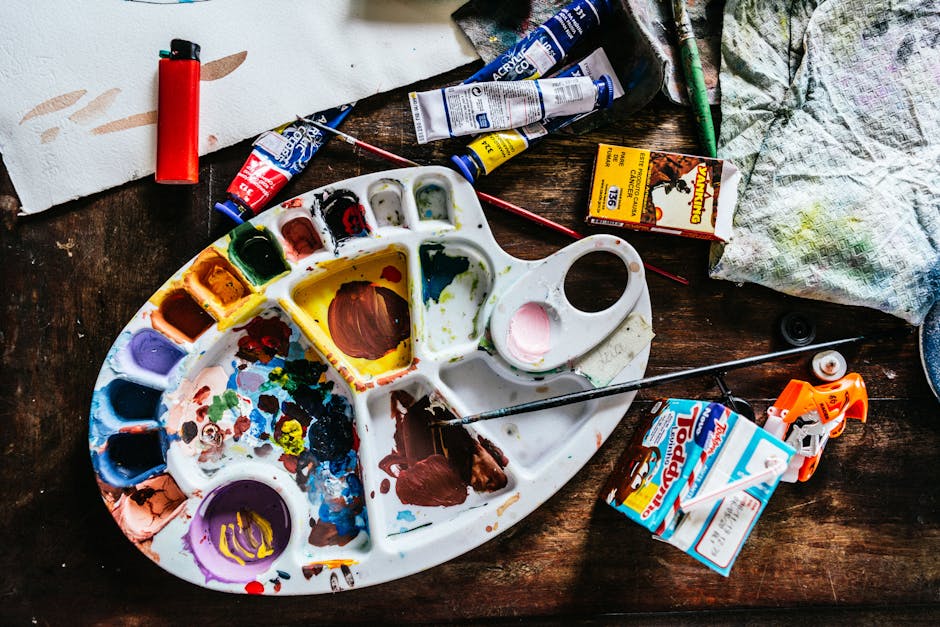
It dries fast. Minutes, not hours. That is a gift when you want to put one color over another, and a nuisance when you want to blend two colors into each other, because the window is short. Almost every complaint beginners have about acrylic traces back to this.
It dries slightly darker. Judge a mix against a dry test patch on scrap, not against the wet stroke. Matching a color you mixed yesterday against a wet puddle today is how paintings end up patchy.
A damp paper towel under a sheet of baking parchment makes a serviceable palette that keeps paint workable far longer than a dry plate. It costs nothing and it changes the experience.
1. A sky
The most forgiving subject there is, and a whole painting on its own if you want it to be. Nobody knows what your sky is supposed to look like, so nothing can be wrong.
What trips people up: trying to blend the whole sky at once and finding the first section has already dried. Work in bands instead. Lay each color as a stripe, then go back and soften only where two stripes meet, while both are still wet. Our note on wet on wet acrylic covers how to hold that window open.
2. Flowers
Petals are irregular by nature, so an irregular brushstroke reads as a petal rather than as a mistake. A lavender field painted entirely with the tip of a cotton swab, dotted along a few green stems, looks better than it has any right to.
Start with flowers built as petals around a circle: daisies, black-eyed Susans, zinnias, sunflowers. They are all the same problem.
What trips people up: starting with roses. A rose is a spiral of overlapping tonal shifts and it is genuinely difficult. Come back to it.
3. Fruit
An apple is a sphere, and a sphere is three tones: a light side, a mid tone and a shadow side, plus a small highlight. Get those three in the right places and roundness appears on its own.
What trips people up: forgetting the shadow the fruit casts on the table. Without it the apple floats. The cast shadow is doing more work than the highlight.
4. A still life of two or three objects
Duller to describe than it is to do, and the single most useful thing a beginner can paint, because everything is holding still and you can look for as long as you like.
What trips people up: lighting it from everywhere. Put one lamp to one side, turn the rest off, and the shapes announce themselves.
5. Silhouettes
Paint a sky, let it dry properly, then put a dark shape over it: a treeline, a rooftop, a headland, birds. High contrast carries the picture and no detail is required inside the dark shape.
What trips people up: impatience. Acrylic is touch-dry in minutes but give it a good hour before you drag black across pale, or the dark will pick up the light color underneath and go muddy.
6. Mountains
Hard-edged, angular, and depth is a formula rather than a judgment. Distant ranges are lighter, cooler and lower in contrast than near ones. Paint the furthest ridge palest and bluest, and each nearer ridge darker and warmer.
What trips people up: making the far mountains as dark as the near ones. The whole illusion collapses.
7. Water and reflections
Horizontal strokes, broken here and there. Reflections are the same shapes as the things above them, stretched downward and slightly disturbed.
What trips people up: painting the reflection as an exact copy. There is a rule worth knowing: a light object reflects darker than it is, and a dark object reflects lighter than it is. Water pulls everything toward the middle.
8. Abstract color blocks
Flat shapes in three or four colors, edged with painter's tape. It looks deliberate on a wall and it asks nothing of your drawing.
What trips people up: paint bleeding under the tape. Press the tape edge down hard, paint over the edge with the background color first and let it dry, then paint your new color. The background seals the gap.
What to do next
If you want the shortest route to a finished painting rather than a set of exercises, a numbered canvas removes the drawing and the color mixing and leaves you the part most people actually enjoy. Our designs are in the full collection.
If you would rather build the skills, two things will improve everything above: understanding how colors relate, covered in our guide to the basic color wheel, and getting comfortable with layering acrylic paint, which is what acrylic is best at. The surface makes a difference too, and types of canvas for painting explains why.


