


Garden scenes are one of the most requested subjects we get asked about, and they are also where the gap between how a design looks and how it paints is widest. Dense planting means a great many small sections, and a canvas that reads as soft and restful from across a room can be a month of close work up close.
Here are the six in our range, honestly described, easiest first.
Cosmos From the Garden
Pink cosmos in a green glass jar, standing by a window. Cut flowers rather than a garden bed, and the gentlest of the six.
The blooms are large and well spaced, so each flower head is a handful of generous sections rather than a spray of slivers, and the background is quiet and covers fast. The glass jar is the one part that will teach you something — glass is a stack of light and dark shapes with hard edges, and the instinct to soften those edges is exactly the wrong one. Cosmos From the Garden is a good first flower canvas.
Nature's Blessings
Geese at a lakeside dock with hanging flower baskets. This is a landscape with flowers in it rather than a flower painting, which is precisely what makes it manageable.
The water, the dock and the sky are broad forgiving areas that go down quickly, and the flower baskets give you concentrated color without asking you to paint a whole bed of it. If you like the idea of a garden scene but not the idea of four hundred petals, Nature's Blessings is the sensible route in.
Colorful House Near the Lake
A flower-filled porch above a spring lake. A step up in density, and a lovely picture.
The house and the water do most of the work, and the planting on the porch is the reward at the end. Worth knowing before you start: the flowers here are massed rather than individually drawn, so they are many small sections of closely related pinks and reds. Keep the pots closed and work one color right across the canvas before opening the next, or you will spend the evening hunting. Colorful House Near the Lake is a fair middle choice.
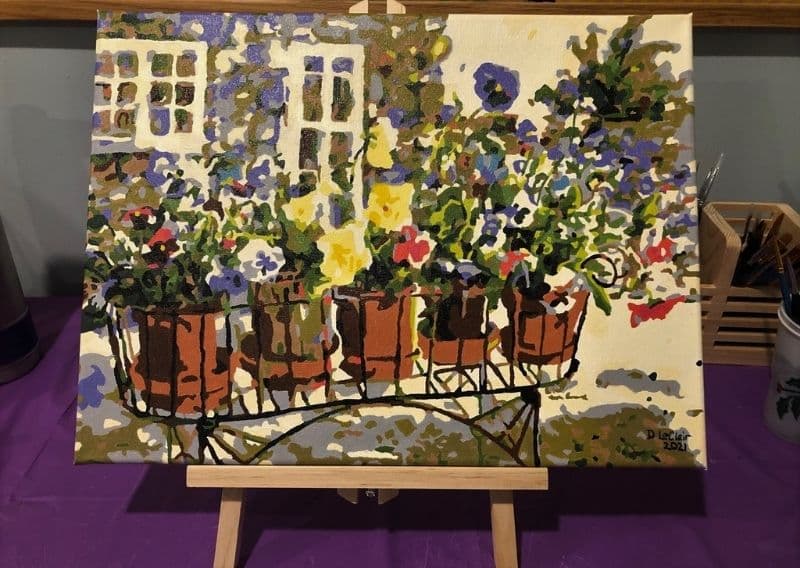
Ritas Pansies
Potted pansies on an iron stand against a stone wall. Beautiful, and more work than it looks.
Pansies have small faces with dark markings at the center, and there are a great many of them. Getting those dark centers clean is what makes the finished piece. Behind them the stone wall is not a flat backdrop — it is broken into a lot of small tonal shapes, which is realistic and is also a long evening.
The reward is that Ritas Pansies uses more of the color wheel than anything else we make. If you enjoy the process rather than the finish line, that variety is the pleasure of it.
Sweet Petunias
Terracotta pots of pink petunias against a stone wall, and the most demanding of the six. This is the one our reviewers most often describe as harder than expected, and they are right.
Petunias are trumpet-shaped and they overlap, so wherever one bloom passes in front of another you get a thin crescent section needing a fine brush and patience. There are a lot of them. It looks superb finished, which is why people keep choosing it — just go in expecting thirty-odd hours rather than fifteen, and take the 16 by 20 rather than the 12 by 16. Shrinking a busy design makes every section smaller and the job harder. Sweet Petunias is worth it if you have the time.
Countryside House
A red-roofed house with a stone path, flower beds and a mountain stream. We are going to be straight about this one because it is the design we most often see mismatched to a buyer.
It is a low-light palette. The greens are deep, the shadows carry a lot of very dark color, and the flower beds are small bright notes in a picture that is otherwise dim. Painted carefully it has real atmosphere. Painted expecting a bright summer garden, it comes as a surprise, and that is exactly what has happened to some of the people who bought it.
If dark, moody landscapes appeal to you, Countryside House is a good painting and the stream is genuinely satisfying to do. If you want cheerful, choose one of the others above.
The farmstead option
Not a garden exactly, but people looking for this kind of scene often land on it: The Road Home is a white farmhouse and red barn at the end of a summer day. It is one of our best sellers and one of the most forgiving canvases we make — big simple shapes, warm light, and nothing fiddly. If the appeal of a garden painting is the mood rather than the flowers, it is the easier way to get there.
If you want the still-life end of the same subject — flowers in vessels rather than in the ground — October is autumn flowers in ceramic pitchers, and Apple Harvest is baskets of apples on a garden table. Both are covered in our guides to floral designs and fruit and still life.
How to get through dense planting without losing patience
One color at a time, right across the canvas. On a garden design this matters more than anywhere else. The same green recurs in sixty places, and finding them one at a time is how these kits get abandoned halfway.
Darks first. The shadow gaps between leaves, the dark flower centers, the recesses in the planting. Pale petal colors will cover a dark that has strayed slightly over its line; the reverse almost never works.
Two coats on the pale pinks, creams and yellows. They are thin by nature and will not hide the printed number in one pass. Let the first dry properly rather than working a second into a wet one.
Do the background before the flowers. Foliage and wall behind, blooms in front. Your hand then rests on finished areas rather than on the sections you care most about.
Break it into sessions and stop before you get tired. Dense work punishes a tired hand, and one careless half hour undoes a careful week.
Only one pot open at a time. Greens and pale pinks are the colors you use in small amounts over many sessions, which is exactly how they dry out. A drop of water stirred into a stiffening pot usually recovers it, and there is a matched extra paint set for every design if one runs short.
Your own garden
Plenty of people want a particular garden rather than a generic one — a border they planted, a grandmother's roses, the view from a kitchen window. A custom kit made from your own photograph will do that.
Photograph it in soft light rather than midday sun, and get closer than feels natural. A wide shot of a whole garden becomes an unreadable green mass on a numbered canvas, because the individual plants are too small to survive the simplification. One good border, one bench, one climbing rose against a wall — those work.
Everything we make is in the flowers collection and the full range.


