


Flowers are the most requested subject in paint by numbers and the one where the gap between how a design looks and how it paints is widest. A canvas of massed blooms looks soft and inviting on a product photo, and turns out to be four hundred small sections that all need a steady hand. Roses are the exception worth calling out, because the petal shadows carry the whole flower.
If none of the designs is quite the one you have in mind, what it costs to design your own sets out the realistic options and prices.
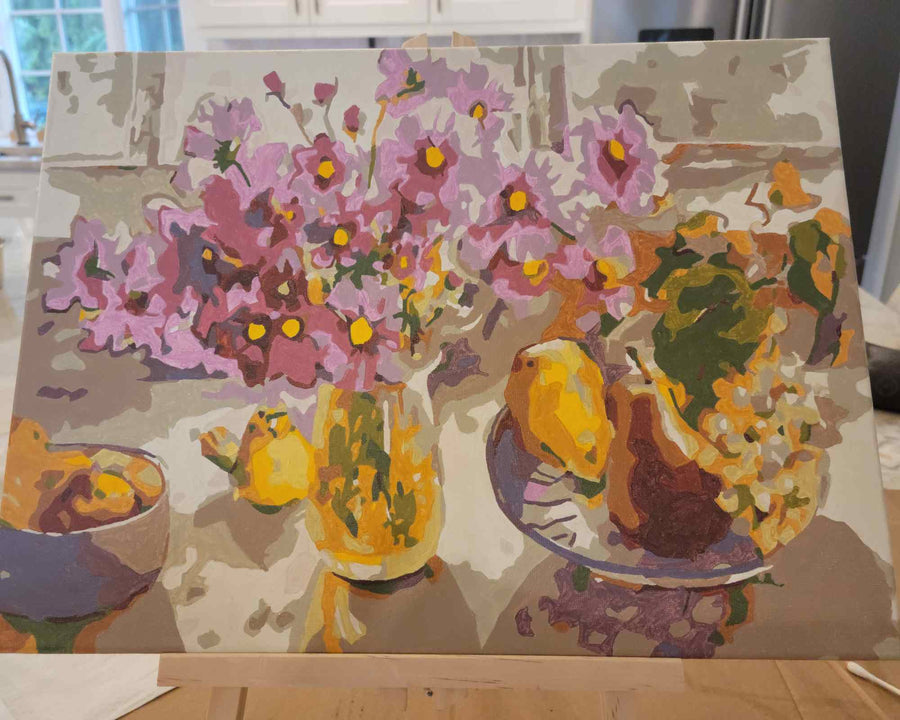
We have four true florals. Here they are, easiest first, with what is actually hard about each one.
1. Cosmos From the Garden — the one to start with
Pink cosmos in a green glass jar, standing by a window. It is the most forgiving flower design we make, for two structural reasons.
The blooms are large, simple and well spaced, so each flower head is made of a handful of generous sections rather than a spray of slivers. And the background is a soft, quiet field that covers quickly and gives your hand somewhere to rest. Most of the canvas goes down fast, which means the fiddly part is short.
The one thing that will teach you something is the glass jar. Glass is not a color, it is a stack of light and dark shapes with hard edges, and the instinct to soften those edges is exactly wrong. Paint them as printed and it works. Cosmos From the Garden is a genuinely good first canvas.
2. October — a still life more than a bouquet
Autumn flowers gathered into ceramic pitchers. It sits a step up from Cosmos because there is more going on, but it is not a difficult painting.
What makes it work is that the pottery gives the eye somewhere solid to land. The pitchers are broad curved forms with clear light and shade, so the canvas is not wall-to-wall petals. If you have painted one design and want a second that will teach you something without punishing you, October is the one. The autumn palette also means the colors are warm and closely related, which is easier to keep track of than a canvas of a dozen unrelated hues.
3. Ritas Pansies — beautiful, and more work than it looks
Potted pansies on an iron stand against a stone wall. This is where the honest warning starts.
Pansies have small faces with dark markings at the center, and there are a lot of them. Each flower head is several small sections, and getting the dark centers clean is what makes or breaks the finished piece. Behind them, the stone wall is not a flat backdrop — it is broken into a great many small tonal shapes, which is realistic and also a long evening's work.
The reward is that Ritas Pansies uses more of the color wheel than anything else in the range. If you like the process rather than the finish line, that variety is the pleasure of it. If you want something done in a fortnight, this is not it.
4. Sweet Petunias — the most demanding of the four
Terracotta pots of pink petunias against a stone wall. This is the one our reviewers most often describe as harder than expected, and they are right.
Petunias are trumpet-shaped and they overlap, so where one bloom passes in front of another you get thin crescent sections that require a fine brush and patience. There are a great many of them. The terracotta is straightforward, the stone is textured, and the flowers are a long haul.
It also looks superb finished, which is why people keep choosing it. Just go in knowing that Sweet Petunias is thirty-odd hours rather than fifteen, and pick the 16 by 20 rather than the 12 by 16 — shrinking a busy design makes every section smaller and the job harder, not easier.
Room matters too. choosing a design for the kitchen covers heat, grease and steam, which rule out more paintings than taste does.
The one with a flower in its name that is not a floral
Morning Glory is two white egrets beside a flowering beach path at sunrise. It is a bird painting with flowers in it, and it draws a steady stream of people looking for a morning glory vine.
We are not going to pretend otherwise, because someone buying it expecting a climbing flower is going to be disappointed. If the birds appeal to you it is a lovely canvas and one of our better-rated designs. If you came for flowers, Morning Glory is not it.
Flowers inside a scene
If you want flowers without a canvas made entirely of petals, Colorful House Near the Lake is a flower-filled porch above a spring lake. The blooms are there in quantity but they are one element in a landscape rather than the whole subject, which makes it a much gentler job than a straight floral. Colorful House Near the Lake is a reasonable compromise. What to expect from a flower design covers the rest of the range, including the ones we would steer a beginner away from.
Four things that make any floral easier
Work one color across the whole canvas before moving on. On a floral this matters more than anywhere else, because the same pink recurs in forty places and hunting for them one at a time is how kits get abandoned.
Do the darks before the lights. The dark centers, stems and shadow gaps first. Pale petal colors will cover a dark that has strayed over its line; a pale color underneath will not survive a dark laid on top.
Expect two coats on the pale pinks, creams and yellows. They are thin by nature and will not hide the printed number in one pass. Let the first coat dry properly rather than working a second into a wet one.
Keep the pots closed. Only the pot you are using should be open. Petal colors are the ones you use in tiny amounts over many sessions, which is exactly how they dry out. If one does stiffen, a drop of water stirred in usually brings it back, and there is a matched extra paint set for every design if a color runs short.
Where two petals meet and the printed line looks harsh, a light touch with a barely damp brush while both are wet will soften it. Our guide to blending on a numbered canvas covers how far to take that before it goes muddy.
If you want a specific flower
We do not have roses, sunflowers, lilies, peonies or orchids, and there is no point implying otherwise. If you have a particular flower in mind — a garden you planted, a bouquet from a wedding, the peonies your mother grew — a custom kit from your own photograph is the honest route to it. Photograph the flowers in soft daylight rather than full sun, and get close enough that the blooms fill the frame, because a distant flower bed becomes an unreadable green mass on a numbered canvas. The same rule decides whether a butterfly design works, since the wings carry all of the detail.
our garden and flower kits sets out which designs are genuinely garden scenes and which only look like it in a thumbnail.
Everything we do make is in the flowers collection and the full range.


