


We do not make a sunflower kit. There are 39 designs in our catalog and none of them is a sunflower, so if that is what brought you here, the honest answer comes first rather than buried under a list of things we do sell.
What follows is worth reading anyway, because sunflowers are one of the harder subjects a numbered canvas can hand you, and because there is one route to a sunflower painting from us that is real.
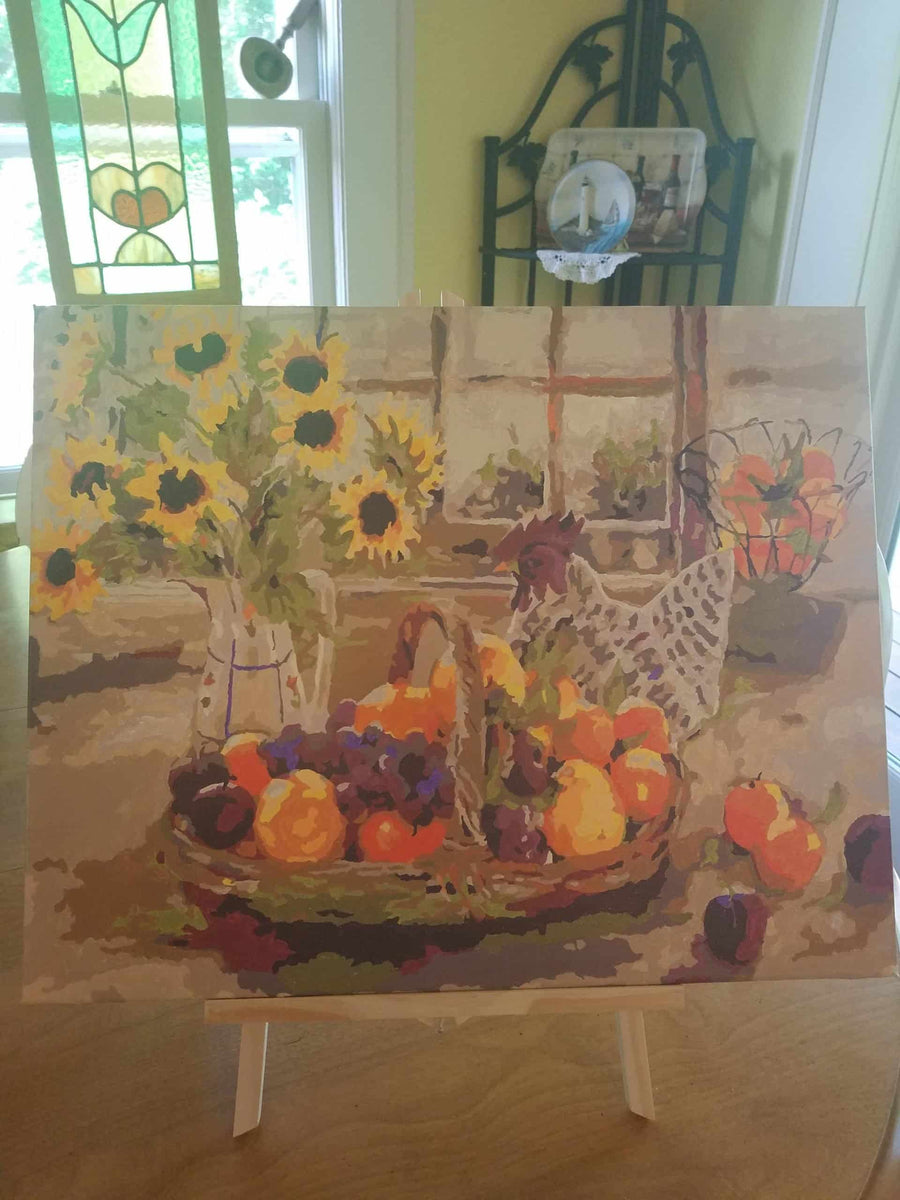
Why sunflowers are harder than they look
The problem is yellow. Yellow pigments are the least opaque family on the palette. A single coat of a light yellow over a printed guide number will usually leave the number faintly visible underneath, so sunflower-heavy sections need two thin coats where a dark green section needs one. Let the first coat dry properly before the second, or the brush lifts what is already there.
The second problem is that a sunflower painting has a narrow range of values. The petals, the center and the background often sit close together in lightness, and paintings that lack that spread read flat no matter how accurate the colors are. In a numbered canvas the artist has already solved this for you, which is exactly why the browns, the shadow greens and the darkest center tones matter more than the bright yellows. Paint them properly and the yellows look luminous. Rush them and nothing you do to the petals will save it.
If you want to understand why the yellows sit so oddly next to the violets in the shadows, the color wheel explains it in one diagram: they are opposites, and opposites next to each other are what makes a sunflower painting vibrate.
What Van Gogh actually painted
Since almost every article on this subject reaches for him, it is worth getting right.
Van Gogh painted sunflowers in two distinct groups. In Paris in 1887 he painted cut sunflower heads lying on a surface, not arranged in a vase. Then in Arles in 1888 he painted the pictures most people picture when they hear the word: sunflowers in an earthenware vase, made to decorate the room he was preparing for Paul Gauguin. He painted four of those in a single week in August 1888 and made repetitions of them in January 1889. Sources differ on the exact total across both cities, which is a reasonable clue that anyone quoting a precise figure with confidence has not checked it.
What he was doing technically is the useful part. He painted yellow on yellow, using a warm yellow ground behind warm yellow flowers, and relied on drawing and brushwork rather than color contrast to separate the shapes. That is the opposite of how a numbered canvas works, and it is why his versions look nothing like the sunflower prints they inspired.
We do not sell reproductions of anyone's paintings. Every design in our catalog is original artwork we license from the artist.
The florals we do have
Sweet Petunias is petunias in terracotta pots, pink and white against warm earth. It is the closest thing we make to the mood people are usually after when they search for sunflowers: warm, summery, a single clear subject.
Ritas Pansies puts pansies in pots on a wrought-iron cart beside a window. More color variety than the petunias and more small sections to work through.
Cosmos From the Garden is pink cosmos in a glass jar with pears beside them, painted in pale, chalky tones. Quiet rather than bright, and the gentlest of the three to paint.
October is autumn flowers massed in pitchers and vases. It has the most color in it of any of the florals and the most work.
Fair warning on all of them: florals mean a lot of small adjacent sections, which is slower going than a landscape of the same size. Budget more evenings than you would for a cabin scene.
The one way to get a sunflower canvas from us
Send us the photograph. A custom canvas made from your own photo is the same numbered canvas, printed from a picture you took. A sunflower field on a road trip, a jar of them on a kitchen table, the ones somebody grew in their yard. That is a sunflower painting that means something, which a stock print of a flower nobody in the family grew never quite manages.
Photos with strong daylight and a clear subject convert best. Backlit sunflowers with the sun behind them look wonderful to the eye and turn into a dark shape with a bright rim on canvas.
Painting yellows well
- Two thin coats, not one thick one. Thick yellow dries with visible ridges and still shows the number through the middle.
- Do the darks first in each flower head. The dark center gives you something to judge the petal tones against.
- Keep a separate brush for yellow. Yellow picks up traces of everything and goes muddy faster than any other color on the tray.
- Let sections dry before you paint the one beside them. Wet yellow bleeding into wet green is the usual cause of a dirty edge. There is more on this in our guide to layering acrylic paint.
If none of the florals suit and the custom route is not what you want either, the whole catalog is in one collection and it is easier to browse by what the artwork actually shows than by what the title says.


