


A giraffe is an unusual painting subject because the pattern is the subject. Take the markings away and you have a tall brown animal. Everything that makes a giraffe painting good happens in how those patches are handled, and on a numbered canvas that is a specific, learnable problem.
To say it plainly at the start: we do not make a giraffe design. Our catalog is licensed original artwork and runs to cabins, coastlines, birds and florals. So this is a guide to buying and painting one from anywhere, plus the one route through us that genuinely applies.
Why the Patches Are the Whole Job
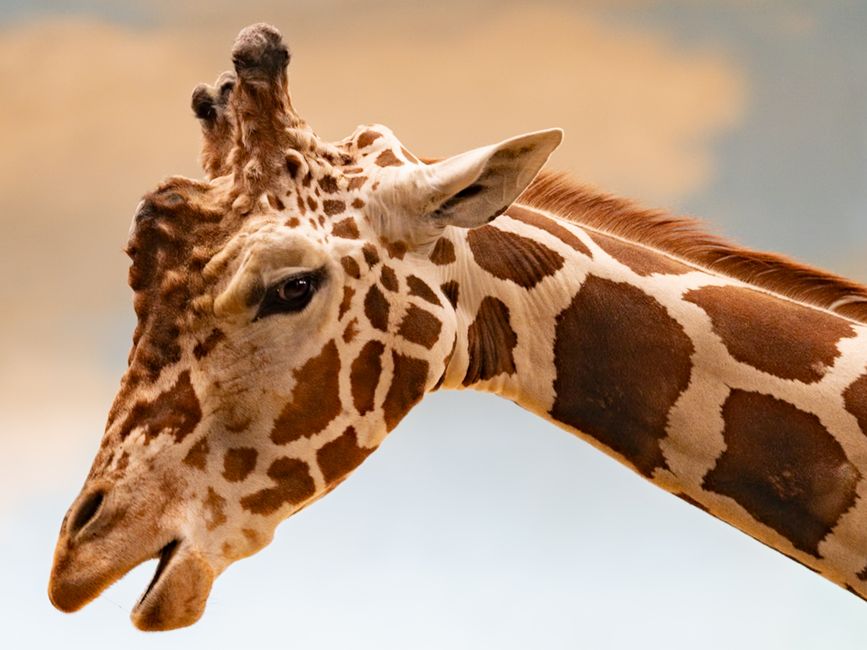
A giraffe's markings are not a flat pattern printed on a flat animal. They wrap around a barrel-shaped body, which means three things are happening at once in every patch:
They get narrower toward the edges. A patch on the side of the neck facing you is wide and roughly regular. The same patch near the silhouette edge is squeezed thin. This is what tells the eye the neck is a cylinder, and it is why a giraffe painted with evenly spaced patches looks like a giraffe-patterned cutout.
They darken in shadow. The patches on the shaded side of the body are not the same brown as the ones in the light. On a good numbered canvas this is why you have four or five browns rather than one, and putting them in the right places is what makes the animal solid.
The gaps between them do as much work as the patches. The cream network between the markings carries the light. It is lighter on top of the back and along the top of the neck, and it goes grayish underneath. If you paint every gap the same cream, the giraffe goes flat no matter how carefully you do the patches.
A well-drawn kit will already have these variations printed as separate numbers. Your job is to trust them rather than assume two similar browns are a printing quirk.
What to Check Before Buying a Giraffe Kit
- How many browns are in the palette. One brown means a flat animal. Four or five means someone drew it properly.
- The size, relative to the patches. Giraffe designs are naturally tall and thin, which means a lot of vertical canvas is neck. On a small canvas the patches down the neck become very small sections. Bigger is easier here.
- What is behind it. An acacia and open sky gives you large restful areas. A busy savanna with grass, trees and a herd gives you no rest at all.
- Rolled or folded. Folded canvas arrives with hard creases through the image that never come fully out. Rolled in a tube arrives flat.
- Whether a full-size reference is included. On a subject with five near-identical browns, a printed reference beside you is the difference between a comfortable evening and a squinting one.
The Order to Paint One
- Sky and background first, all of it, right up to the outline. Painting the sky around a finished giraffe leaves a pale halo you will spend an hour chasing.
- The cream network next, as one coat across the whole animal. It will look like a plain pale giraffe and that is correct at this stage.
- The patches, darkest first. The shaded side, under the belly, behind the far legs. Then the mid browns, then the lit patches along the back and the top of the neck. Light acrylic covers dark acrylic more easily than the reverse, so this order saves second coats.
- Legs and face last, with the finest brush, when everything around them is dry.
Three Things That Lift a Giraffe Canvas
Keep the patch edges slightly soft. On a real giraffe the markings have a faintly ragged boundary rather than a clean cut. You do not need to change the shapes to get this: paint the patch, let it dry, then break the edge in one or two places with a nearly dry brush. Two minutes for a noticeably better animal.
Do not paint the mane as a shape. The short upright mane along the neck is a row of fine strokes pulled in one movement from the neck outward. Filling it in as a block reads as a stripe.
The eye is the last thing you touch. Giraffes have very dark eyes with long lashes, and one clean dark mark with a single tiny light dot in it does more for the painting than an hour anywhere else. Get the paint the right consistency first and commit to it in one go.
Common Fixes
Wrong brown in a patch. Let it dry completely, then paint the correct one over the top. Two coats if the wrong one was darker. Five minutes, not a ruined canvas.
Pale gaps showing between patch and background. Let the first dry, then bring the neighboring color slightly over the boundary. A hairline of bare canvas shows far more than a fractionally shifted edge.
Running low on the main brown. Predictable, because it covers the largest area. Ration it from the start rather than finding out at the hindquarters. If the pot has only thickened rather than emptied, a single drop of water stirred through usually brings it back.
Your Own Photograph
If the giraffe you want is one you actually saw, from a safari or a zoo, that is a better painting than any stock design and it is the version we can help with. We turn photographs into numbered kits, printed in the USA, in 12x16, 16x20 and 18x24 inches.
For a giraffe photo specifically: shoot in even light rather than harsh midday sun, which blows out the cream network and leaves nothing to paint. Get separation between the animal and what is behind it. And crop in, because a giraffe small in a wide frame becomes a lot of grass. You can start one on the custom paint by numbers page, and our guide to choosing a photo goes further.
What We Do Make
Our designs are landscapes, birds and wildlife, licensed from the artists rather than lifted from stock. Every kit ships rolled in a tube, with vacuum-sealed paints, brushes in a range of sizes and an 11 by 17 inch reference print. The catalog is here, the beginner's guide covers the working order, and the customer gallery shows what people have finished.


