


Let us deal with the obvious thing first. We do not make a sailboat kit. There is no yacht, no schooner and no regatta scene anywhere in our catalog, and if that is specifically what you came for, we would rather tell you now than sell you something else.
What we do have is water, and boats on it. And there is something genuinely worth knowing about painting boats on a numbered canvas, because rigging is one of the few things that a numbered design handles badly and it is worth understanding why before you buy one from anybody.
Why rigging is hard on a numbered canvas
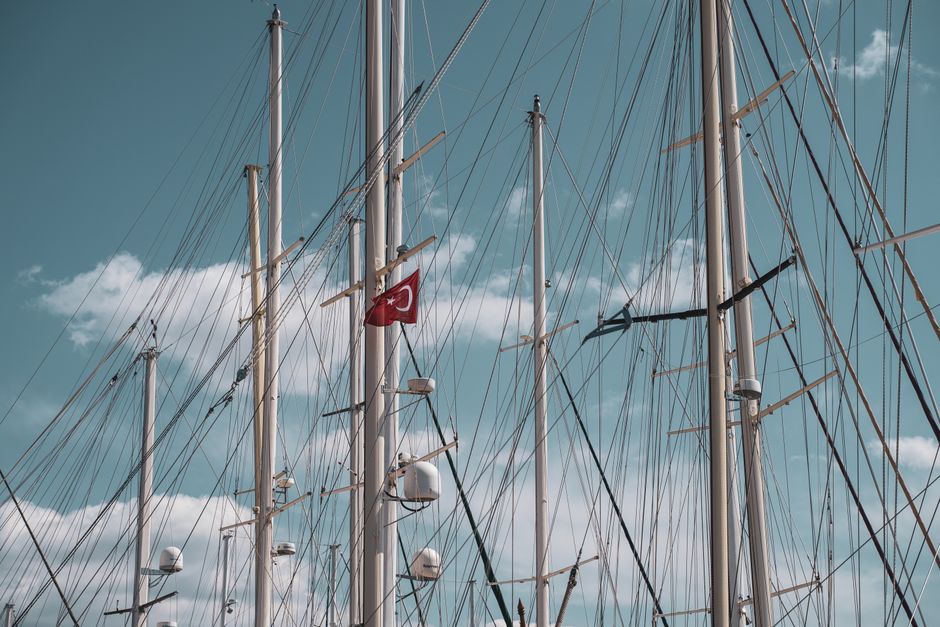
A numbered canvas works by dividing an image into flat regions of a single color. That works when the shapes are areas. It breaks down when the shape is a line.
A mast, a stay, a halyard, a mooring rope — these are all essentially lines, sometimes only a pixel or two wide in the original artwork. A design that includes them has to render each as a very long, very thin numbered section, which is difficult to paint cleanly, or thicken it until it is paintable, which makes the boat look like it is rigged with rope the diameter of a broom handle.
This is why so many sailboat kits look slightly wrong finished. It is not poor manufacturing. It is a genuine limit of the format.
If you are looking at a sailboat design from anyone, zoom into the rigging on the product photo. If the lines are printed at a sensible width relative to the hull, someone has thought about it. If they are thick enough to be comfortable to paint, look at whether the boat still reads as a boat.
What we do have on the water
Moonlight Bay — a Kim Norlien design, a green canoe pulled up on the shore of a moonlit lake with a campfire burning. Two light sources doing different jobs, which is what stops a night scene going flat.
Summer's Song — a canoe and a campfire on a lake at dusk, and one of the more forgiving designs we make. A reasonable first canvas.
Rocky Mountain Campsite — a tent and canoe on a mountain lake at sunset. The mountains and the water carry the picture and the boat is a manageable amount of detail.
Cabin Fever — a lakeside log home at dusk with a red canoe at the dock. The canoe is a small note of strong color against a lot of blue and green, which is exactly what makes it work.
If it is the coast rather than the boat you are after, Guiding Light and Golden Hour are both clifftop lighthouses above the water, and Seaside Escape and Be Still are quieter beach scenes. All of them are in the full collection.
Painting a hull so it sits in the water
The single most common failure with any boat painting is that the boat looks like it is resting on the water rather than in it. Three things fix that, and all three are already in a well-designed kit if you paint them properly.
The waterline is a hard edge and everything else is soft. Where the hull meets the water there is a crisp boundary, and it usually needs to be crisper than a beginner makes it. Paint it as printed and do not blend it.
The water is the harder half, and how to paint waves and water is about painting what you can see rather than what you know is there.
The reflection is a soft edge and it belongs to the water, not the boat. Directly beneath the hull there is normally a darker shape. It is the boat's reflection, it should sit slightly darker and less saturated than the boat itself, and its edges should be softened rather than left hard. That contrast — hard above, soft below — is what glues the two together.
The hull is a curved surface. A canoe is a long cylinder, so it has a light side, a shadow side, and a strip of reflected light bouncing up off the water along the bottom of the shaded side. That bounced light is the section people are most tempted to skip because it looks wrong on its own, and it is the one that makes the hull look round.
Painting water
Water is the most forgiving subject in this whole category, which is why so many kits use it and why lake designs are good beginner choices. A few things make it look right rather than merely filled in.
Horizontal strokes. Let the brush run across the canvas rather than up and down. Water is a flat plane seen at an angle, and the direction of a stroke reads as the direction of a surface.
Soften the bands where they meet. Water is normally painted as broad horizontal bands of slightly different color running toward the horizon. Blending those seams while both are wet is the single change that turns a flat blue rectangle into a body of water. Our guide to blending on a numbered canvas covers how far to take it.
Leave the sparkle alone. The small bright flecks on the surface are the last thing to go on, over dry paint, with a fine brush and very little paint. Do not blend them into anything.
Water is darker close to you. On a still lake the near water is usually deeper in tone than the distance. If a kit prints it that way, resist the urge to even it out.
Masts and thin lines, if your design has them
If you do end up with a design that includes rigging, the technique is the same as for any long thin section: use the side of the brush rather than the point, pull the stroke toward yourself, turn the canvas so the line runs the comfortable way for your hand, and rest your little finger on the canvas or a card. A liner brush — long, thin bristles — holds enough paint for a whole line in one stroke, and it is the one brush worth buying separately for this kind of work.
Paint the sail or the sky first, let it dry completely, then lay the line over the top. Trying to fill a thin gap between two large areas is much harder than painting the line over a dry background.
Our note on getting clean lines goes through the mechanics in more detail.
If you want a specific boat
Sailing people usually want a particular boat rather than a generic one — the one they own, one they crewed on, one their father had. A custom kit made from your own photograph will do that, with the rigging caveat above still applying.
Photograph the boat from the side or three-quarters rather than head on, in the softer light of morning or late afternoon rather than at midday, and get close enough that the hull fills a good part of the frame. A boat photographed from a distance against bright water becomes a silhouette, and there is nothing in a silhouette for a numbered design to work with.


