


Yellow is the awkward color. It has the least covering power of any pigment on the palette, it turns green the moment a trace of blue reaches it, and it goes chalky the instant you add white. A convincing yellow flower is a technical achievement as much as a pretty subject, which is part of why the best-known ones are so well known.
Here are the paintings worth knowing, and then what makes yellow difficult to handle if you want to paint some yourself.
Van Gogh's sunflowers
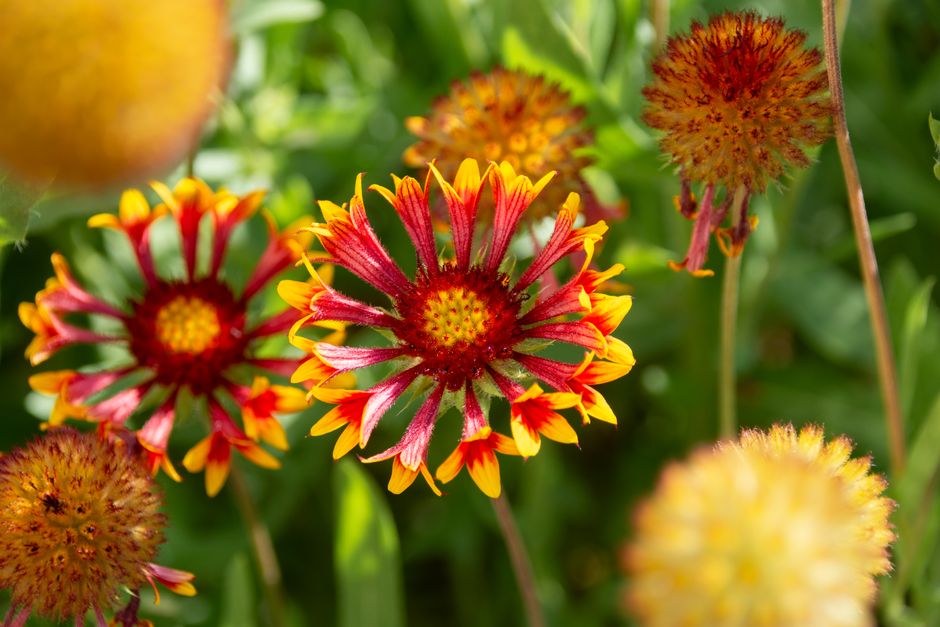
The obvious answer, and the right one.
Van Gogh painted seven canvases of sunflowers in a vase: four in August 1888 in Arles, and three more the following January which he described as identical copies of the earlier ones. He made them to decorate the room Paul Gauguin would be staying in at the Yellow House. One of the 1888 canvases, Fifteen Sunflowers in a Vase, hangs in the National Gallery in London.
What makes them remarkable is the problem he set himself. The flowers are yellow, the vase is yellow, the table is yellow and the wall behind is yellow. He is separating four planes using nothing but the temperature and value of a single hue, with almost no help from contrast of color. Most painters would reach for a dark background to make the flowers sing. He refused to, and it works anyway. Several African painters make that refusal a principle rather than an exception.
They are also not idealized flowers. Several of the heads are past their best, gone to seed, with petals curling. He painted them the way they actually were on the table. Daisy designs take the same approach, which is why they read as observed rather than decorative.
The irises at Saint-Rémy
Less famous and, for anyone interested in color, arguably more instructive. In the asylum at Saint-Rémy, Van Gogh painted a vase of irises set against a flat yellow ground.
Violet and yellow sit opposite each other on the color wheel, so each makes the other look more intense. It is the same effect he used everywhere and here it is almost diagrammatic. If you have ever wondered why a yellow flower looks brighter in a purple vase, this is the painting that explains it.
Klimt's Farm Garden with Sunflowers
Painted in 1907 during a summer by the Attersee, and now in the Belvedere in Vienna.
It is worth correcting a description of this painting that circulates widely, including in the earlier version of this article. It is not a field of yellow flowers with a few green leaves. It is a densely packed cottage garden, crowded with pinks, whites, reds and blues, with the sunflowers standing up out of it. Klimt cropped away the sky and the horizon entirely, so the flowers reach every edge of the canvas and there is nothing to give you a sense of scale or distance. That flatness is the point, and it is why the picture looks modern.
One more correction while we are here. Klimt is often described as having worked as an architect and designed public spaces in Vienna. He did not. He trained as an architectural painter, which meant painting decorative schemes inside buildings — ceilings at the Burgtheater and the Kunsthistorisches Museum among them. The two get conflated constantly.
Where the tradition starts
Flower painting was for a long time considered a lesser kind of picture. Religious and historical subjects were what serious collectors wanted. That changed in the Netherlands across the sixteenth and seventeenth centuries, when flower still life became a genre in its own right.
Ambrosius Bosschaert the Elder, born in 1573 and dead by 1621, is one of the painters usually credited with that shift. His bouquets are arranged with an almost botanical precision, symmetrical and lit evenly, every petal distinct. He founded something like a family business at it: all three of his sons — Ambrosius the Younger, Johannes and Abraham — became flower painters too.
Here is the detail most people find surprising. The flowers in those Dutch bouquets never stood in a vase together, because many of them do not bloom in the same season. The paintings are composites, assembled from individual studies made across the year. They look like observation and they are closer to construction.
Rachel Ruysch, working from 1664 to 1750, carried the tradition to its high point and had one of the longest and most successful careers of any painter of her era.
Manet's last bouquets
In the final year of his life Édouard Manet, too ill to work at any scale, painted a series of about sixteen small canvases of the cut-flower bouquets that visitors brought to his bedside. They were finished in 1882 and 1883, and they are looser and lighter than anything else he made.
A note on how he is usually labeled: Manet was not an Impressionist. He never exhibited with the group, kept submitting to the official Salon instead, and did not describe himself that way. He was older than most of them and an enormous influence on them, which is a different thing.
Fantin-Latour
Henri Fantin-Latour, 1836 to 1904, painted flowers steadily for decades alongside the group portraits he is also known for. His still lifes are quiet, close-toned and soft-edged, with none of Van Gogh's attack — the roses are the best loved of them. Worth looking at directly after the sunflowers, because the two show completely opposite ways of getting a flower to read as alive.
Painting yellow: why it is difficult
Everything above becomes more interesting once you have tried it. Four things go wrong, reliably.
Yellow does not cover
Yellow pigments have low opacity, so a single coat over anything darker will let it show through. This is not a fault in the paint and it is not fixed by loading the brush more heavily, which just leaves a ridge. Two thin coats, fully dry between them.
Yellow is contaminated instantly
A trace of blue left in the brush turns yellow green. A trace of red turns it orange. Because yellow is so light in value, it shows every impurity, where a dark color would absorb it unnoticed. Rinse properly before you pick up a yellow, and check the rag rather than the brush.
The shadows are not brown or gray
This is the mistake that flattens most yellow flowers. The instinct is to darken yellow with black or gray, which produces a dead olive. The shadow side of a yellow petal is warmer and more saturated than the lit side, not simply darker — it runs toward ochre, orange and raw sienna. Look at the seed heads in the sunflowers and you can see exactly that. Mixing a convincing copper depends on the same warm-over-warm logic.
Yellow needs something dark nearby
Yellow is already close to the lightest value available, so it cannot be made to look brighter by adding white — white only makes it chalky. Brightness in painting is relative. Put a deep violet or a dark green next to it and the same yellow appears to glow. Our guide to the basic color wheel covers why complementary pairs do this.
Painting some yourself
If the appeal here is the subject rather than the art history, a numbered canvas removes the two hardest parts — deciding what the shadow color should be, and mixing it — and leaves you the part that is actually enjoyable.
Florals are the more demanding end of our range, and it is worth saying why: every petal is its own numbered section, so there are far more small shapes than in a landscape. The compensation is that a slightly wobbly edge vanishes in a bed of flowers in a way it never would in an open sky. October is the warmest of them, a Judy Buswell watercolor of zinnias, poppies and cosmos spilling out of ceramic pitchers, and Cosmos From the Garden is the quieter one, pink cosmos in a green glass jar on a windowsill. The full range is here.
If it is your own garden you want on the wall, a custom kit made from your photograph will do it. Flowers work well as a custom subject for the reason above: forgiving edges.
Common questions
What is the most famous yellow flower painting?
Van Gogh's sunflowers, without much competition. The 1888 Arles canvases are among the most reproduced paintings in existence.
Why did Van Gogh paint sunflowers so often?
Practically, they were what was available in Arles in August, and he was decorating the Yellow House for Gauguin's arrival. Artistically, they let him work almost entirely in yellow, which he was preoccupied with at the time.
What do yellow flowers mean in a painting?
It depends entirely on when and where it was painted, and a lot of what circulates online is invented. In Dutch still life the reliable reading is not the individual flower but the whole bouquet: cut flowers, at their peak, already beginning to fade. The subject is that it does not last.
Are the flowers in old still lifes painted from life?
Individually yes, together no. The bouquets are assembled from separate studies of blooms that were never in the same room, let alone the same vase.
What yellow paint should I use?
For most purposes a cool yellow and a warm one will cover everything: lemon yellow for the light and clean mixes, and cadmium yellow or yellow ochre for warmth and shadow. Adding a third yellow helps far less than owning a decent violet to put beside them.


