


Ledgebay does not make a daisy kit. That is worth saying before you scroll: if you came here looking for a canvas of white petals around a yellow center, the catalog of 39 designs does not have one.
What it does have is a good deal of the daisy family. Daisies belong to the aster family, Asteraceae, and so do cosmos, zinnias and black-eyed Susans. They share the same construction, a ring of flat ray petals around a disc center, which means they are painted the same way and cause trouble in the same places. Three designs are built around exactly that shape.
Where the daisies actually are
Nature's Blessings, for real daisies
This is the closest thing in the catalog to what you came for. Along the bottom edge of Nature's Blessings there is a drift of white oxeye daisies and a stand of black-eyed Susans, both painted large enough to work with comfortably. Above them the scene opens into a garden gate hung with red geraniums and purple petunias, Canada geese on a boardwalk, a swan on dark water, and a dozen songbirds tucked into the fence line.
The daisies are the easy part of a design that is not, overall, easy. The songbirds are small and there are many of them, and the hanging baskets are dense with overlapping blooms. It is a rewarding canvas, but it is not a first one.
Cosmos From the Garden, for the daisy shape at a workable size
Cosmos are daisy-family flowers with broad ray petals and a yellow disc, and Cosmos From the Garden is full of them: pink and mauve blooms in a glass jar, with a pear and a bowl of fruit alongside on a pale table. The blooms are large, the petal count per flower is low, and the background is quiet. If you want the daisy shape without a busy canvas around it, this is the one to start with.
October, for zinnias
Zinnias are also daisy-family, and October is a tableful of them in orange, magenta and coral, arranged across a pink jug, a cream crock, a copper pot and a dark blue enamel coffee pot, with nasturtiums trailing at the edges.
One thing to know before you open it. October was painted in watercolor, and watercolor edges are soft. A numbered canvas has to convert those soft washes into hard-edged regions, so the printed shapes here look more abstract than in the oil-painted designs. A single petal may be split into three numbered patches that only resolve into a petal once all three are filled. Fill a whole flower before you judge how it is going.
Two other designs are flowers without being daisies. Ritas Pansies is a wrought-iron cart of pansies and geraniums in terracotta pots; Sweet Petunias is pink and white petunias in three pots against a plain ground. Both have soft, ruffled, overlapping petals rather than flat spokes, which is a different painting problem and generally a gentler one, because there are fewer hard edges to keep clean. All five sit together in the flower designs.
How to paint petals without muddying them
The complaint about painted flowers is almost always the same. They went gray. Four habits prevent it.
Skip a petal
Acrylic sets fast but not instantly, and two wet edges touching will bleed into each other. Pink meeting white makes a dull rose nobody chose. Paint every other petal, give them ten minutes, then come back and fill the gaps. The edges stay where you put them.
Rinse and then dry
A brush that has only been rinsed is still holding water, and that water thins the next color and drags traces of the last one into it. Rinse, then pull the bristles across a folded paper towel until it comes away clean. That one habit accounts for most of the difference between crisp petals and cloudy ones, and there is more on it in our guide to cleaning your paintbrushes.
Two thin coats, not one thick one
Pale yellows and whites are the worst offenders for letting the printed number show through, and the instinct is to load the brush heavily. Thick acrylic ridges up, dries unevenly and stays tacky at the edges. Lay a thin coat, let it dry properly, lay a second. The number disappears and the surface stays flat.
Disc centers last
The dark center of a daisy is the smallest shape on the flower and it sits surrounded by the palest paint on the canvas. Paint it once the petals are fully dry, with the smallest brush in the set, and put slightly less paint on the brush than feels right. A center that is a shade too small still reads as a daisy. A center that has bled into the petals reads as a mistake.
Flower designs also use their light colors hard, because whites and pale yellows cover the most area and want two coats. If a pot runs low before you are finished, there is a matched extra paint set for every design.
If you want an actual daisy
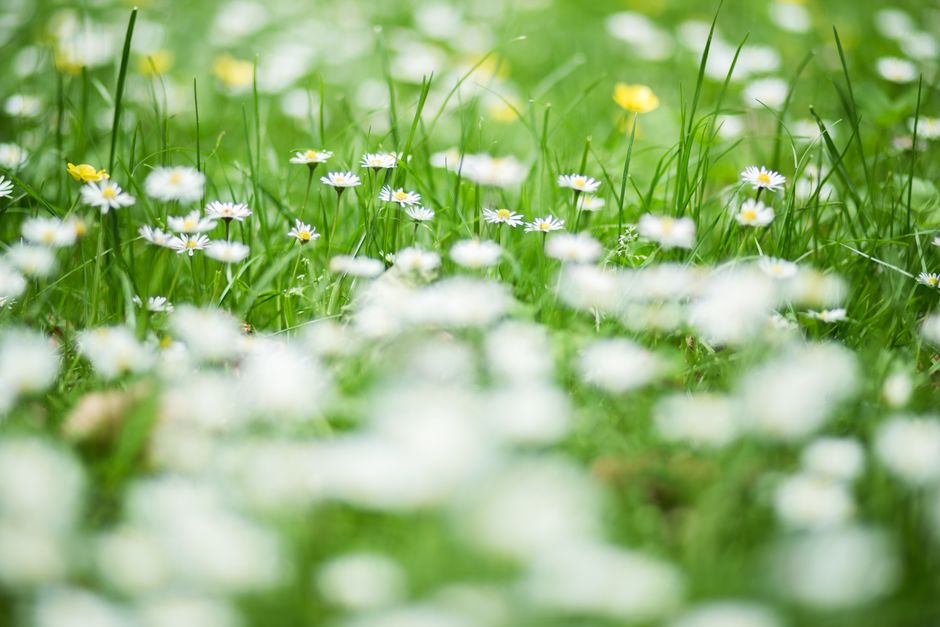
The one way to get a daisy canvas from Ledgebay is to send a photograph of one. Custom Paint by Numbers turns your own photo into a numbered canvas, and flowers convert well when the photo is right.
Get close. One or two blooms filling the frame works, because the shapes are large and the color boundaries are clear. A whole field of daisies photographed from standing height does not, because at that distance each flower is a few pixels of white and there is nothing for the conversion to draw an edge around. Shoot in open shade rather than direct sun, so the white petals keep their detail instead of going flat and blank.
What comes in the box
Stock designs come as 12x16 framed, 16x20 framed, or 16x20 unframed. The canvas is pre-primed cotton and ships rolled in a tube rather than folded, so it arrives without a crease line through the middle of your flowers. The paints are vacuum-sealed, there are brushes in a range of sizes, and there is an 11x17 reference print. That print matters more on a flower design than on anything else, because it is the only reliable way to see which petal a numbered patch belongs to before you commit a color to it.


