


Sunflowers are the most attempted flower in amateur painting and one of the hardest to bring off, for two reasons that have nothing to do with drawing ability.
The first is that they are painted almost entirely in yellow, which is the most difficult color on the palette. The second is that the middle of the head is not what most people think it is.
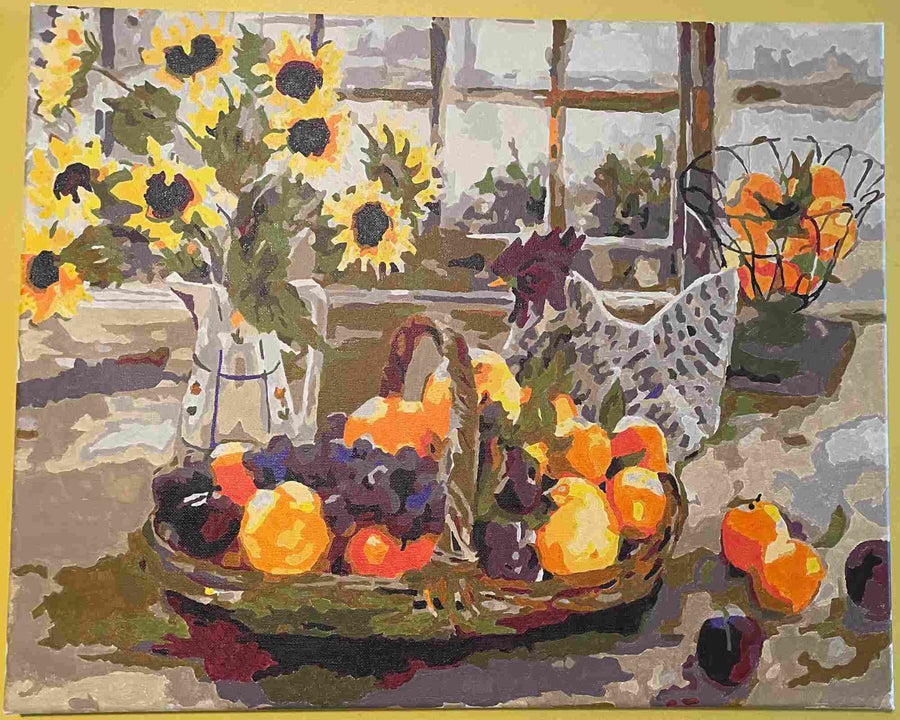
What you are actually painting
A sunflower is not one flower. The head is a composite: hundreds of tiny individual flowers packed into the disc at the center, ringed by the large petal-like ones around the outside.
That matters when you paint it, because those central florets are arranged in interlocking spirals and they sit on a domed surface rather than a flat one. Painted as a flat brown circle, which is what most people do, the whole flower goes dead. Painted with the center slightly lighter where it catches the light and darker toward the lower edge, with some suggestion of that spiral texture, the head reads as a solid object.
The other thing to notice, which sounds like a small point and is not: the outer petals are rarely tidy. Real sunflower heads have petals that curl, twist, cross each other and go brown at the tips. A ring of identical even petals looks like a child's drawing of the sun. Van Gogh painted his past their best, gone to seed, with the petals curling, and it is a large part of why they are convincing.
The yellow problem
Yellow has the least covering power of any pigment on the palette. It is contaminated by the smallest trace of anything else in the brush, and it goes chalky the moment you add white. Three things follow.
Two thin coats, always
A single coat of yellow over anything darker will let it show through, and loading the brush more heavily only leaves a ridge. On a numbered canvas this is especially true, because there is a printed black number underneath every yellow region. Let the first coat dry properly and go again.
Rinse before every yellow
A trace of blue left in the bristles turns yellow green. A trace of red turns it orange. Because yellow is so light in value, it shows every impurity, where a dark color would swallow it unnoticed. Check the rag, not the brush.
The shadows are not brown
This is the mistake that flattens more sunflowers than any other. The instinct is to darken yellow with gray or black, which produces a dead olive. The shadow side of a yellow petal is warmer than the lit side rather than simply darker: it runs toward ochre, orange and raw sienna.
How to make yellow look bright
You cannot do it by adding white; white only makes it chalky and lighter. Yellow is already close to the lightest value available, so brightness has to come from what is next to it.
Put a deep violet, a dark green or a warm brown beside a yellow and the same yellow appears to glow. Violet is the strongest of the three because it sits directly opposite yellow on the color wheel, and each intensifies the other. Our guide to the basic color wheel covers why complementary pairs behave like this.
It is worth knowing that Van Gogh refused this shortcut. In the Arles canvases the flowers are yellow, the vase is yellow, the table is yellow and the wall behind is yellow, and he separates the four planes using nothing but temperature and value within a single hue. It is an extraordinarily difficult thing to do and not the place to start. We have written about those paintings, and the other yellow flower painters worth knowing, in yellow flower paintings and the artists behind them.
Sunflowers as a numbered canvas
We should say plainly that we do not currently make a sunflower design. If that is specifically what you are looking for, we do not have it.
What we do have in that direction is October, a Judy Buswell watercolor of zinnias, poppies and cosmos spilling out of a row of ceramic pitchers and stoneware jugs on a pale tabletop, in orange, magenta and soft pink. It is the warmest and sunniest thing in the range.
Worth knowing before you order any floral: they are the more demanding end of a numbered range. Every petal is its own section, so there are far more small shapes than in a landscape. The compensation is real, though. A slightly wobbly edge disappears completely in a bed of flowers, in a way it never would in an open sky.
If it is your own sunflowers
A photograph of a vase on your own table, or a field you drove past, can be turned into a numbered canvas directly through our custom kits, in 12x16, 16x20 or 18x24.
Two pieces of advice specific to this subject. Photograph them with light coming from one side rather than straight on, because side light is what separates one petal from the next; flat frontal light turns the head into a yellow disc. And put them against something dark. A yellow flower photographed against a bright window has nothing to be bright against, and the conversion will have nothing to work with either.
The rest of our designs are in the full collection.


