


Most articles on this subject promise that painting will sharpen memory, ease arthritis and hold dementia at bay. We are not going to tell you that, because it is not true, and because the honest version is useful in a way the exaggerated one is not.
What follows is what painting reasonably does, and then the practical part: how to set it up so that hands, eyes and back are comfortable for an hour at a time.
What it does
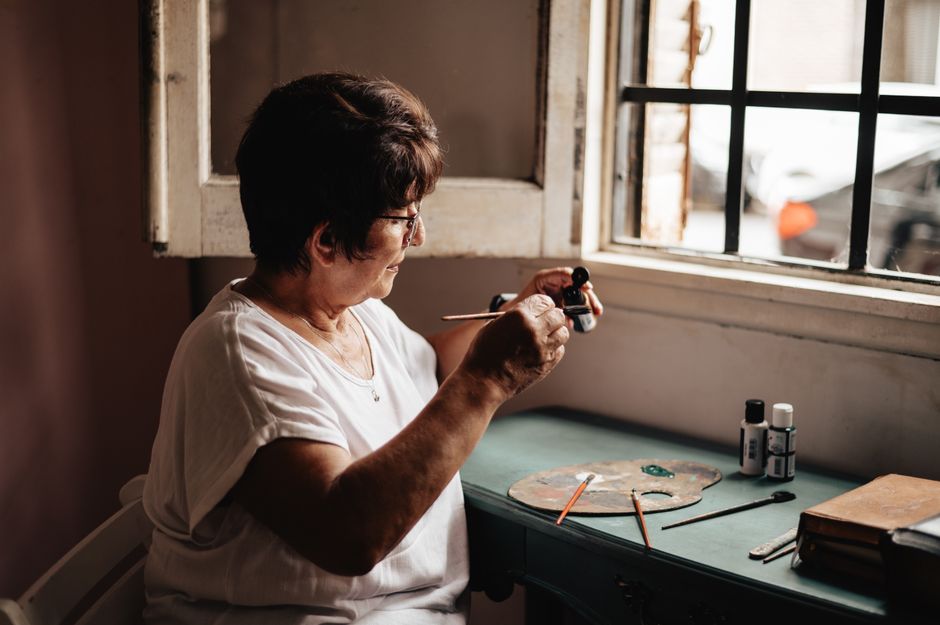
It occupies attention without demanding decisions. This is the real mechanism and it is worth stating plainly. Freehand painting is a long series of choices, and choices are tiring. A numbered canvas removes every one of them, so attention has somewhere easy to go. People describe the result as calming, and what they are describing is the absence of friction.
It leaves something behind. An evening of television leaves nothing. Two hours on a canvas leaves visible progress, and at the end of a few weeks there is an object. For anybody whose days have lost their shape, that is not a small thing.
It is sociable if you want it to be. Painting alongside someone, or in a group at a library or a community center, gets people into the same room with an easy reason to be there. Company is one of the few things in this area with genuinely good evidence behind it.
It keeps the hands in use. Regular fine motor work maintains dexterity in the ordinary way that using anything maintains it.
What it does not do
It does not treat arthritis. It does not slow dementia or restore memory. It is not a substitute for treatment for depression, and anyone selling it as one is overreaching.
Art-based activities are used in dementia care and they do good work there, but what they are good at is engagement and mood in the moment, not changing the course of the illness. That is a real benefit and it deserves to be described accurately.
We have set out where the evidence actually sits in the benefits of art therapy, including the difference between a hobby and a clinical discipline.
Setting it up: eyes
This is where most of the difficulty is, and most of it is fixable.
- Buy the bigger canvas. A 16x20 and a 12x16 of the same design have the same number of regions, so the larger canvas has bigger shapes and bigger printed numbers. This is the single most effective adjustment and it costs a few dollars.
- Light from over your shoulder, not from the ceiling. An adjustable lamp positioned behind and to one side puts light onto the canvas without your head casting a shadow across the work. Overhead lighting guarantees you are working in your own shadow.
- Keep the printed reference sheet propped up. Every kit of ours includes an 11 by 17 inch printout, and reading a number off that at arm's length is far easier than finding it on the canvas.
- Use a magnifier. A lit magnifier on a stand leaves both hands free. There is nothing to feel awkward about here; plenty of our customers keep one on the table permanently.
We should be straightforward about one thing. The most common complaint in our own reviews, and across this whole category, is that the printed numbers are small or faint. The measures above are not a workaround for a fault, they are how most people paint these comfortably.
Setting it up: hands
- Fatten the brush handle. A thin wooden handle is hard to grip with stiff fingers. A length of foam pipe insulation, a rubber pencil grip, or a wrap of self-adhesive bandage turns it into something you can hold loosely, which is far less tiring than pinching.
- Hold it further back. Gripping near the ferrule feels like control and produces tension. Holding further along the handle gives smoother movement from the arm rather than the fingers.
- Brace the arm. For an unsteady hand, rest the elbow on the table and the heel of the painting hand on the canvas edge or on a ruler laid across the frame. Steadiness comes from support, not from effort.
- Go one brush size up. A slightly larger brush in the small regions is easier to control than the tiniest one in the kit, and the difference in the finished picture is invisible.
Setting it up: back and neck
The ache people report after an hour comes from looking straight down at a flat canvas with the head tipped forward. Raising the far edge by fifteen or twenty degrees brings the work toward the eye line and lets the head sit closer to upright. A couple of hardback books under a board will do it, or a small tabletop easel, which is included with our framed sizes. Our note on whether you need an easel explains why the tall studio kind is the wrong tool here.
Sessions of thirty to forty-five minutes suit most people better than marathon sittings. The canvas is not going anywhere, and acrylic that has thickened in the pot usually comes back with a drop of water and a stir.
Choosing a design
Two things to look for and one to avoid.
Look for large open areas such as sky, water and open fields, and look for well-separated colors, so that picking up the wrong pot is obvious rather than subtle.
Avoid dark, low-contrast designs. A picture built out of near-blacks is harder on the eyes than any amount of fine detail, because there is nothing to distinguish one region from the next.
Moonlight Bay is the one we would suggest first: a full moon over a still lake with a canoe and a campfire. It is our most-reviewed design and reviewers call it forgiving for a first canvas, since the sky, the water and the moon track are all wide unbroken areas. Summer's Song is the other, and reviewers say directly that the numbers on it are easy to read.
One last thought about buying it for someone
If this is a gift for a parent or grandparent, the kit is the easy part. Put a good lamp and a magnifier in the box with it, and if you can, do the first hour alongside them. The first evening is the one where people decide whether this is for them, and it is nearly always the setup rather than the painting that makes up their mind.
Our customer gallery is full of finished canvases sent in by people who started exactly this way, and the rest of the designs are in the full collection.


