


Ocean scene covers three quite different paintings, and which one you choose changes the experience far more than the canvas size does. It is worth knowing which you are buying before you buy it. A turtle design is the clearest example of that difference. Fish designs are a smaller category than people expect, and worth checking before you go looking.
choosing and painting a water scene goes further into the two kinds of ocean design and how differently each behaves under the brush.
1. Open water and sky
Sea, sky, a horizon, and not much else. Large areas of closely related blues and grays, with a sunset or a cloud bank doing most of the work.
This is the most rhythmic thing you can paint by numbers, and it is the one people most often say they lost hours to. You work in long horizontal bands, one color at a time, with the same stroke repeated across the width of the canvas. Very few interruptions, very little decision-making.
It is also the most forgiving. There is no drawing to get wrong and nothing that will read as inaccurate. If you want the calm rather than the challenge, this is the category.
2. Beach and shoreline
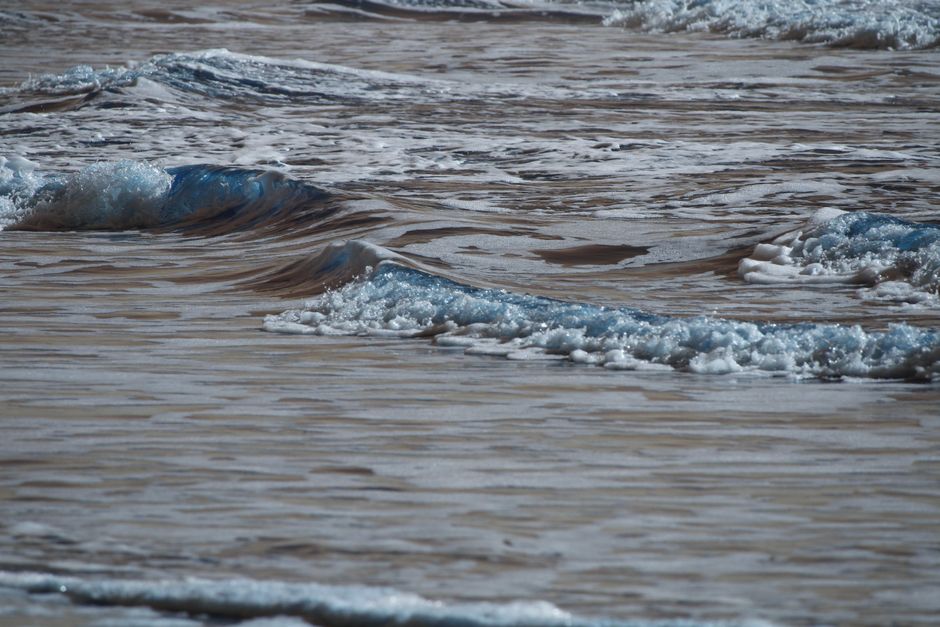
Adds sand, foam, rocks, and often a boat, a pier or a figure. More variety, more distinct areas, more to look at while you work.
Two things get more demanding. Foam is the lightest thing on the canvas and needs two clean coats with a properly rinsed brush, because a stroke of sea blue dragged into it turns the whole crest gray. And wet sand is much paler than dry sand and takes its color from the sky, which is the detail that makes a beach look wet and the one people most often paint too dark. Painting a beach from scratch runs into exactly the same tone, without the numbers to guide it.
A better choice than open water if you find long stretches of one color boring, which plenty of people do.
3. Underwater
Reefs, fish, light shafts coming down through the surface. Visually the most striking of the three and comfortably the hardest.
The reason is section density. Coral and shoals reduce to hundreds of small irregular shapes in a narrow band of blues and greens, which is slow work in colors that are difficult to tell apart in the pot. It is also unforgiving of a wandering edge in a way that open water is not.
We do not make an underwater design, and previous versions of this page implied otherwise by talking about coral reefs and kelp forests. If that is what you want, a custom kit from a photograph is the route, and take the largest size.
What we actually have
Seaside Escape and Moonlight Bay are the two most people start with. Still Waters is a lake rather than a coast, and Guiding Light is a cliff-top lighthouse above open water, with a bald eagle and a birch in autumn color.
Seaside Paradise is the other seascape, and it should carry a warning. It is the design our customers most often describe as demanding, because it combines broad sky gradients, a lot of water and fine sections all at once. A genuinely good painting and the wrong place to begin.
The full range is here.
Photographing your own coast
Most people who want a sea painting have a particular stretch of water in mind, and a custom kit from your own photograph is usually a better answer than a generic scene. A few things separate a photo that paints well from one that does not.
- Level horizon, off center. The horizon is the one line that has to be dead straight, and it should sit roughly a third of the way up or down the frame. Through the middle divides the picture in half.
- Some cloud. A cloudless blue sky is a large area of canvas with almost nothing in it. Broken cloud gives the top half of the painting something to be.
- Something for scale. A boat, a groyne, a figure on the sand, a rock. Without it the eye cannot tell whether it is looking at a bay or a puddle.
- Low sun. Early or late light rakes across water and wet sand and gives you the highlights that make the surface read. Midday sun flattens everything.
- Go bigger for detail. Rigging, railings, distant buildings and rocks need room. At 16x20 or 18x24 they survive; at 12x16 they get simplified into blocks.
Before you start
Whichever you choose, the techniques are the same and there are four that matter: every stroke in the water runs horizontally, the sea takes its color from the sky so distant water is paler than you expect, the horizon stays hard-edged while everything else can be softened, and foam gets two clean coats.
We go through all of it in how to paint water well, and our beginners guide covers the basics if this would be your first kit.


