


Ledgebay does not make a fish design, and it is better to say so at the top than to bury it. There are water scenes in the range, fish convert well as a custom canvas from a photograph you own, and there is one thing a custom canvas definitely cannot be. All three are covered below.
Why fish are harder than they look
Worth understanding before you go hunting for a kit, because it explains why good fish designs are rarer than good bird ones.
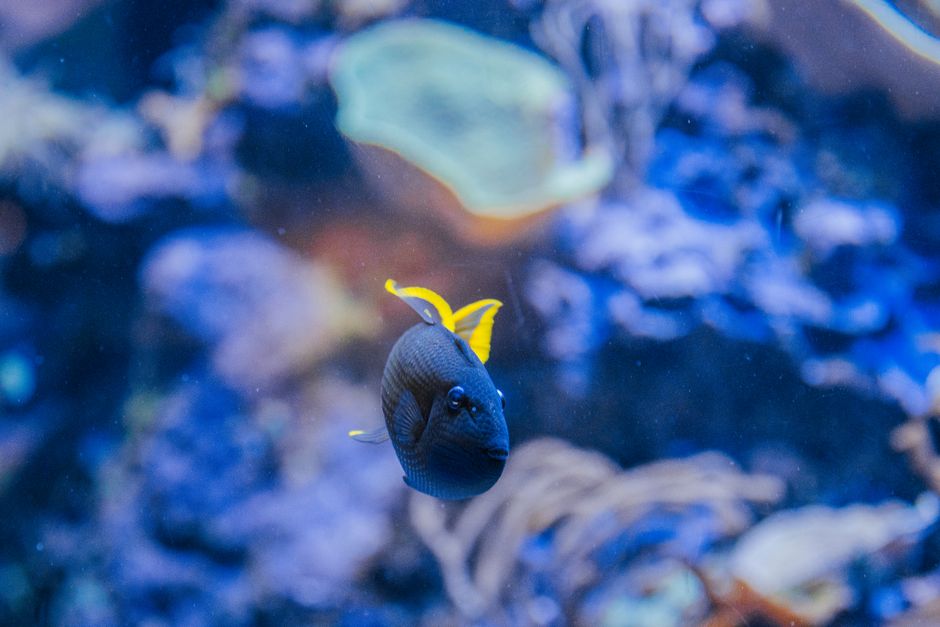
A bird is defined by bands of flat color, which is exactly what a numbered canvas produces. A fish is defined by iridescence: color that shifts across the body and changes with the angle of the light. Flatten that into discrete shapes and the shimmer goes, because the shimmer was never a set of shapes to begin with.
The fish that do convert well are the ones patterned in hard-edged blocks rather than gradients. Reef fish with strong stripes and bands, koi with defined patches, a clownfish. A silver trout in moving water is the difficult end of it.
The water around the fish has its own problem: rippled water is one of the most section-dense things you can paint, comparable with dense foliage.
The water scenes that do exist
No fish, but several designs where water is the subject rather than a background, which is often what people are actually after.
- Seaside Escape and Seaside Paradise for coastal scenes. Seaside Paradise is one of the more demanding designs in the range.
- Still Waters and Moonlight Bay for calm inland water.
- Sunset Swans if it is birds on water you want.
- Guiding Light, a cliff-top lighthouse above an open lake with a bald eagle off the point.
All 39 are listed in the catalog, and the customer gallery shows finished ones, which is a better guide to how a design actually turns out than any product image.
A fish canvas of your own
A custom canvas made from your photograph is the route to a specific fish. People do this with aquarium fish, with koi ponds, and with a catch worth remembering.
What works:
- Side-on and filling the frame. A fish photographed at an angle through curved glass loses its shape.
- Strong pattern. Stripes, bands and defined patches survive conversion. Subtle iridescence does not.
- A background with some tone in it. Rock, plants, a dark tank wall. A pale fish against pale water gives the conversion nothing to separate.
- Sharp. Fish move, and aquarium light is dim, which is a combination that produces motion blur. Nothing recovers a blurred subject, so take several and pick the crisp one.
And one honest expectation: the finished canvas will look like a painting of your fish, not a photograph of it. Shape and pattern come through faithfully; shimmer does not.
What a custom canvas cannot be
This is worth being direct about, because an earlier version of this page said the opposite and it was wrong.
We cannot make a canvas from a copyrighted character. Not Nemo, not Dory, not Ariel, not any other film, television or book character. Those characters belong to the studios that own them, and printing one onto a product is not something a customer can authorize by uploading a picture.
The same applies to any photograph you did not take and do not have permission to use, including images found online. Send a photograph that is yours.
Painting fish and water well
- Water first, fish afterward. Everything behind the subject goes in and dries completely before the subject does. A pale fin painted onto still-soft water drags and the edge is lost for good.
- Follow the direction of each section. On a fish the shapes already run the way the scales and fins lie. Pull the brush along them rather than dabbing.
- Do not blend the color bands. They are meant to sit as distinct steps and they resolve at normal viewing distance. Blending them is the usual way people make a fish look worse than the design intended.
- Sample close blues on paper. Water designs run on many near-identical blues and greens, and telling them apart in the pot is genuinely difficult. Dab each one on white paper, label it with its number, and compare the painted samples.
- The eye last, when everything around it is dry.
Common questions
What comes in a Ledgebay kit?
Pre-printed cotton canvas, rolled in a tube rather than folded so it arrives without creases. Acrylic paints, vacuum-sealed so they arrive moist. Brushes in a range of sizes. Printed instructions, a full-color reference photo and an 11x17 printout of the design. Framed sizes also include a wooden tabletop easel. Varnish is not included and is optional.
Are the canvases already framed?
The framed sizes are, and arrive pre-stretched on a wooden frame ready to hang. The unframed 16x20 ships rolled and is trimmed close to the print, so it suits mounting flat to a board rather than stretching over bars. The framing guide covers the options.
How long does one take?
Budget 10 to 20 hours of actual painting on a 16x20 of moderate complexity, over a few weeks of evenings. Water-heavy designs run longer because of the number of small sections.
What if I run out of a color?
Each stock design has a matching set in the extra paint collection. On a custom canvas the paints are mixed for your specific image, so add the spare sets at checkout rather than afterward.
Would this suit a beginner?
A water-heavy design would not be the easiest place to start. The beginner guide goes through what makes a first canvas manageable.


