


There is no dog in the Ledgebay catalog, and that is deliberate rather than an oversight. Nobody who searches for a dog canvas actually wants a generic Labrador. They want the one asleep under the table, or the one that died in March. A stock design cannot be that dog, so the sensible route is a photograph of your own.
What follows is the practical part: how to choose the photograph, and how to handle the three things that decide whether a painted dog looks like your dog or like a dog.
Choosing the photograph
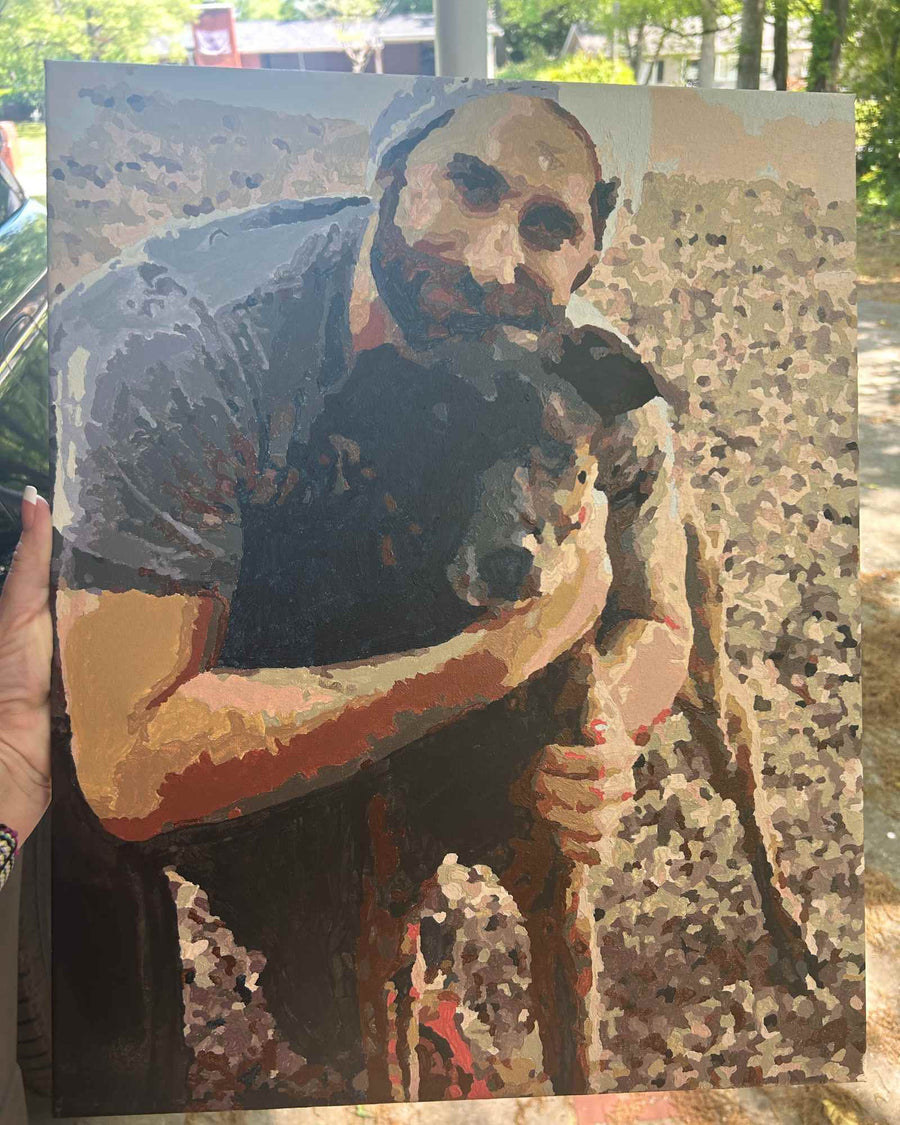
This decision matters more than anything you will do with a brush afterwards. A numbered canvas is built by dividing an image into flat regions of color, so whatever the photograph does not contain clearly, the canvas will not contain at all.
- Get down to their eye level. A photograph taken from standing height is a picture of the top of a dog's head. Kneel, or put the camera on the floor.
- Daylight from a window, never flash. Flash flattens fur into a single tone and puts a hard white disc in the eye. A dog sitting a few feet from a window on an overcast day is close to ideal.
- Fill the frame. Head and shoulders converts far better than a full body across a room. Detail that is small in the photo disappears entirely in the conversion.
- Separate the dog from the background. A black dog on a dark sofa has no edge, so no edge gets drawn. Put a light blanket behind a dark dog and a dark one behind a pale dog.
- The eyes must be sharp. If the eyes are soft, nothing else rescues it. Focus on the near eye.
- Avoid overhead midday sun. It drops the eye sockets into shadow, which reads as two dark holes once the image is reduced to flat regions.
If you are working from an old photograph of a dog you have lost, choose on expression rather than on technical quality. A slightly soft picture of the right moment is worth more than a sharp one of the wrong one, and a good conversion can carry a surprising amount.
Fur is not painted hair by hair
This is where people go wrong first. A numbered canvas does not give you individual hairs, and it should not. It gives you the masses: a lighter patch where the light catches the shoulder, a darker one under the jaw, a mid-tone across the flank. Painted flat and cleanly, those masses read as fur from a few feet away, which is where the picture will actually be seen.
Two habits improve it. Pull the brush in the direction the coat lies rather than back and forth, because acrylic keeps a faint bristle texture and that texture will do some of the work for you. And at the outer silhouette, where fur meets background, a very slightly ragged edge reads more like an animal than a perfectly clean one. It is the one place on the whole canvas where precision works against you.
A small round brush with a decent point makes this easier than a flat one. Our guide to brush types covers which to reach for.
Dark coats need light, not different colors
A black or dark brown dog arrives as a set of very close dark values, several of which look identical in the pot. The temptation is to decide the kit has made a mistake and to exaggerate the difference. Do not. Those small separations are exactly what gives a black coat its shape, and pushing them apart turns a dog into a patchwork.
What genuinely helps is a lamp directly over the canvas, working one number at a time across the whole surface, and two thin coats on every dark region so the finish stays even. Thick black shows every ridge.
The eyes are the last thing you paint
Leave them until everything around them is fully dry, then use the smallest brush you have.
The mark that matters is the catchlight, the small bright reflection in the eye. It is usually the single most important spot of paint on the canvas, because it is what makes the animal look alive rather than stuffed. Three rules: keep it small, put it in the same position in both eyes, and put it on last.
The same logic applies to the highlight on a wet nose. Small, late, and slightly less than feels right.
Size, and what is in the box
Go larger than you think for a dog. Faces and eyes need room, and on a small canvas the regions around the muzzle and eyes compress into shapes that are awkward to paint. Custom Paint by Numbers comes as 12x16, 16x20 or 18x24, framed or unframed, and for a portrait the two larger sizes are worth the difference.
The canvas is pre-primed cotton and ships rolled in a tube rather than folded, the paints are vacuum-sealed and mixed to your design, and there is an 11x17 reference print. There is more on how the conversion itself works in paint by numbers from photos.
The animals we do have
For the record, the animal designs are songbirds, wolves, swans, bluebirds, a moose and a tiger. Fine canvases, none of them a dog. If you want to see what finished custom portraits look like on real walls, the customer gallery is full of them, and a good number are somebody's dog.


