


Short answer: not in the same puddle, and not in a paint by numbers kit.
There is one combination that genuinely works and is standard practice among painters — oil laid over dried acrylic — and one that will destroy a painting slowly, which is acrylic laid over oil. The difference matters, and it is worth understanding why rather than just memorizing it.
Why they do not mix
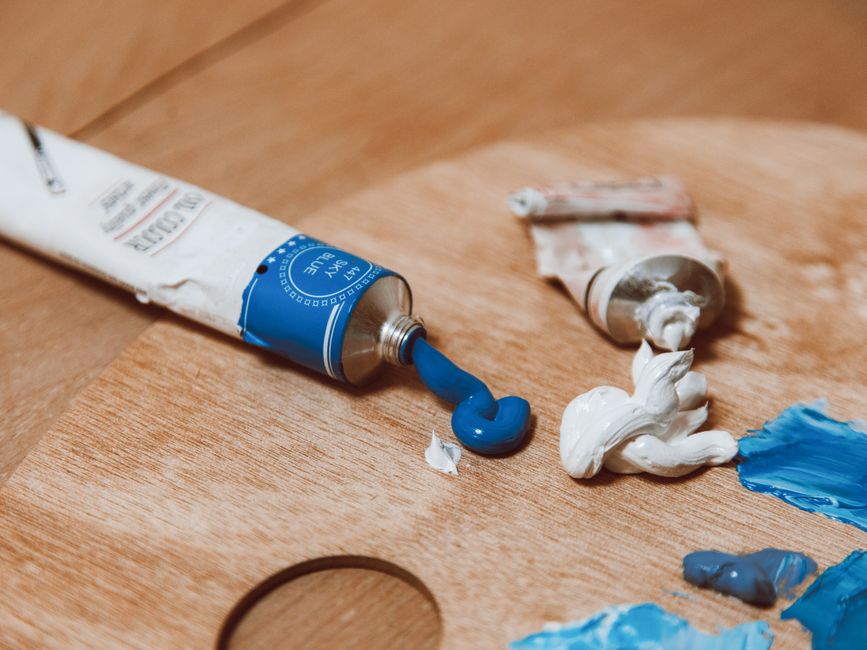
The two paints dry by completely different mechanisms.
Acrylic is pigment suspended in an acrylic polymer carried in water. It dries by the water evaporating, which lets the polymer particles pull together into a continuous plastic film. It is quick, and once that film has formed it is stable and no longer water-soluble.
Oil is pigment ground into a drying oil, usually linseed. It does not dry by evaporation at all. It cures by oxidation — reacting with oxygen from the air and slowly stiffening into a solid. That process takes days to be touch-dry and months to be genuinely hard.
Stir them together in a palette and you are asking water and oil to combine, which they do not. What you get is a curdled mess that may look acceptable while wet and then, as the water leaves and the oil oxidizes at its own pace, separates into a film that never properly bonds to anything.
The layering rule, and the reason for it
Oil over acrylic: fine
Let the acrylic dry completely, then paint oil on top. This is ordinary practice — an acrylic ground or underpainting under oil paint is what most commercially primed canvas is set up for.
It works because dried acrylic gives a stable, slightly toothy surface that oil can grip. It has the additional real benefit of sealing the canvas, so the oil is not soaking into and eventually rotting the fibers.
Acrylic over oil: never
This is the one that fails, and it fails slowly enough that you will not notice until the painting is finished and hung.
Cured oil paint is smooth, slightly flexible and repels water. Water-based acrylic laid on top of it cannot key into that surface. It sits there, dries, and forms a skin with nothing holding it down. Months or years later it lifts, cracks and flakes away, usually taking your work with it.
The rule people remember it by is simply oil over acrylic, never acrylic over oil.
One correction worth making
You will read that using an acrylic underpainting speeds up the oil layer on top, so an oil painting can dry in a few hours rather than days. That is not true.
Oil cures by oxidation, and nothing underneath it changes that. What an acrylic underpainting genuinely saves you is the time you would have spent waiting for an oil underpainting to dry before working over it — often several days. The oil on top still takes exactly as long as oil takes. If a painting appears to dry unusually fast, that is thin paint and a warm dry room, not the layer beneath it.
What this means for a paint by numbers kit
Do not introduce oils into one. There is no version of this that improves the result.
A numbered kit ships with acrylics matched to the printed sections. Filling some sections with acrylic and others with oil, which is a suggestion that circulates a lot, gives you a canvas where half the surface is satin and half is glossy, half is dry in twenty minutes and half is tacky for a week, and every boundary between the two is visible under a lamp. There is no gain to set against that.
The same goes for watercolor and gouache, for a more basic reason: the canvas is primed. Watercolor works by soaking into absorbent paper, and a primed canvas does not absorb. It will bead, streak and lift off on your sleeve. Both are also too transparent to cover the printed numbers, which is the one job the paint in a kit has to do.
If a section is not covering well, the answer is a second thin coat once the first is properly dry — not a different kind of paint. Our practical tips cover that in more detail.
Combinations that do work
Away from numbered canvases, on your own work, three of these are worth knowing.
Acrylic underpainting, oil on top
Block in the composition and the broad tonal areas in thin acrylic. Let it dry hard — an hour is plenty. Then work in oil over it, with all the blending time oil gives you. You get the speed of acrylic for the boring part and the handling of oil for the part that matters.
Watercolor with gouache
Both are water-based and gum-bound, so they are entirely compatible. The difference is opacity: watercolor is transparent, gouache is opaque. Wash in the large areas and the light with transparent watercolor, then use gouache over the top for the solid passages and the highlights, which watercolor cannot give you because it has no white to speak of.
Acrylic under, acrylic over
Worth stating because it is the one nobody asks about. Acrylic bonds to itself indefinitely and forgivingly, which is why it suits building up in layers and painting out mistakes.
The paint types, briefly
- Acrylic — water-based, dries in minutes, opaque, sticks to almost anything, permanent once dry. Slightly darker dry than wet.
- Oil — slow-curing, richest color depth, the easiest to blend, needs solvent to clean up.
- Watercolor — transparent, made for absorbent paper, re-wets when dry so it can be lifted and reworked.
- Gouache — opaque watercolor. Also re-wets, which is its great convenience and its great frustration, since a new layer can disturb the one beneath.
- Encaustic — pigment in heated wax, applied molten. A different craft with different equipment.
Common questions
Can I mix oil and acrylic to get a longer working time?
No. If you want acrylic to stay open longer, use an acrylic retarder made for the purpose, or a wet palette. Adding oil does not slow acrylic down, it just stops it bonding.
I already painted acrylic over oil. What now?
If it is a small area and still recent, scrape it back to the oil layer and repaint in oil. If the whole surface is covered, there is no reliable fix — the acrylic will release eventually. Better to know now than in two years.
Can I varnish a paint by numbers canvas?
Yes, with a clear acrylic varnish, once it has cured for several days. It evens out the sheen, which is worth doing because some pigments dry matte and others satin and that reads as patchy under a lamp.
Are there oil paint by numbers kits?
They exist, but they are uncommon, and ours are acrylic. Oil in a kit means a canvas that stays wet for days between sittings, which is the opposite of what most people want from one.
If you are choosing a first canvas, our guide to picking an easy kit covers what actually makes a design forgiving, and the range is in the shop.


