


Some evenings you are flat and there is no particular reason for it. Painting something bright is a modest, practical response — not a cure for anything, but an hour spent making something instead of scrolling past other people's things. A rainbow abstract is the easiest version of that, because there is nothing to get right.
What a Rainbow Abstract Is
Abstract art works on color and form rather than on subject. A rainbow abstract is simply an abstract built from the full spectrum — red through violet — in whatever arrangement you like.
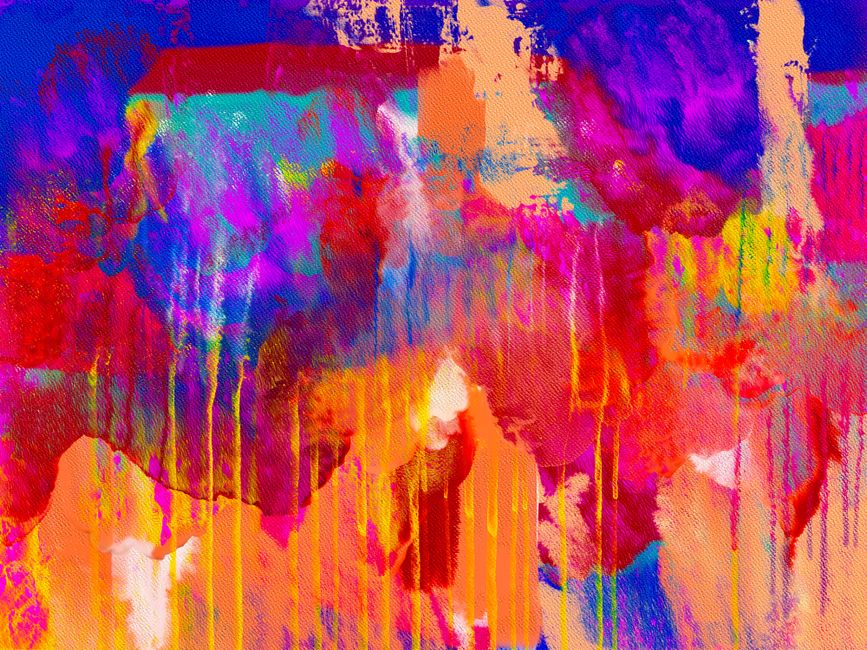
It does not have to be arch-shaped. Stripes, blocks, drips, concentric rings and unresolved smears all qualify. The only rule is that the colors run through the spectrum, and that rule exists mostly to save you from having to decide on a palette.
Does Painting Actually Help?
Worth being careful here, because this subject attracts a lot of overclaiming.
There is a reasonable body of research on art therapy and structured creative activity showing reduced anxiety, and it is worth reading rather than taking on trust: Art Therapy: A Complementary Treatment for Mental Disorders. Note what it covers, though. It is about art therapy, generally facilitated, not about an evening with a canvas at your kitchen table, and nobody has studied rainbow abstracts specifically.
What we can say from our own reviews is narrower and more useful. People describe an hour of focused work with something to show at the end, and a fair number of them describe it as what they do instead of a night of television. That is a modest claim and probably a true one.
The mechanism is not mysterious. Freehand painting carries a lot of decisions — what to paint, how to mix it, whether it looks right. A rainbow abstract strips most of those out, and what is left is repetitive, physical and absorbing.
What You Need
All of it is cheap, and most of it you may already own.
- Acrylic paints. A basic set covers the spectrum. Craft-grade is fine for this; you are after brightness, not archival permanence.
- Canvas or heavy paper. Canvas board is inexpensive and takes thick paint without buckling. Watercolor paper works and costs less, but standard printer paper will cockle the moment it gets wet.
- A few brushes. One wide flat and one round is enough. A cheap set is a reasonable place to start.
- A palette. A dinner plate does the job.
- Water, paper towels, and something to hold the brushes. An old jar or a washed tin can.
- A pencil and eraser, if you like to sketch the layout first. Many people do not, and on this subject it is genuinely optional.
Five Ways to Paint One
In rough order of difficulty.
- Stripes. Bands of color straight across the canvas, thick or thin. The simplest version and still the most satisfying to look at from across a room.
- Sponge. Dab color on with a damp sponge, letting neighboring colors overlap at the edges. Gives texture without any brush control at all.
- Drips. Thin the paint, load the top edge of an upright canvas, and let gravity do the work. Unpredictable, which is the appeal.
- Fingers. Direct and messy, and the fastest way to stop treating the canvas preciously. Worth one attempt even if you never do it again.
- Stencil. Lay a geometric or floral stencil over a finished rainbow ground and paint through it in a single contrasting color. The only technique here that needs any planning.
Two things worth knowing whichever you choose. Adjacent colors on the spectrum blend cleanly; colors from opposite ends turn gray where they meet, so keep red away from green unless you want mud. And acrylic dries darker than it looks wet, which is worth a test dab before you commit a whole stripe.
When It Is Finished
Hang it. A bright abstract does more for a plain wall than its cost suggests, and there is a particular satisfaction in a room containing something you made.
They also give well. A painting from someone's own hand is an unusual thing to receive, and rainbow abstracts suit almost any room, which is more than can be said for most artwork.
If a Blank Canvas Is the Problem
For some people the blank canvas is the whole obstacle, and no amount of "there is no wrong way to do it" gets them past it. A numbered kit removes that: the composition is settled and the evening goes on color and brushwork.
Our catalog is licensed artwork rather than abstracts, and Custom Paint by Numbers will turn any image you upload into a numbered canvas. Finished ones are in the customer gallery.
If you would rather go at it freehand, how to paint abstract covers the technique in more depth, and abstract paint by numbers covers the middle ground between the two.


