


Horses are among the most requested subjects in paint by numbers and among the least forgiving. This is what to check before you buy one, and how to paint it once it arrives.
To be straightforward at the top: we do not currently make a horse design. Our catalog is licensed original artwork, and it runs to cabins, coastlines, wildlife and florals. If you want a horse canvas you will be buying it from someone else, so the useful thing we can offer is an honest account of what separates a good one from a frustrating one.
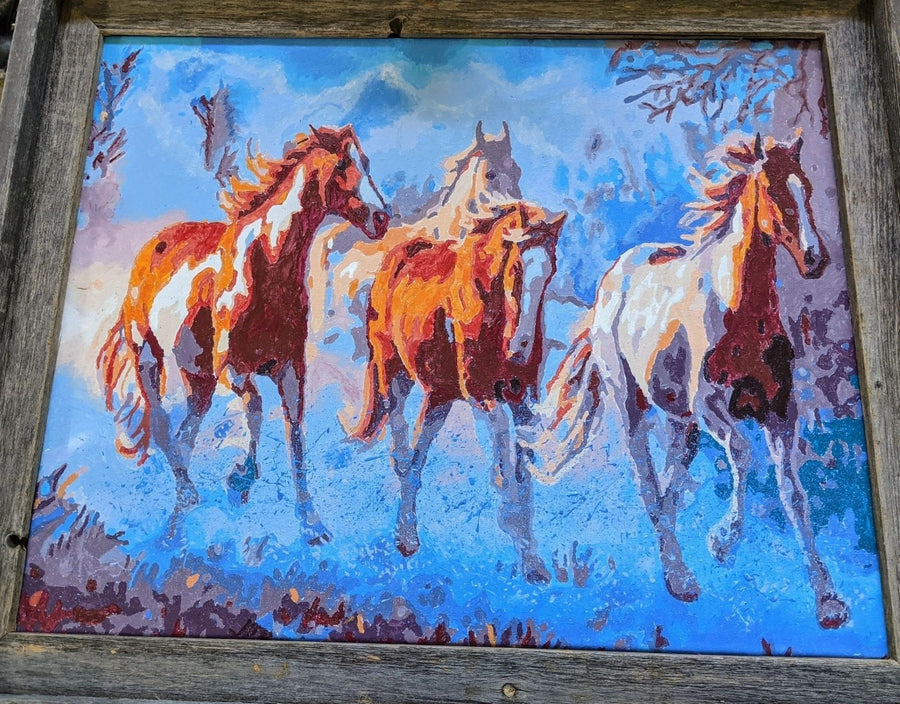
Why Horses Are Harder Than They Look
On a numbered canvas the drawing is already done for you, so the usual difficulty with horses, which is that everyone can tell instantly when the anatomy is wrong, does not apply. The difficulty moves somewhere else.
The whole animal is one color. A bay horse is brown. What makes it read as a solid, muscular body rather than a brown cutout is nothing but shading, and on a numbered canvas that shading is a run of eight or ten browns that all look nearly the same in the pot. Getting them in the right sections is the entire job, and mixing two up is genuinely visible in the finished piece.
We do not sell a horse design. getting a horse on canvas explains what to look for elsewhere, and what makes the subject genuinely demanding.
Dark horses are the hardest canvases in the category. A black or dark bay horse means the printed numbers sit under dark paint in a dark area of the design, which is exactly where they are hardest to read. A gray, palomino or chestnut horse is far kinder.
Manes and tails are hundreds of slivers. Flowing hair reduces to a great many long thin sections, each with its own number. Some painters find that absorbing. Others find it the point at which a canvas goes back in the box.
What to Check Before You Buy
- Coat color and light. Look for a lighter horse in daylight rather than a dark one at dusk, at least for a first canvas.
- How much of the canvas is the horse. A horse in a wide field gives you a large restful sky and grass to work on. A close head study is all coat and mane, with nowhere to rest.
- Rolled or folded. Folded canvas arrives with hard creases through the image that never fully come out. Rolled in a tube arrives flat. This is the most common complaint in the whole category and the easiest thing to avoid.
- Whether a full-size reference is included. On a subject where ten browns have to be told apart, a large printed reference beside you is worth more than any other extra in the box.
- The size. Bigger is easier here, not harder. The same design on a larger canvas means larger sections, which on a mane is the difference between pleasant and punishing.
Painting the Coat
Two habits do most of the work.
Follow the direction the hair grows. Short strokes running down the shoulder, along the barrel, down the leg. Even though each section is a flat color, brushing in the direction of the coat leaves a faint grain in the paint that catches the light and reads as an animal rather than a shape. It costs nothing and it is the single biggest improvement available.
Work dark to light. Lay in the shadowed underside and the deep creases first, then the mid tones, then the lit surfaces along the back and the top of the neck last. Light acrylic covers dark acrylic much more easily than the reverse, so this order saves second coats and it keeps the sequence of values straight in your head.
Do the background first, before any of the horse. It sets the value of everything in front of it, and painting a sky around a finished animal leaves a pale halo you will spend an evening chasing.
Manes, Tails and Fine Lines
The technique here is one stroke per hair, pulled from the root outward in a single movement, rather than filling each sliver in like a shape.
Thin the paint very slightly with water so it flows off the brush instead of dragging. Load the belly of the brush rather than the tip. Then commit to the stroke. A confident line that is a fraction off beats a hesitant one gone over four times, and on a mane nobody will ever know which is which.
This is the same problem as painting grass, and if you want a design that teaches it, our Morning Ride kit is built almost entirely out of it. Reviewers of that one say plainly that it is not for the faint of heart.
Common Fixes
Wrong number in a section. Let it dry completely, then paint the correct color over the top. Two coats if the wrong color was darker. This is a five-minute problem.
Pale gaps between sections. Very common on a mane. Let the first section dry, then bring the neighboring color slightly over the boundary. A hairline of bare canvas shows far more than a slightly shifted edge.
A color running low. On a horse it will be the main coat color, because it covers the largest area and often needs a second pass. Ration it deliberately from the start rather than discovering the problem at the hindquarters.
Your Own Horse
This is the version of the request we can actually help with, and it is a better painting anyway. A generic galloping horse is a picture anyone can own. Your own horse is not.
We turn photographs into numbered kits, printed in the USA, in 12x16, 16x20 and 18x24 inches, framed or unframed, with the option of one or two extra paint sets at checkout.
For a horse photograph specifically:
- Shoot side-on or three-quarters, in even outdoor light. Overcast is better than bright sun, which blows out the highlights on a shiny coat and leaves nothing to paint.
- Avoid a dark stable. Detail lost in shadow in the photograph is detail that cannot be recovered in the conversion.
- Get separation from the background. A dark horse against a dark hedge gives the conversion nothing to work with.
- Go larger for a head study. 18x24 if the face and eye matter to you, because fine detail becomes flat shape at smaller sizes.
You can start one on the custom paint by numbers page, and our guide to choosing a photo goes further into what converts well.
What We Do Make
If a horse is not essential and you would rather have a finished canvas soon, our own designs are landscapes and wildlife: cabins, coastlines, birds and florals, licensed from the artists rather than lifted from stock. Every kit ships rolled in a tube, with vacuum-sealed paints, brushes in a range of sizes and an 11 by 17 inch reference print. The catalog is here and the customer gallery shows what people have finished.


