


"Paint by numbers" means a canvas printed with faint outlines, every section carrying a number, and a set of paints numbered to match. You fill each section with its color. There is no drawing and no color mixing.
The second half of that definition is the interesting part. Removing the decisions is what makes the format work, and it is also the most plausible explanation for why people find it settling.
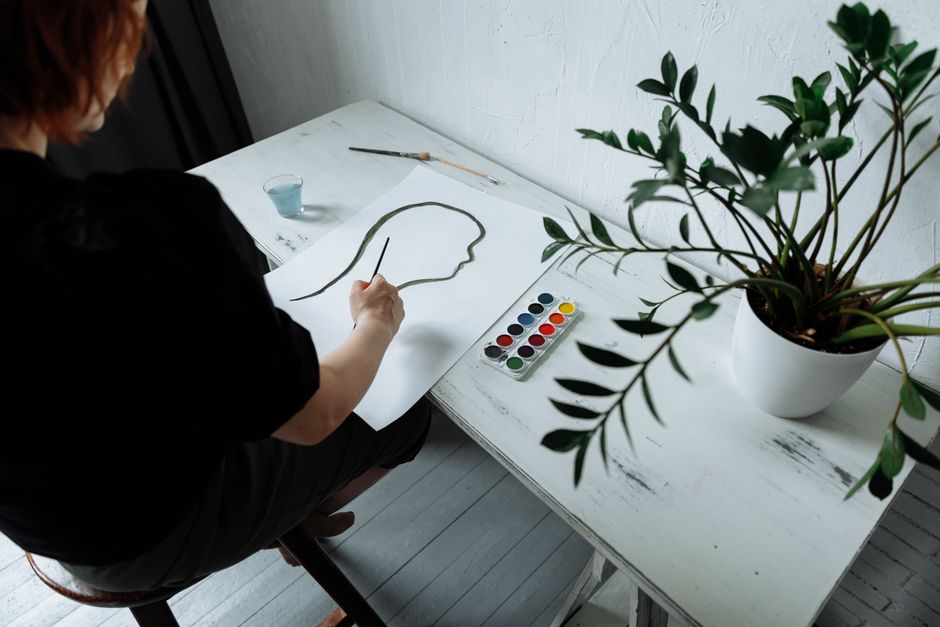
What Is in a Kit
A pre-printed canvas, a tray of numbered acrylic paints, brushes in two or three sizes, and a reference image showing the finished picture. Better kits include a full-size printed reference, because the numbers on the canvas are small.
Most kits are acrylic. A few use oil, which is rare for practical reasons — solvents, cost, and drying times measured in days rather than minutes.
The format was conceived in 1949 at the Palmer Paint Company in Detroit, where Max Klein backed the idea and Dan Robbins drew the early designs under the Craft Master name. It was a genuine craze by the mid-1950s. There is more in our piece on vintage paint by numbers.
What the Research Actually Shows
This subject attracts a great deal of overclaiming, some of which used to be on this page. Here is the careful version.
Art therapy and anxiety. There is a reasonable body of work indicating that art therapy — structured creative activity, generally with a trained therapist — is associated with reduced anxiety and improved mood. A useful overview is Art Therapy: A Complementary Treatment for Mental Disorders.
The cortisol study, reported correctly. Kaimal, Ray and Muniz (2016) measured salivary cortisol before and after 45 minutes of art making in 39 adults. About 75% of participants showed lower cortisol afterwards. That is the finding, and it is worth stating precisely because it is so often mangled into "art making lowers cortisol by 75%" — which is not what the study found and not what the numbers say. The study is Reduction of Cortisol Levels and Participants' Responses Following Art Making. Note also that the drop was not universal — some participants' levels rose — and that prior art experience made no difference. Meaning in a painting is a separate question from any of that, and the paintings people find meaningful rarely have much in common.
Art and trauma. Art therapists including Gretchen Miller have written about art providing a way to approach difficult material without requiring it to be put into words, which is genuinely useful where language is the obstacle.
Three limits worth holding onto. All of this studies facilitated art therapy, not a kit at your kitchen table. Nobody has studied paint by numbers specifically. And none of it is treatment — if you are struggling, tell a doctor or a friend. A canvas is a good evening, not a substitute for help.
What Painters Themselves Report
Narrower, and more believable. These come from our own reviews and from what people say across the category.
It is absorbing. The most common description is losing an hour without noticing. Several of our reviewers say it is what they do instead of scrolling on a phone all evening, which is a modest claim and probably the true one.
The decisions are gone. This is the mechanism, and almost nobody says it plainly. Freehand painting carries constant judgement — what to paint, how to mix it, whether it looks right — and judgement is exactly what a tired or anxious mind does badly. Take it away and what remains is repetitive, physical and undemanding.
Progress is visible. Every completed section is a small, obvious win. That steady visible progress is more of the appeal than the finished picture is.
There is something at the end. An object, on a wall, that you made. For a lot of people that is the whole point — an alternative to an evening of television that leaves something behind.
It works alongside other people. Two canvases, one table. It is one of the few crafts where people can do it together without needing to talk.
What It Does Not Do
In fairness, some claims you will see about this hobby do not hold up:
- It will not make you a painter. It teaches brush control and color handling, which transfer. It does not teach drawing or composition, which are the hard parts.
- It is not a mistake-proof activity. You will paint outside a line. Let it dry and go over it. The claim that there is "no room for error" is what makes people abandon a canvas the first time they make one.
- It will not improve your memory. That claim gets repeated widely and there is nothing behind it.
If You Want to Try One
Start with a design that has large sections and a moderate color count — the number of colors is printed on the box and is the best guide to how demanding a kit will be.
Our catalog is here, and Custom Paint by Numbers turns a photograph of your own into a numbered canvas. Finished work by other people is in the customer gallery, and the beginner's guide covers the order to work in.


