


People do find painting calming, and they say so unprompted. Across our own customer reviews, the word that comes up most often after the artwork itself is some version of calm — kept me busy and focused, a good way to switch off, better than scrolling on my phone all evening. That is worth taking seriously. It is also worth being careful about what it does and does not mean.
The honest version
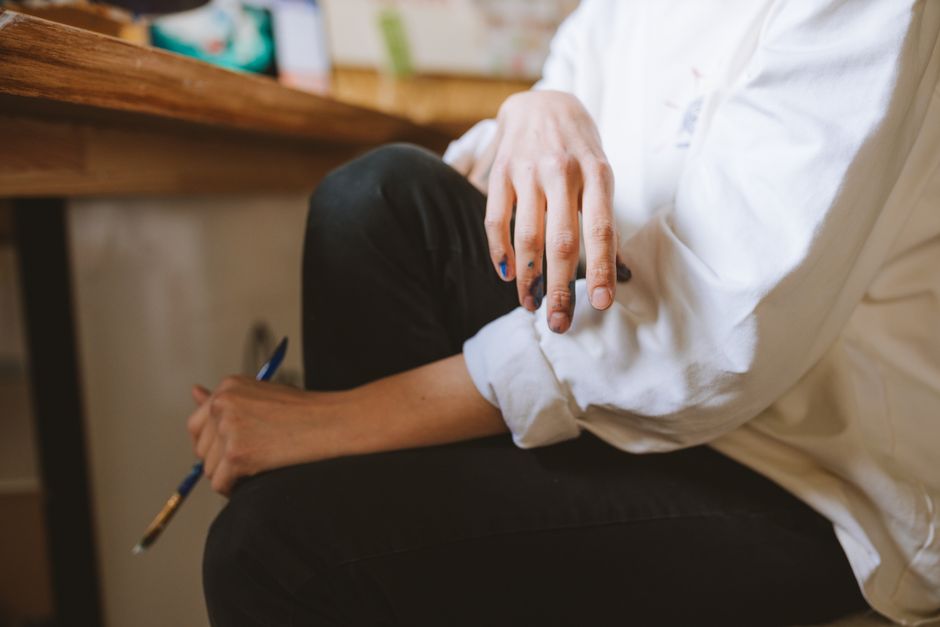
A painting kit is a hobby, not a treatment. Art therapy is a licensed clinical profession: a practicing art therapist holds a master's degree and has completed supervised clinical hours, and what they do in a session is psychotherapy that happens to use art materials. That is a different thing from a pleasant evening with a canvas, and anyone selling you a kit as therapy is overreaching.
If you are dealing with anxiety, depression or grief, a hobby is a good thing to have and not a substitute for talking to a doctor or a qualified therapist. We would rather say that plainly than sell a canvas on a promise it cannot keep.
With that said, the calming effect people describe is real, and there is a reasonable explanation for it.
Why painting is absorbing
The decisions are already made
This is the mechanism, and it is specific to numbered painting rather than painting in general. Freehand work carries a constant stream of decisions — what to paint, how to compose it, which colors to mix, whether that shadow is right. Those decisions are where the effort and the self-consciousness live, and for a beginner they are exhausting.
A numbered canvas strips all of them out. What remains is a simple, repetitive, physical task with a clear rule. That is close to ideal conditions for the absorbed state people call flow, and it arrives much faster than it does with a blank canvas.
Progress you can see
Each finished section is a small, visible result. Most things people do in an evening leave nothing behind. A canvas that is measurably further along than it was an hour ago is unusually satisfying for that reason, and it is why people describe picking it up again the next night without needing to talk themselves into it.
It occupies your hands and your eyes
Matching a number, loading a brush, staying inside a line — it takes just enough attention that there is not much left over for turning over the day. That is most of what people mean when they say a hobby takes their mind off things.
What the research actually shows
There is one study people cite constantly and it is usually overstated, so here it is accurately.
A 2016 study led by Girija Kaimal at Drexel University measured cortisol — a hormone associated with stress — in saliva before and after 45 minutes of art making. There were 39 participants aged 18 to 59, working freely with collage materials, modeling clay and markers. Around three quarters showed lowered cortisol afterward. Some showed no change and a few showed an increase. Prior art experience made no measurable difference, which surprised the researchers.
Making it a habit rather than a one-off is a separate problem, and making it stick is mostly about removing decisions.
What that supports: making art for three quarters of an hour was associated with a measurable physiological change in most of a small group of people, whether or not they considered themselves artistic.
What it does not support: that painting treats anxiety, prevents any disease, or works for everyone. It was a single small study, it did not involve paint by numbers, and a quarter of participants saw no benefit. Anyone citing it as proof that painting is medicine has read the headline and not the paper.
Setting up an evening that actually works
If the calm is what you are after, a few things help more than the choice of design.
- Leave it set up. The single biggest predictor of whether a canvas gets finished is whether packing it away is required. A tray or a board you can lift whole solves this.
- Good light, and a lamp you can pull close. Straining to see the numbers is the fastest way to turn a relaxing hour into a tense one.
- Short sessions are fine. Twenty minutes counts. Nothing spoils if you leave it a week.
- Start with the biggest areas. Early visible progress is what makes the session feel worthwhile.
- Pick a design you actually want on your wall. Motivation comes from the picture, not the process.
- Choose an easy first canvas. A design with large calm areas and detail concentrated in one place is far more pleasant than a dense one. Fighting a difficult canvas is not restful.
Our guide to the best kits for beginners names the designs that suit a first attempt and the ones worth leaving until later, which is the more useful half of that question.
Where paint by numbers came from
The idea belongs to the Palmer Paint Company of Detroit. In 1950 its owner, Max S. Klein, and a commercial artist named Dan Robbins worked up the first sets; the Craft Master brand launched the following year and sold in the millions. Robbins took the idea from the practice of numbering sections of a design for assistants to fill in, an approach attributed to Leonardo da Vinci's workshop.
Critics at the time complained that it was not real painting. It never claimed to be. What it does is remove the barrier that stops most adults from ever picking up a brush, and that turns out to be the useful part.
Getting started
Our kits arrive as a pre-printed cotton canvas rolled in a tube rather than folded, with acrylic paints vacuum-sealed so they arrive moist, brushes in a range of sizes, and an 11x17 printout of the design so you are not leaning over the canvas to read a number. Framed sizes come pre-stretched on a wooden frame with a tabletop easel and are ready to hang the moment you finish.
You can browse the full range of designs, or send a photograph of your own for a custom canvas, printed in the USA. To see how the designs come out in other people's hands, the customer gallery is the honest version.
an honest review of the format is our own assessment, including the parts that do not flatter it.


