


Painting with someone who has dementia is worth doing. It gives you both something to do that is not television, it produces an object at the end, and it is one of the few activities where the person is making something rather than being managed.
It will not slow the disease. We want to say that near the top, because a great deal of what is written about art therapy and dementia implies otherwise.
What the evidence actually supports
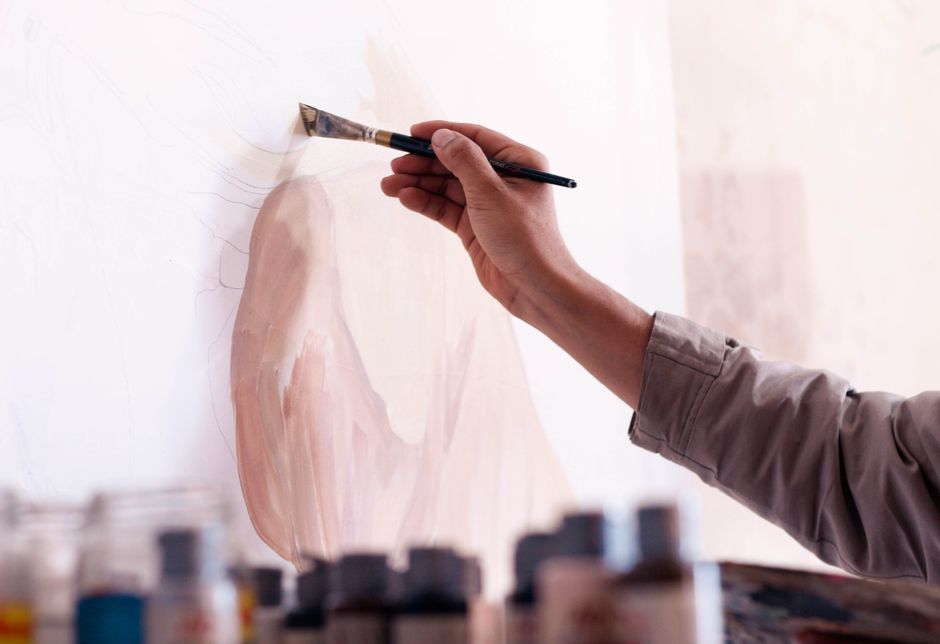
The honest summary is that the formal evidence is thin and the practical case is strong.
The Cochrane review of art therapy for dementia, published in 2018, found only two randomized trials worth including, covering 60 participants between them, and rated the quality of that evidence as very low. Its conclusion was that there is insufficient evidence to say whether art therapy works, and that better studies are needed. That is not the same as saying it does not help. It means nobody has measured it properly yet.
The Alzheimer's Association, meanwhile, runs an art program called Memories in the Making and describes the purpose of art plainly: a sense of accomplishment and purpose, and an opportunity for self-expression. They do not present it as a treatment. Neither will we.
So expect a better afternoon, some conversation, and a finished canvas. Do not expect a change in the course of the illness, and be wary of anyone selling you one.
Five things that make it go well
These come from the Alzheimer's Association's own caregiver guidance, and they are more useful than any product recommendation.
- Keep it on an adult level. Avoid anything that might be demeaning or seem childlike. This is the guidance that gets ignored most often. Children's craft kits are cheap and widely recommended for this purpose, and handing one to an adult who raised a family and ran a household is a small insult even if they can no longer say so.
- Talk while you paint. The conversation is half the value. Ask about the scene, ask what it reminds them of, let it wander.
- Help them start. You may need to load the brush and begin the stroke yourself. Starting is often the hard part, not continuing.
- Use safe materials. Water-based acrylic, no solvents, no craft knives. Keep the water jar visibly separate from anything on the table that could be drunk.
- Allow plenty of time. There is no need to finish in one sitting, or at all.
Is paint by numbers the right format?
Sometimes, and it depends a great deal on where things stand.
Early on it is a good fit. The numbering removes the decisions that make freehand painting daunting, so the person reaches the absorbing part quickly and produces something that looks like the picture. That sense of a job done properly is the whole point of the exercise.
Later it stops being a good fit, and it is better to know that in advance. Matching a printed number to a numbered pot is a working-memory task, and it is exactly the kind of task that gets harder. If following the numbers becomes a source of frustration, the answer is not a simpler kit. The answer is to set the numbers aside, open a few pots of color, and let them paint the canvas however they like. The result will not match the reference photo, and that does not matter in the slightest.
Watch for frustration rather than for progress. If they are enjoying it and the canvas is coming out wrong, they are doing it right.
Choosing a kit
The practical criteria are much the same as for any older painter, and we go through them in more detail in our guide to choosing a kit for seniors. In short:
- Large canvas. 16x20 rather than 12x16. The same design gets about two-thirds more room, so every section is bigger.
- Few, large sections. Sky, water, snow and a barn wall are large forgiving areas. Flowers are the opposite, because every petal is its own numbered shape.
- Colors that are easy to tell apart. A palette built from a dozen near-identical pinks is genuinely harder work. Color discrimination declines with age even without dementia, as the lens of the eye yellows.
- Framed, if it will be hung. A framed canvas arrives pre-stretched and goes on the wall as soon as it dries, with no trip to a framing shop.
- Good light. A lamp pulled in close does more than any feature of the kit itself.
Two designs in our own range fit this well. Summer's Song is a canoe and a campfire at dusk, and it is the one design our reviewers say directly has easy-to-read numbers; the lake, the sky and the tree trunks are wide and simple. Away From it All is a log cabin above a lake, with the sky, water and rock face laid out as large comfortable areas. The full range is here, and every design's page says what is harder about it.
The reminiscence angle is the strongest one
If there is one thing worth taking from this, it is that the subject matters more than the kit. A generic landscape is a pleasant afternoon. The house they grew up in, the church where they married, a dog they had for fifteen years — that is a different conversation entirely, and conversation is what you came for.
Our custom kits are made from a photo you send, printed in the USA, in 12x16, 16x20 or 18x24. Choose the largest size, and pick a photo with one or two faces rather than a group, since faces get small quickly. Even if the painting is never finished, the reference print sitting on the table earns its keep.
There are finished ones in the customer gallery.
Common questions
Does art therapy slow dementia or improve memory?
There is no good evidence that it slows the disease, and nobody credible claims that it does. What art activity is reasonably shown to do is help with mood, engagement and self-expression. Some research also reports fewer behavioral and psychological symptoms among people with artistic hobbies, but that is an association in a small literature rather than a demonstrated effect.
Is art therapy the same as painting at the kitchen table?
No, and the distinction is worth keeping straight. Art therapy is a credentialed profession: a trained therapist working to a treatment plan. What most of us do at home is an art activity, which is a good thing to do and a different thing. If the clinical version is what you want, ask the care team for a referral rather than buying a kit.
What if they paint the wrong colors in the wrong places?
Leave it. Correcting someone mid-activity turns the one thing they are succeeding at into another thing they are failing at. If they ask for help, help. If they do not, do not.
What if a paint pot runs out?
Every design in our range has a matching replacement set. A pot that has only thickened usually comes back with a drop of water and a stir.
How long should a session be?
Twenty minutes is a session. Stop while it is still going well rather than when it stops going well, because that is what makes someone willing to sit down again tomorrow.
Sources: Deshmukh et al., Art therapy for people with dementia, Cochrane Database of Systematic Reviews, 2018; Alzheimer's Association, Art and music.


